
Official statement
Other statements from this video 7 ▾
- □ Does Page Experience on desktop really deserve your attention as a ranking factor?
- □ Is Google really rewarding in-depth product reviews over surface-level content?
- □ Is Google finally opening up URL inspection through API automation?
- □ Should you really migrate to Google Analytics 4 to avoid losing your traffic data?
- □ Should you really leverage Search Console with Data Studio to optimize your SEO tracking?
- □ Does Search Console Insights make traditional Search Console obsolete for content creators?
- □ Is Google finally bridging the gap between SEO and development teams with a new video series?
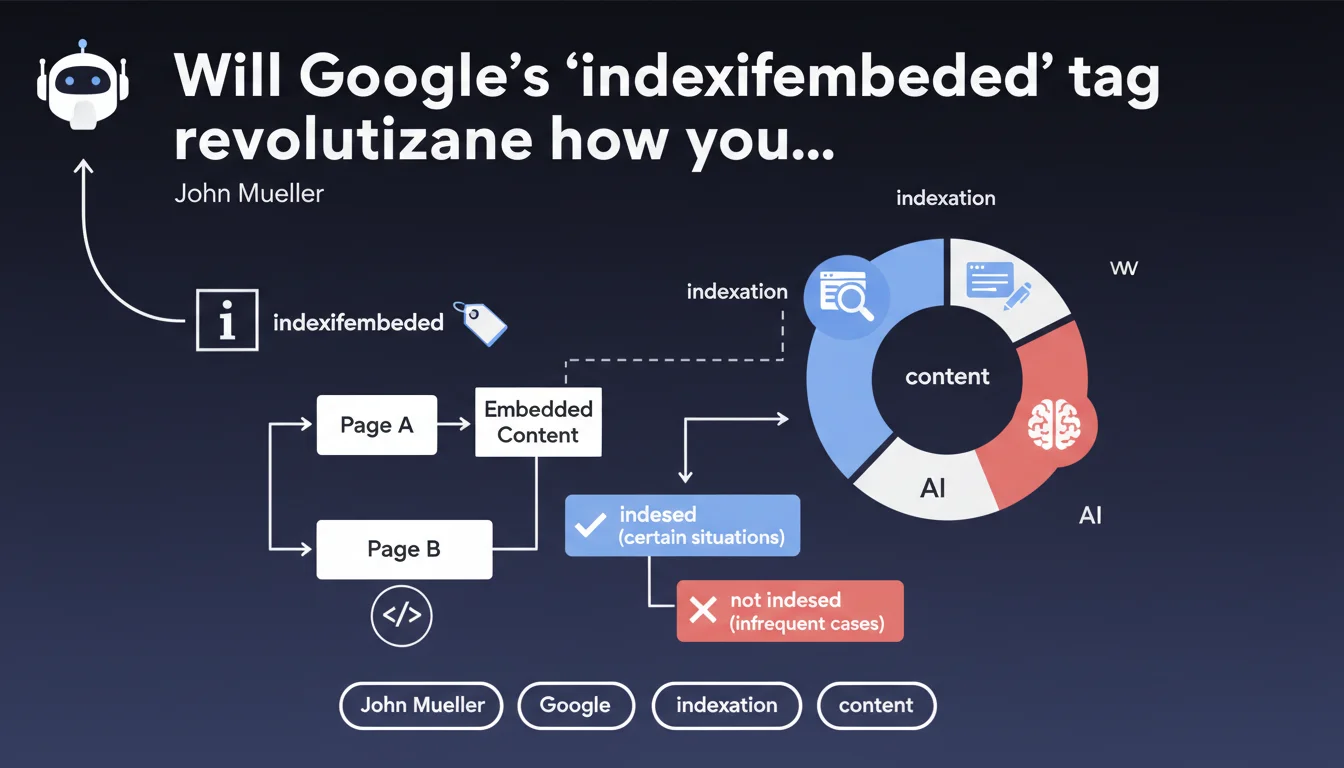
Google is introducing the 'indexifembedded' meta robots tag to control content indexation in specific embedding contexts. It addresses niche use cases, not the majority of websites. Concretely, this tag lets you decide whether your page's content can be indexed when embedded elsewhere.
What you need to understand
Why is Google launching a new robots tag now?
The indexifembedded tag addresses a precise technical need: controlling content indexation when it's embedded in an external context. Think iframes, widgets, embedded players — all those cases where your content appears on a third-party site.
Google itself acknowledges that this directive covers infrequent use cases. It doesn't replace robots.txt, noindex, or canonical tags. It complements your toolkit for specific situations where content is consumed differently depending on its display context.
In what situations does this tag actually make sense?
Imagine an embeddable video player that you offer to partners. On your own site, you want the page indexed normally. But when displayed in an iframe on a third-party site, you might prefer Google not to index it in that specific context.
Another scenario: technical content meant exclusively to be embedded (calculators, interactive widgets, iframe-based tools) where standalone indexation makes no sense for the end user.
How does this tag work alongside other robots directives?
The indexifembedded tag doesn't function in isolation — it complements the existing ecosystem. If you're already using noindex, this new directive has no effect since the page isn't being indexed anyway.
It only applies when Google attempts to index your content in an embedding context. On your main domain, standard rules continue to apply normally.
- The tag replaces no existing directive; it adds an extra layer of granularity
- It only applies to embedding situations (iframes, embeds, widgets)
- Use cases concern a minority of websites according to Google itself
- No obligation to implement it if your content is never embedded elsewhere
SEO Expert opinion
Does this new directive answer a real market need?
Let's be honest: most sites have never had to manage indexation issues related to content embedding. Google makes this clear — these are infrequent use cases.
Yet this tag demonstrates an interesting evolution — Google is progressively refining its ability to understand the content consumption context. The same HTML fragment can have different relevance depending on whether it's viewed directly or embedded. This aligns with the logic of featured snippets and indexed passages.
What gray areas remain in this announcement?
John Mueller remains vague about the exact detection mechanisms. How does Google determine that a page is being displayed in an embedded context? [To verify]: Does the algorithm rely solely on iframes, or do other technologies trigger this logic?
Another unclear point — the impact on crawl budget. If Google must now evaluate the embedding context in addition to the content itself, does this represent an additional load for sites offering massive amounts of embeddable content? No quantified data at this stage.
Does this tag change the game for embeddable content platforms?
For players who massively distribute content through widgets (comparators, media players, embeddable SaaS tools), this directive finally provides precise control. Until now, blocking indexation of embedded versions often meant sacrificing normal indexation.
This is likely the main benefit: segmenting indexation by context without duplicating pages or multiplying complex robots.txt rules. But only if your content is actually consumed in both modes — otherwise, you're optimizing a non-problem.
Practical impact and recommendations
Should you implement this tag on your client sites?
The short answer: probably not. Unless you specifically manage content meant to be embedded on third-party sites, this directive offers no practical value.
Ask yourself this simple question — are your pages regularly integrated into iframes or widgets on other domains? If not, move on. This tag will add nothing to your current indexation strategy.
How do you test whether this tag impacts your indexation?
If you decide to experiment with indexifembedded, start by precisely identifying the affected pages. Don't deploy at scale — first test on a restricted sample of content actually embedded elsewhere.
Then monitor Search Console for any variations in impressions and positions. The problem? Google provides no specific metric to distinguish standard indexation from embedded context indexation. You're flying blind.
What implementation mistakes should you avoid?
Don't combine indexifembedded with noindex — it makes no logical sense. If you're already blocking indexation, the embedded directive is simply ignored.
Another classic trap: adding this tag to pages never integrated elsewhere, "just in case." You're adding unnecessary code and complicating your technical stack for zero measurable benefit.
- Audit your content to identify what's actually embedded on third-party sites
- Verify you're not already using noindex on these pages
- Test on a restricted sample before any large-scale rollout
- Document precisely why you're implementing this for easier future maintenance
- Don't assume this tag magically improves SEO — it addresses a specific functional need
❓ Frequently Asked Questions
La balise indexifembedded remplace-t-elle la balise noindex ?
Dois-je l'ajouter sur toutes mes pages par précaution ?
Comment Google détecte-t-il qu'une page est affichée en mode embarqué ?
Cette balise a-t-elle un impact sur le budget crawl ?
Puis-je combiner indexifembedded avec d'autres directives robots ?
🎥 From the same video 7
Other SEO insights extracted from this same Google Search Central video · published on 31/03/2022
🎥 Watch the full video on YouTube →
💬 Comments (0)
Be the first to comment.