
Official statement
Other statements from this video 10 ▾
- □ Are snippets really the most underestimated SEO lever to boost your CTR?
- □ How do you write page titles that won't get truncated by Google?
- □ Do you really need to repeat your keywords in titles to rank higher on Google?
- □ Why does Google insist so strongly on having unique title tags for every page?
- □ Does Google really generate different snippets for the same page based on each search query?
- □ Can Google really override your title tags and meta descriptions?
- □ Should your meta description really be a sales pitch?
- □ Should you really forget about the 155-character limit for meta descriptions?
- □ Should you really write meta descriptions as complete sentences?
- □ How can you technically optimize title tags and meta descriptions to maximize their SEO impact?
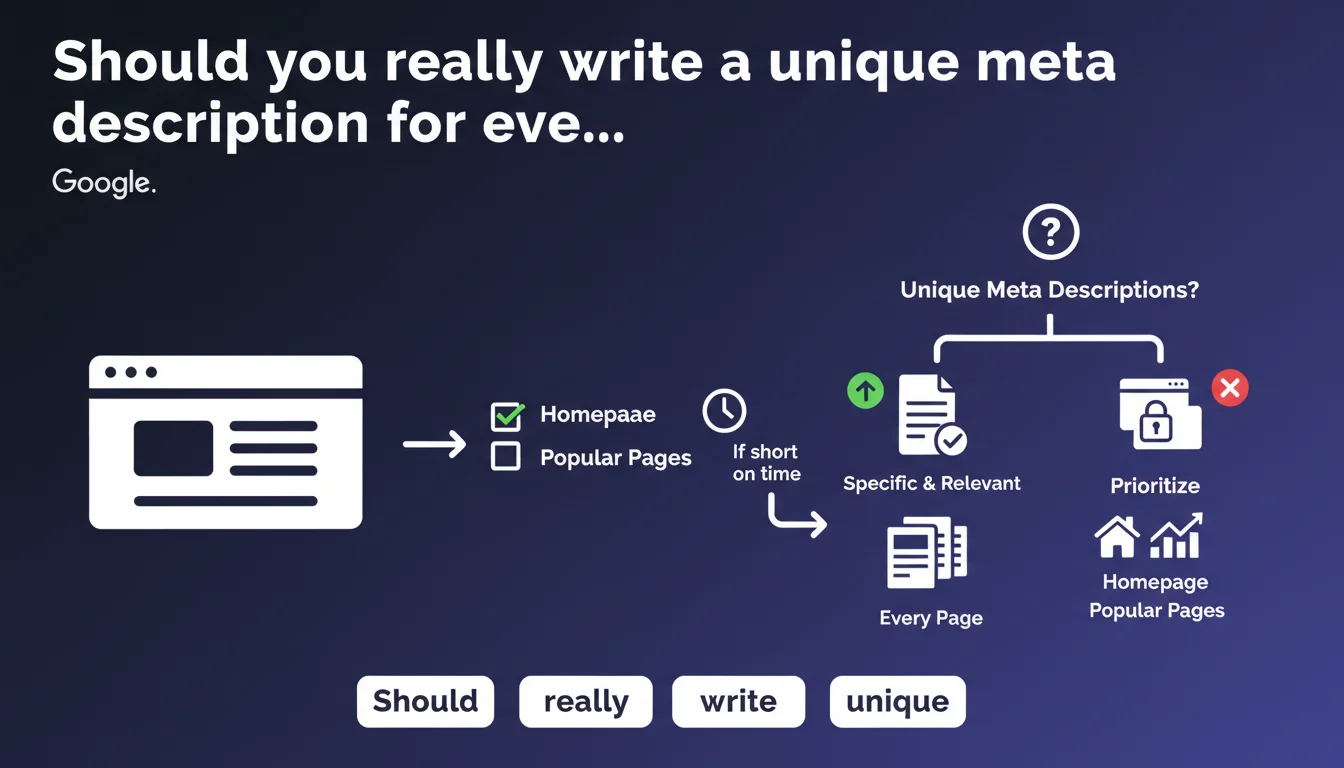
Google recommends creating a unique and relevant meta description for each page on your site. If resources are limited, prioritize your homepage and pages generating the most traffic. This guideline aims to optimize click-through rates from search results.
What you need to understand
Why does Google insist on unique meta descriptions?
Meta descriptions are not a direct ranking factor, but they influence your click-through rate (CTR) in the SERPs. When Google displays your snippet, a relevant and specific description increases the likelihood that a user will click your result over a competitor's.
The problem with duplicated or generic descriptions? They give the impression of a neglected site, and more importantly, Google may decide to ignore them in favor of automatically generating an excerpt from your page content. In other words, you lose control of your SERP messaging.
What happens if you don't provide a meta description?
Google will pull from your page's visible content to create a snippet. Sometimes it works out, often it doesn't. The engine selects passages containing the search query terms, but with no guarantee of narrative coherence.
On pages with minimal text or technical content, the result can be disastrous: truncated sentences, information out of context, even gibberish. You're essentially letting Google tell your story for you.
Does this recommendation apply to all types of websites?
Theoretically yes, but in practice it's more nuanced. An e-commerce site with 50,000 product pages can't always afford to manually write each meta description. News sites publishing 30 articles a day can't either.
Google implicitly acknowledges this by suggesting you prioritize: homepage, main category pages, popular content. For everything else, a hybrid approach (dynamic templates + manual writing on strategic pages) remains acceptable.
- Uniqueness: each page must have its own meta description, no copy-pasting
- Relevance: the description should reflect the actual page content
- Prioritization: focus your efforts on the homepage and high-traffic pages if resources are limited
- Snippet control: a well-written meta reduces the risk of Google generating a haphazard excerpt
- CTR impact: an engaging description can significantly increase click-through rate
SEO Expert opinion
Does this recommendation actually reflect real-world practices?
Let's be honest: on sites with thousands of pages, unique meta descriptions everywhere is often wishful thinking. Real-world observations show that Google frequently ignores provided meta descriptions, even well-written ones, in favor of generating its own excerpts based on the query.
Testing has shown that on certain long-tail queries, Google displays a personalized snippet in 70-80% of cases, regardless of your meta quality. The engine prioritizes passages containing exactly the search words, even if your meta is flawless. [To verify] depending on your industry and query types.
What are the real trade-offs to make?
Google's advice is sound for strategic pages, but applied blindly, it becomes counterproductive. Writing 10,000 mediocre meta descriptions manually has no value — you might as well let Google do the work.
The pragmatic approach? Identify the 20% of pages generating 80% of your organic visibility, and craft their meta descriptions with precision. For the rest, a well-designed dynamic template (inserting product name, key features, price) will do just fine.
When does this rule become secondary?
On news sites and blogs with daily publishing, nobody manually writes meta descriptions for each article. CMS systems automatically generate an excerpt from the opening characters, and it works fine.
For low-visibility pages (archives, technical pages, non-indexable content), investing time in meta descriptions is pure waste. Focus your resources where measurable SEO impact exists.
Practical impact and recommendations
How do you effectively prioritize meta description writing?
First step: extract from Search Console or your analytics tool the pages actually generating organic traffic. Sort by impressions and clicks. You'll likely discover that 200-300 pages concentrate most of your visibility.
Start with those pages. Check if they have a meta description, and if so, whether it's relevant. Concretely? A good meta description mentions the user benefit, naturally contains the primary keyword, and stands out from visible competitor results in the SERP.
What should you do for sites with massive page volumes?
Dynamic templates are your ally. For an e-commerce site, a typical structure: "[Product name] - [Key feature] at [Price]. [Call-to-action]. [Site USP]" can automatically generate acceptable descriptions.
The key is avoiding identical or overly generic descriptions ("Discover our quality products"). Ensure each variable injected into the template provides specific information: model, color, size, availability.
- Audit your current meta descriptions (tools: Screaming Frog, Oncrawl, Botify) to identify duplications
- Prioritize high-traffic/impression pages: homepage, main categories, top products/articles
- Write manually, 150-200 characters max, leading with user benefit
- Test your meta descriptions in the SERP: are they truncated? Do they stand out from competitors?
- Implement dynamic templates for lower-priority pages (long-tail, archives)
- Monitor CTR in Search Console after optimization to measure real impact
- Absolutely avoid duplicated descriptions across multiple pages
Google's recommendation is valid, but requires a strategic approach rather than mechanical application. Focus on pages that matter, intelligently automate the rest. ROI is measured in improved CTR, not number of meta descriptions written.
For complex sites with thousands of pages, developing a coherent approach balancing manual writing, dynamic templates, and prioritization represents a significant technical and editorial undertaking. Bringing in a specialized SEO agency may prove worthwhile to avoid pitfalls, particularly for the initial audit, template definition, and impact measurement — skills requiring expertise and methodological rigor.
❓ Frequently Asked Questions
Quelle est la longueur idéale d'une meta description ?
Google utilise-t-il toujours la meta description que j'ai rédigée ?
Faut-il inclure des mots-clés dans la meta description ?
Peut-on laisser Google générer automatiquement toutes les meta descriptions ?
Comment vérifier rapidement si mes meta descriptions sont dupliquées ?
🎥 From the same video 10
Other SEO insights extracted from this same Google Search Central video · published on 24/02/2022
🎥 Watch the full video on YouTube →
💬 Comments (0)
Be the first to comment.