
Official statement
Other statements from this video 10 ▾
- □ Are snippets really the most underestimated SEO lever to boost your CTR?
- □ How do you write page titles that won't get truncated by Google?
- □ Do you really need to repeat your keywords in titles to rank higher on Google?
- □ Why does Google insist so strongly on having unique title tags for every page?
- □ Can Google really override your title tags and meta descriptions?
- □ Should your meta description really be a sales pitch?
- □ Should you really forget about the 155-character limit for meta descriptions?
- □ Should you really write meta descriptions as complete sentences?
- □ Should you really write a unique meta description for every single page?
- □ How can you technically optimize title tags and meta descriptions to maximize their SEO impact?
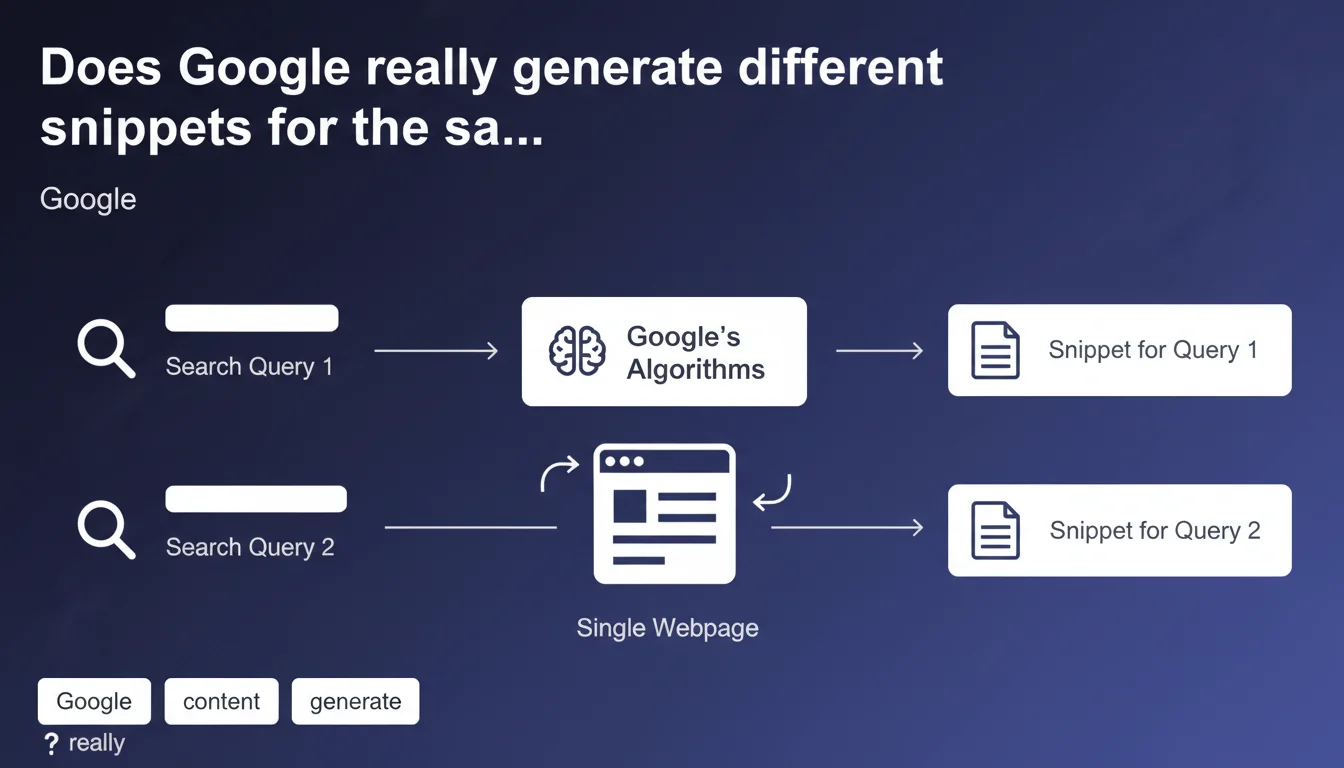
Google automatically generates snippets based on the user's search query, which means the same page can display different excerpts depending on the searches. This context-aware personalization mechanism means you don't directly control what appears — Google chooses what it considers most relevant for each search intent.
What you need to understand
What exactly is a snippet and how does Google build it?
A snippet is that text excerpt that appears below the blue title in search results. Contrary to what many believe, it's not simply your meta description tag pasted as-is.
Google analyzes the page content and dynamically selects the excerpt it considers most relevant for the user's specific query. This automatic generation relies on algorithms that evaluate the semantic match between the search and different parts of your content.
Why does the same page display completely different snippets?
Because each query represents a different intent. If your page covers both "how to install WordPress" and "how to secure WordPress," Google will display the excerpt relevant to what the user is actually searching for.
This context-aware personalization means Google pulls from your content based on context. A single page can therefore have dozens of different snippets depending on the angles users take when searching for it.
Does Google always use the meta description?
No, and this is where many get it wrong. The meta description is merely a suggestion, not an instruction. Google regularly ignores it in favor of a visible content excerpt it judges more aligned with the query.
Based on field observations, Google uses the meta description in only about 30-40% of cases — and even then, this varies enormously depending on industry and query type.
- Snippets are generated dynamically based on each user's search query
- The same page can have dozens of different snippets depending on searches
- Meta description is just one signal among many, not a guarantee of display
- Google prioritizes contextual relevance over webmaster editorial control
- Excerpts come from visible content as much as from meta tags
SEO Expert opinion
Does this statement match what we actually observe in the field?
Absolutely, and it's even well-documented reality. A/B tests on meta descriptions regularly show that Google ignores them as it sees fit. Let's be honest: we've all seen snippets completely different from what we carefully crafted.
The problem is that Google remains deliberately vague about the precise criteria that trigger one excerpt over another. We know contextual relevance plays a role, but the exact mechanisms remain opaque. [To verify]: What are the respective weights of meta description, H2-H3 tags, keyword-rich paragraphs, and bulleted lists?
What are the practical limitations of this automatic generation?
Snippet variability can create messaging inconsistencies. You may have crafted a perfect meta description for your brand, yet Google might replace it with a more technical excerpt that's less sales-focused but more "relevant" by its standards.
Another issue: Google sometimes generates snippets that are completely out of context, pulling truncated sentence fragments, or displaying secondary content instead of your main message. This is particularly problematic for pages with dense content or complex structures.
Can you really influence which snippets Google selects?
Yes, but indirectly. Content structure plays enormously: concise, targeted paragraphs generate better excerpts than dense blocks of text. Short, direct answers at the beginning of sections increase the probability of being selected.
What works: placing clear definitions, concise answers, and structured content (lists, tables) that Google can easily extract and reuse. What doesn't work: writing a meta description and praying it displays exactly as you wrote it.
Practical impact and recommendations
How do you optimize your content to maximize snippet quality?
First rule: structure your content in self-contained, understandable blocks. Every paragraph should be able to stand alone, because Google might pull it out of context.
Place key information at the beginning of sections. The first three lines after an H2 or H3 statistically have better chances of being used as a snippet. Avoid long, convoluted introductions — get straight to the point.
Work on your meta descriptions anyway, writing them as genuine, value-added summaries, not keyword stuffing. Google uses them more willingly when they're well-written and relevant.
What technical mistakes sabotage your snippets?
Content hidden behind accordions or JavaScript tabs is problematic. Google can crawl it, but it prioritizes immediately visible content for snippet generation. If your best paragraph is tucked behind a tab, it risks being overlooked.
Pages with duplicate content or repetitions generate inconsistent snippets. Google randomly pulls from variants and creates redundant or contradictory excerpts.
Also watch out for misused data-nosnippet tags: they allow you to exclude certain areas from the snippet, but if you overuse them, you limit Google's options and risk a generic, unappealing snippet.
Should you actively monitor the snippets that are displayed?
Yes, and regularly. Use Search Console to identify queries generating impressions but low click-through rates — often it's the snippet not selling your page. Compare against actual SERP results to see what Google is displaying.
Test different paragraph formulations on your strategic pages. A simple A/B test on content structure can radically change generated snippets and improve CTR by 20-30% on certain queries.
- Structure content in self-contained blocks of 2-3 sentences maximum
- Place essential information at the beginning of sections after each heading
- Write quality meta descriptions even if display isn't guaranteed
- Avoid content hidden behind JavaScript for strategic information
- Use lists, tables, and structured formats that are easily extractable
- Monitor snippets via Search Console and analyze CTR by query
- Test different formulations to optimize generated excerpts
- Avoid repetitions and duplicate content that generate inconsistent snippets
❓ Frequently Asked Questions
Google utilise-t-il systématiquement la meta description comme snippet ?
Peut-on forcer Google à afficher un snippet spécifique ?
Pourquoi mes snippets changent-ils d'une requête à l'autre ?
Le contenu caché derrière des accordéons est-il utilisé pour les snippets ?
Comment savoir quels snippets Google affiche pour mes pages ?
🎥 From the same video 10
Other SEO insights extracted from this same Google Search Central video · published on 24/02/2022
🎥 Watch the full video on YouTube →
💬 Comments (0)
Be the first to comment.