
Official statement
Other statements from this video 12 ▾
- □ Why is Google now rejecting certain directives in your robots.txt file?
- □ Can Google really index your URLs blocked by robots.txt without you being able to do anything about it?
- □ Does Google really process HTTP status codes during the crawl phase, not after?
- □ Does Google extract meta robots and canonical tags during indexing rather than at crawl time—and why does this distinction matter for your site?
- □ Can a single noindex tag on an hreflang page contaminate your entire international cluster?
- □ Should you really rely on JavaScript to handle noindex directives?
- □ Should you use X-Robots-Tag to keep PDFs and binary files out of Google's index?
- □ Should you disable Google cache to take control of how your snippets appear in search results?
- □ Can you really force Google to refresh a snippet without owning the website?
- □ Does Google's removal tool actually delete your URLs from the index?
- □ Why does it really take Google months to permanently remove a page from its index?
- □ Does Google's URL removal tool actually stop crawling your pages?
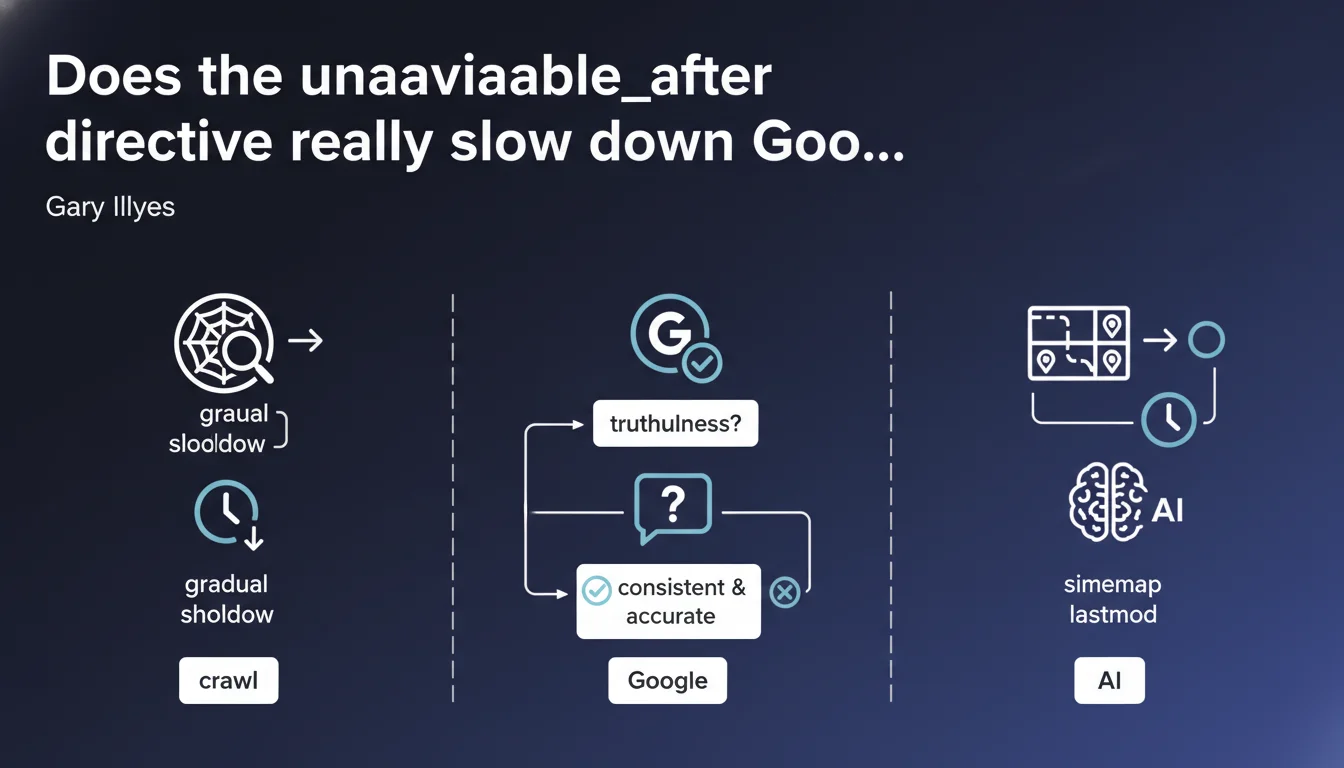
Google gradually slows down crawling of pages with the unavailable_after directive, but continues to check their status to ensure information reliability. Google only uses this directive if it detects it as consistent and accurate over time — exactly like lastmod in sitemaps.
What you need to understand
What does the unavailable_after directive actually do?
The unavailable_after directive allows you to signal to Google that a page should no longer be available after a specific date. Concretely, it's implemented via a meta tag or an X-Robots-Tag HTTP header.
Contrary to popular belief, this directive doesn't cause crawling to stop abruptly. Google gradually slows down its crawl frequency while continuing to check whether the page actually respects what it declares.
Why does Google keep crawling despite the directive?
The search engine applies a consistency verification logic here. It wants to ensure that the directive isn't misleading or misconfigured — exactly as it does with lastmod in sitemaps.
If you systematically lie about your modification dates or availability end dates, Google eventually ignores your signals. Trust is earned, not decreed.
When does Google actually apply this directive?
The condition is simple but demanding: the directive must be consistent and accurate over time. If your pages regularly announce availability end dates that never materialize, Google will stop believing you.
It's a protection mechanism against abuse — and an invitation to deploy this directive only when you're certain of your editorial strategy.
- Gradual slowdown of crawling, not an immediate halt
- Google verifies the consistency of your declarations over time
- The directive is only applied if it's reliable and accurate
- Same logic as lastmod: lying = losing Google's trust
SEO Expert opinion
Is this statement consistent with observed practices?
Yes, and it's even one of the rare cases where Google is transparent about a trust mechanism. Crawlers don't take your directives at face value — they learn from your behavior.
In the field, we do observe that sites that play with lastmod or unavailable_after eventually see their signals ignored. Google doesn't say 'you're lying,' it simply stops listening to you.
What nuances should be added?
The notion of 'gradual' remains vague. We don't know if the slowdown spreads over days, weeks, or months. [To verify]: Google provides no precise metrics on the timeline.
Another critical point: what defines a directive as 'consistent and accurate'? Is a 5% error rate acceptable? 10%? Google remains silent on this threshold.
When does this directive become counterproductive?
If you use it on content with uncertain lifespan, you're taking a risk. Once the directive is set, removing the page later than planned can send a confusing signal.
Another pitfall: using it on recurring pages (annual events, sales) without adjusting dates each year. Google might treat them as dead when they actually return cyclically.
Practical impact and recommendations
Should you use unavailable_after on your site?
Only if you have content with a certain expiration date: limited-time promotional offers, one-off events, limited edition products.
Never use it by default or 'just in case.' Every directive must correspond to a clear and documented editorial intention. Otherwise, you risk losing Google's trust for all your signals.
What mistakes should you absolutely avoid?
Don't set an unavailable_after date unless you're certain to remove it or respect it. Google will remember your inconsistencies.
Also avoid mixing this directive with late 301 redirects or abrupt deletions. The signal must be consistent with actual action: if you announce an end on March 15th, the page must actually disappear or become inaccessible on that date.
- Identify content with limited and certain lifespan
- Document every unavailable_after use in a tracking spreadsheet
- Verify that the page is actually removed or made inaccessible on the announced date
- Never use this directive as a classical crawl budget management tool
- Monitor server logs to observe the gradual slowdown in crawling
- Don't mix unavailable_after with late redirects or inconsistent HTTP status changes
How can you monitor the impact of this directive on your site?
Analyze your server logs to observe Googlebot's visit frequency on the pages in question. You should see a gradual decline, not a sharp stop.
Cross-reference this data with your Search Console: if pages with unavailable_after remain heavily crawled weeks after the announced date, it might mean Google doesn't believe you.
❓ Frequently Asked Questions
Quelle est la différence entre unavailable_after et noindex ?
Google respecte-t-il toujours la date indiquée dans unavailable_after ?
Peut-on annuler une directive unavailable_after après l'avoir posée ?
Cette directive accélère-t-elle la désindexation d'une page ?
Faut-il utiliser unavailable_after pour les pages 404 ou 410 ?
🎥 From the same video 12
Other SEO insights extracted from this same Google Search Central video · published on 04/08/2022
🎥 Watch the full video on YouTube →
💬 Comments (0)
Be the first to comment.