
Official statement
Other statements from this video 6 ▾
- □ Is creating truly 'useful' content really the secret to ranking on Google?
- □ Is Japanese SEO really catching up with American standards?
- □ Does Google really roll out algorithm updates at different times in different countries?
- □ Is Japan really getting priority treatment for Google Search features?
- □ Does active community engagement really make you a better SEO professional?
- □ Does Google really read every single piece of user feedback submitted on their documentation?
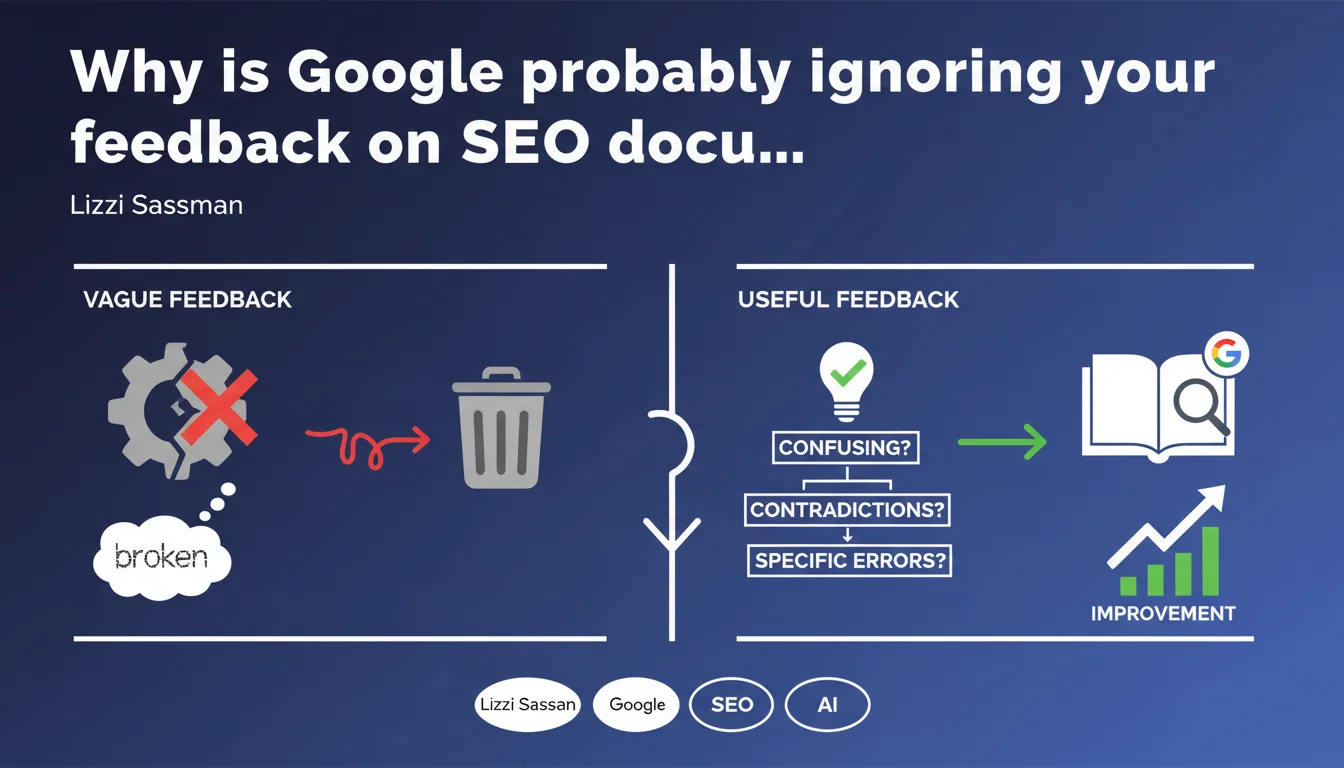
Google prioritizes structured and precise user feedback: pointing out contradictions, flagging factual errors, explaining what remains unclear. Vague comments like "it's broken" or "I don't understand anything" end up in the trash. Concretely? If you want Google to improve its documentation, document your reports the way you would for an internal technical ticket.
What you need to understand
This statement from Lizzi Sassman is about user feedback on Google's SEO documentation — Search Central, guidelines, help articles. She is not talking about feedback on search results themselves.
The message is straightforward: Google receives thousands of feedbacks on its documentation, but only a fraction is actionable. The technical teams that maintain these resources need context, precision, and reproducibility.
What is "useful" user feedback according to Google?
Useful feedback identifies a specific problem: a sentence that contradicts another section, outdated information that conflicts with observed practices, a technical example that doesn't work. In short, something verifiable and fixable.
Conversely, a comment like "this page is terrible" or "I don't understand anything" offers no actionable path. The team doesn't know what's wrong: the complexity level? Poorly explained jargon? A gap in the learning progression?
Why this demand for precision?
Google doesn't have infinite resources to process every piece of feedback. Teams must prioritize: fixing a factual contradiction will have more impact than rewriting an entire page because a user found it "confusing".
Furthermore, Google's SEO documentation is written by multiple teams, sometimes updated asynchronously. Precise feedback helps identify inconsistencies between sections, a recurring problem that Google struggles to resolve.
- Actionable feedback: points out a contradiction, a factual error, an obsolete element
- Vague feedback: expresses general frustration without context or path to improvement
- Google teams prioritize feedback that enables quick corrective action
- SEO documentation suffers from cross-team inconsistencies — precise feedback helps detect them
SEO Expert opinion
Is this statement consistent with observed practices?
Yes, and it's even a finding shared by everyone who has ever reported bugs or inconsistencies to Google. Vague feedback disappears into the void. Well-documented feedback — with screenshots, precise URLs, exact quotes — sometimes gets corrected within weeks.
Concrete example: an SEO practitioner reports that the page on crawl budget states that Google doesn't limit crawl for sites with fewer than 1000 pages, while another page mentions a different threshold. Actionable feedback. Google corrects it. Another user writes "the crawl budget doc sucks". Nothing happens.
What nuances should be made?
Be careful not to confuse "precise feedback" with "highly technical feedback". Google asks for clarity, not necessarily deep expertise. A beginner who reports "this sentence contradicts the one in the previous paragraph" provides more useful feedback than an expert who complains without documenting.
Another nuance: this precision requirement also reflects a structural limitation at Google. If their teams had better editorial governance, with systematic cross-reviews, there would be fewer contradictions to report. The fact that they rely on users to detect these inconsistencies reveals a perfectible editorial process.
When does this rule not apply?
If you report a technical bug on Search Console or Google Analytics, the rules change. Product teams expect logs, step-by-step reproductions, system environments. A simple "it doesn't work" will never be enough.
On the other hand, if you contest an algorithmic decision — for example a penalty you consider unfair — the precision of your feedback won't matter. These decisions don't go through standard user feedback channels.
Practical impact and recommendations
What should you do concretely when you spot an inconsistency in Google's documentation?
First, verify that it's really an inconsistency and not a misunderstanding on your part. Reread both sections in question, look for whether a footnote or sidebar explains the nuance.
Next, document your feedback: URLs of both pages involved, exact quotes of contradictory passages, clear explanation of why it's a problem. If possible, suggest a rewording or clarify what element should be clarified.
Use the feedback button at the bottom of each Search Central page. Avoid public forums for this type of report — editorial teams don't systematically read them.
What mistakes should you avoid?
Don't confuse "I disagree with this recommendation" with "this recommendation contradicts another page". Google won't change a guideline because a user finds it unfair. However, pointing out a factual inconsistency, that can move the needle.
Also avoid drowning your feedback in personal considerations. "This page sucks because I never managed to rank with your advice" is not actionable. "This page claims X while that one claims Y" is.
How do you verify that your site complies with guidelines despite documentation inconsistencies?
Let's be honest: you can't. When Google contradicts itself between two pages of its own documentation, you have to make a choice. Generally, prioritize the most recent source, or the one written by the team closest to the product (e.g., a Googler's statement on the official blog beats a generic help page).
Also monitor documentation updates after your feedback. If a correction appears, your reading was correct. Otherwise — and this is where it gets tricky — you're flying blind.
- Verify that the inconsistency is real, not a misunderstanding
- Document the feedback with URLs, exact quotes, clear explanation
- Use the official feedback button, not public forums
- Don't confuse personal disagreement with factual contradiction
- In case of unresolved contradiction, prioritize the most recent source
- Monitor documentation updates to validate your interpretation
Reporting inconsistencies in Google's documentation requires rigor and method. Identifying these contradictions, documenting them properly, and adjusting your SEO strategy accordingly can quickly become time-consuming — especially when Google never responds directly. If you lack the time or prefer delegating this critical monitoring to experts who know the ins and outs of official documentation, turning to a specialized SEO agency can save you from navigating blindly between contradictory recommendations.
❓ Frequently Asked Questions
Google répond-il aux retours utilisateurs sur sa documentation ?
Où envoyer un retour sur une incohérence dans la doc Search Central ?
Que faire si deux pages officielles de Google se contredisent sur une recommandation SEO ?
Un retour vague comme 'cette page est confuse' a-t-il une chance d'être pris en compte ?
Est-ce que Google corrige vraiment sa documentation suite aux retours utilisateurs ?
🎥 From the same video 6
Other SEO insights extracted from this same Google Search Central video · published on 26/04/2022
🎥 Watch the full video on YouTube →
💬 Comments (0)
Be the first to comment.