
Official statement
Other statements from this video 6 ▾
- □ Le SEO japonais rejoint-il vraiment les standards américains ?
- □ Google déploie-t-il ses mises à jour algorithme partout en même temps ?
- □ Le Japon est-il vraiment prioritaire pour Google Search ?
- □ Faut-il vraiment s'engager activement dans la communauté SEO pour progresser ?
- □ Google lit-il vraiment tous les retours utilisateurs sur sa documentation ?
- □ Pourquoi vos retours utilisateurs sur la documentation SEO de Google sont-ils probablement ignorés ?
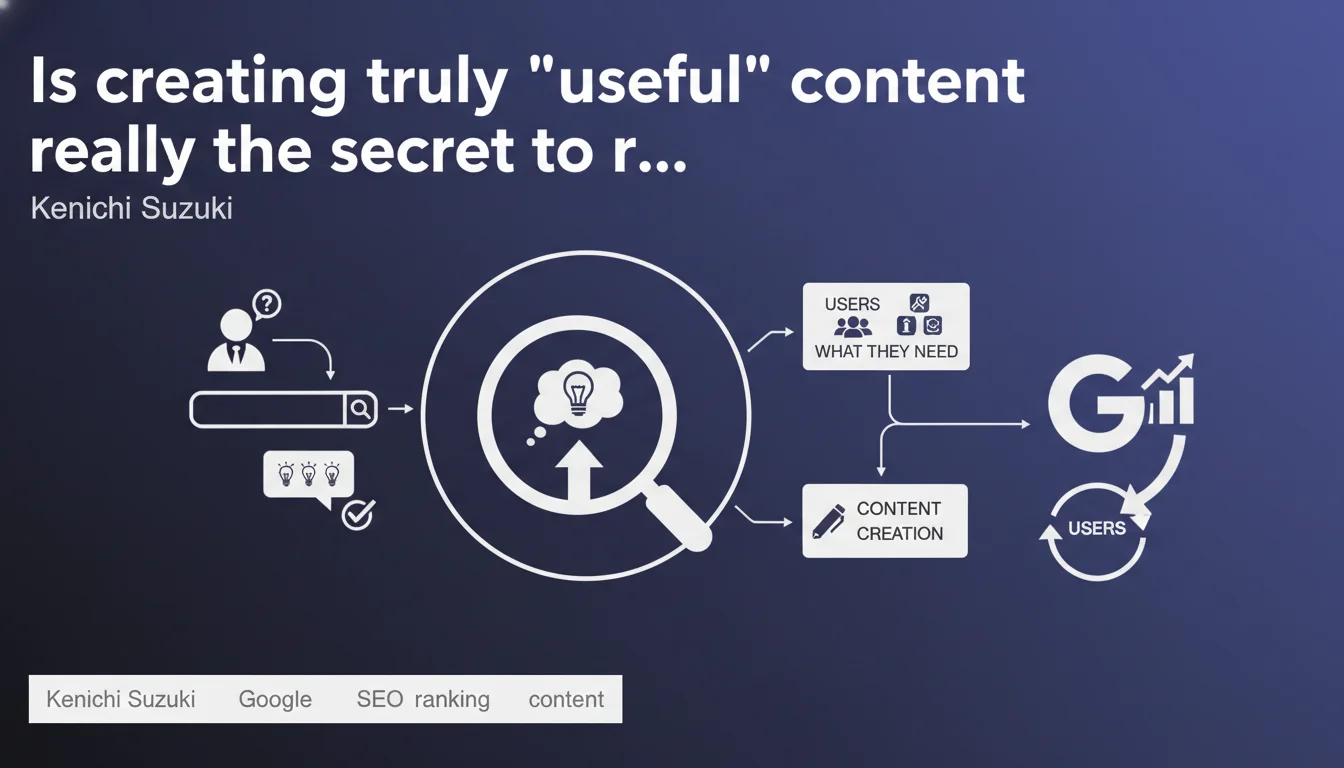
Google keeps hammering home that you need to produce useful content for users, not for yourself. The message seems basic on the surface, but it masks a deeper shift: the algorithm now seeks to evaluate the alignment between a search query and the actual value of a page, beyond traditional technical signals. In practical terms: understanding search intent has become more decisive than ever.
What you need to understand
What does Google actually mean by "providing useful content"?
Google insists that creating content for yourself — meaning to manipulate the engine or simply fill space — no longer cuts it. The algorithm tries to identify whether a page actually answers a real user need, not just a target keyword.
This notion of "usefulness" is intentionally vague. It encompasses both informational relevance, clarity of presentation, and even the overall page experience. But how does Google measure this usefulness? That's another story entirely — and that's where things get tricky.
Why this push to "think about users" all of a sudden?
Because Google is fighting a flood of mass-generated content, often AI-assisted, optimized to rank without delivering real value. Kenichi Suzuki's statement continues the tradition of Helpful Content Updates and the hunt for content farms.
Bottom line: if you're churning out 50 articles a week to cover every variation of a topic with zero expertise or original angle, you're in Google's crosshairs.
What signals does Google actually use to gauge this "usefulness"?
Officially, Google keeps its methods close to the vest. But we can reasonably assume it relies on multiple indicators: time on page, adjusted bounce rate, post-click behaviors (returning to SERPs, site navigation), and likely advanced semantic analysis via NLP.
It's no longer just about keyword density or heading structure. The algorithm attempts to evaluate whether the user found what they were looking for — and whether they left satisfied.
- Search intent becomes the central pillar: informational, transactional, navigational, or commercial.
- Depth of topic coverage matters more than raw article length.
- Engagement signals (tracked via Chrome, Analytics, Android?) likely weigh heavily in the balance.
- Originality and expertise are valued against recycled or shallow content.
SEO Expert opinion
Does this statement align with what we see on the ground?
Yes and no. On paper, Google has been preaching "think about the user" for years. But in practice, we keep seeing technically perfect pages that are hollow, or content aggregators riding the authority wave of their domain.
The reality: "usefulness" remains a subjective concept that Google struggles to measure reliably at scale. Result? Helpful Content updates have hit legitimate sites while sparing well-optimized content farms. [Verify]: Google's actual ability to distinguish "useful" content from "well-optimized" content.
In what cases does this rule not really apply?
Let's be honest: certain sectors still largely escape this logic. Authority sites (major media, institutions, dominant brands) enjoy preferential treatment via the domain bonus. They can publish mediocre content and still rank.
Same goes for YMYL queries where Google favors recognized sources, even if their content isn't always the most "useful" in practical terms. And in some technical or B2B niches, dense, user-unfriendly pages continue to dominate because they answer highly specialized expertise requirements.
What nuances should we add to this narrative?
The problem with this statement is it glosses over technical fundamentals. Producing useful content is great — but if your crawl budget is mismanaged, your canonical tags are a mess, or your site crawls at a snail's pace, you won't rank.
"Usefulness" isn't enough. It sits on top of a solid technical foundation: crawlability, internal linking, Core Web Vitals, quality backlinks. Google sells an idealistic narrative, but the algorithm remains a machine that favors measurable signals.
Practical impact and recommendations
What do you actually need to do to align your content with this expectation?
First step: map search intentions behind each target query. Don't settle for search volume alone — analyze current SERPs to understand what Google considers "useful" for that query.
Then structure your content according to that intent. A practical guide for an informational query, an optimized product page for a transactional query, a comparison for a commercial intent. Each format must serve a specific purpose.
What mistakes should you absolutely avoid?
Stop mass-producing content with no added value. One well-targeted 500-word article beats 10 generic 2000-word slogs. Google is getting better at spotting filler content.
Also avoid recycling competitor content without a fresh angle. If your page says the same thing as the top 10 results, why would Google rank it? Find an original angle, exclusive data, or an unprecedented case study.
How do you verify your content meets this usefulness standard?
Analyze your engagement metrics: average time on page, adjusted bounce rate, pages per session. If users bounce immediately, that's a clear signal your content misses their expectations.
Run user tests or qualitative surveys. Ask your audience if your content actually answers their questions. Sometimes a simple poll reveals huge gaps between what you produce and what's expected.
- Map search intentions for each content cluster
- Analyze current SERPs to identify formats that rank
- Produce original content with clear added value (exclusive data, fresh angle, on-the-ground expertise)
- Structure content based on intent: practical guide, FAQ, comparison, case study
- Measure real engagement: reading time, bounce rate, user feedback
- Avoid filler content mass-produced without expertise
- Integrate visual elements (diagrams, screenshots, videos) to enrich the experience
- Regularly update existing content to maintain relevance
Producing "useful" content for Google means aligning search intent, informational value, and user experience. But this approach doesn't eliminate the need for a solid technical foundation: crawlability, internal linking, performance.
The growing complexity of these optimizations — between semantic analysis, behavioral signals, and technical requirements — often makes partnering with a specialized SEO agency essential to orchestrate a coherent strategy and measure real impact.
❓ Frequently Asked Questions
Est-ce que Google peut vraiment mesurer l'utilité d'un contenu de façon objective ?
Faut-il sacrifier le SEO technique pour se concentrer sur le contenu utile ?
Comment savoir si mon contenu est considéré comme utile par Google ?
Les contenus générés par IA peuvent-ils être considérés comme utiles par Google ?
Cette déclaration annonce-t-elle un changement d'algorithme majeur ?
🎥 From the same video 6
Other SEO insights extracted from this same Google Search Central video · published on 26/04/2022
🎥 Watch the full video on YouTube →
💬 Comments (0)
Be the first to comment.