
Official statement
Other statements from this video 6 ▾
- □ Faut-il vraiment créer du contenu « utile » pour ranker sur Google ?
- □ Le SEO japonais rejoint-il vraiment les standards américains ?
- □ Google déploie-t-il ses mises à jour algorithme partout en même temps ?
- □ Le Japon est-il vraiment prioritaire pour Google Search ?
- □ Google lit-il vraiment tous les retours utilisateurs sur sa documentation ?
- □ Pourquoi vos retours utilisateurs sur la documentation SEO de Google sont-ils probablement ignorés ?
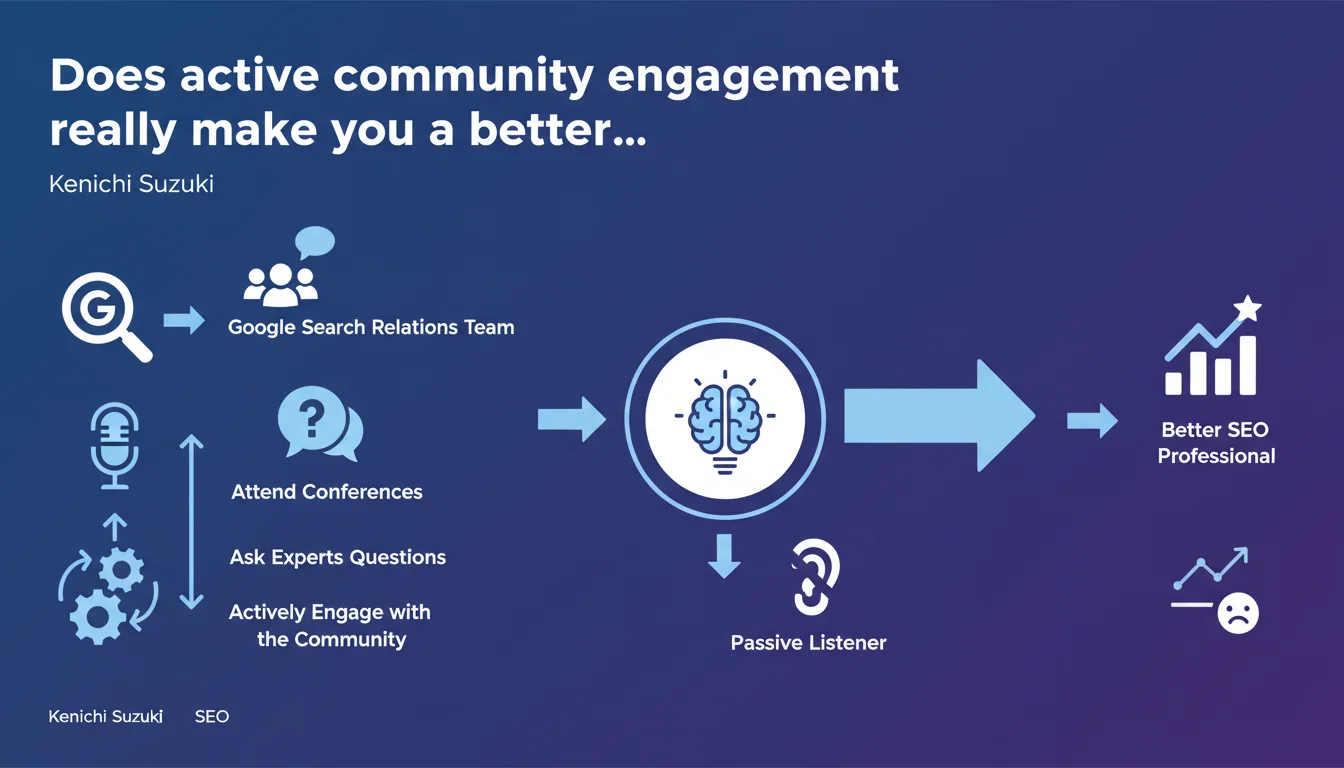
Google recommends actively following the Search Relations team, attending conferences, and asking experts questions rather than remaining a passive spectator. The underlying message: SEO is learned through active community engagement, not solely through passive documentation reading.
What you need to understand
Why does Google emphasize active engagement over passive consumption?
Google makes a clear distinction between consuming SEO content and interacting with the community. The Search Relations team regularly organizes Office Hours, conferences, and Q&A sessions — but their impact depends directly on participants' ability to ask the right questions.
This positioning stems from a simple observation: the professionals who progress fastest are those who confront their field-tested hypotheses with experts, who challenge edge cases, who share their observations. A passive approach generates only superficial understanding of algorithms.
What resources does Google specifically recommend?
The Google Search Relations team relies on several channels: the official blog, YouTube videos, Office Hours (live Q&A sessions), and presentations at conferences like Google I/O or Brighton SEO. These formats enable direct interaction with John Mueller, Gary Illyes, Martin Splitt, and other spokespersons.
But be careful — following these resources is not enough. Google explicitly encourages asking specific questions, submitting concrete cases, participating in discussions on specialized forums. Learning through active iteration takes priority over passive consumption.
Is this approach aimed at beginners or experts?
Kenichi Suzuki's wording clearly targets practitioners in the process of building competence. Beginners benefit from a structured knowledge base (Search Central), but intermediate experts often stagnate due to lack of interaction with peers and Googlers.
The advice suggests that the SEO learning curve is not linear: after mastering the fundamentals, progression comes through debate, confronting edge cases, and collectively analyzing algorithmic patterns. This is where active engagement becomes decisive.
- Follow the Search Relations team across all their communication channels
- Attend conferences and participate in Q&A sessions rather than watching replays
- Ask concrete questions to experts during Office Hours or on forums
- Engage with the community: share your observations, challenge hypotheses, debate updates
- Avoid a passive stance of being just a reader or listener
SEO Expert opinion
Does this recommendation truly reflect on-the-ground reality?
Yes and no. Active engagement undeniably accelerates progress — but only if the context allows for it. An in-house SEO at an SMB has neither the time nor budget to attend three international conferences per year. A freelancer isolated in a remote area can barely access specialized meetups.
Google's advice remains valid for professionals who already have a solid technical foundation. But for a beginner, community engagement without structured basics mainly generates confusion — too many contradictory opinions, too many specific cases that don't apply to their context. The priority should first be mastering the fundamentals.
What nuances should be added to this discourse?
Google naturally pushes toward its own channels — Office Hours, Search Central, sponsored conferences. That's logical, but it shouldn't obscure the fact that some of the best SEO analyses happen outside the Google ecosystem: independent forums, private communities, practitioner Slack groups, specialized newsletters.
Googlers provide general guidance, but they often avoid tactical details to prevent algorithmic manipulation. The real discoveries — ranking patterns, fine-tuned optimizations, bug workarounds — often emerge from collective testing led by the community, not official statements. [To be verified]: this discourse on active engagement says nothing about the variable quality of self-proclaimed experts who monopolize speaking time at conferences.
In what cases does this approach not work?
When the professional lacks critical thinking ability. SEO conferences are filled with contradictory advice, specific cases presented as universal truths, strategies that work for one industry but not another. Without analytical filters, active engagement becomes noise.
Another limitation: questions posed to Googlers during Office Hours often receive evasive or already-documented answers. Asking a good question requires advanced expertise level — which creates a paradox: those who benefit most are those who need it least.
Practical impact and recommendations
What should you concretely do to apply this advice?
Start by mapping out Google's official channels: subscribe to the Search Central blog, enable notifications for John Mueller and Martin Splitt YouTube videos, register for Office Hours. But don't remain a passive consumer — prepare specific questions before each session.
Next, identify 2-3 quality SEO communities where practitioners share on-the-ground analysis. Private Slack groups, specialized forums, active LinkedIn groups. Avoid generic Facebook groups filled with recycled beginner questions. Look for spaces where people share test data, Search Console screenshots, and challengeable hypotheses.
What mistakes should you avoid when engaging with the community?
Don't ask experts overly vague questions. "How can I improve my SEO?" will only get a generic response. Conversely, "I have an e-commerce site with 50,000 products, 30% aren't indexed despite a valid sitemap and sufficient crawl budget — what technical signals am I missing?" generates real discussion.
Also avoid the expert syndrome: attending every conference but never applying anything. Active engagement doesn't replace on-the-ground testing. A hypothesis validated through A/B testing on your own site beats ten theoretical discussions.
How do you measure if this approach is paying off?
The best indicator is your ability to diagnose complex problems without searching for the answer online. If after six months of active engagement, you can explain why a section of your site is losing traffic by cross-referencing signals (user behavior, page depth, internal PageRank distribution, anchor quality), then it's working.
Another sign: you start anticipating algorithm update impacts before they're officially confirmed. Active community practitioners detect patterns 2-3 weeks before Google announcements, by cross-referencing their on-the-ground observations.
- Follow Google's official channels (blog, YouTube, Office Hours) with active notifications
- Join 2-3 advanced SEO practitioner communities (Slack, specialized forums)
- Prepare specific, documented questions before each interaction with experts
- Share your own tests and observations to feed collective discussion
- Attend at least one SEO conference per year with advanced technical sessions
- Avoid vague questions — prioritize concrete cases with supporting data
- Systematically test recommendations heard before applying them at scale
- Measure your progress by your ability to diagnose problems without external help
❓ Frequently Asked Questions
Les Office Hours de Google sont-ils vraiment utiles pour des SEO expérimentés ?
Quelles conférences SEO privilégier pour un engagement actif de qualité ?
Faut-il partager publiquement ses découvertes SEO ou les garder pour soi ?
Comment identifier les experts SEO fiables dans la communauté ?
L'engagement actif remplace-t-il la formation SEO structurée ?
🎥 From the same video 6
Other SEO insights extracted from this same Google Search Central video · published on 26/04/2022
🎥 Watch the full video on YouTube →
💬 Comments (0)
Be the first to comment.