
Official statement
Other statements from this video 6 ▾
- □ Faut-il vraiment créer du contenu « utile » pour ranker sur Google ?
- □ Google déploie-t-il ses mises à jour algorithme partout en même temps ?
- □ Le Japon est-il vraiment prioritaire pour Google Search ?
- □ Faut-il vraiment s'engager activement dans la communauté SEO pour progresser ?
- □ Google lit-il vraiment tous les retours utilisateurs sur sa documentation ?
- □ Pourquoi vos retours utilisateurs sur la documentation SEO de Google sont-ils probablement ignorés ?
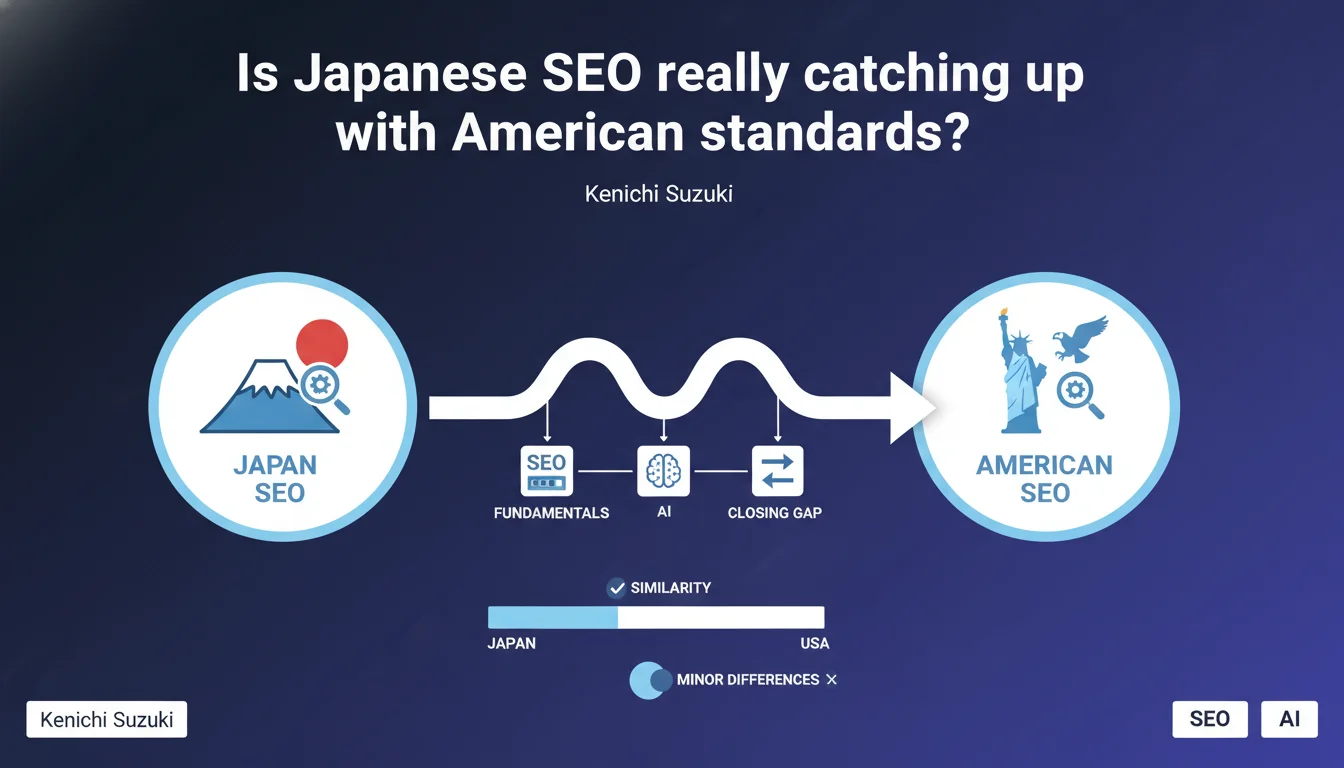
The differences between Japanese and American SEO are gradually disappearing. The fundamentals are now almost identical, even though a few local specificities persist. Google is harmonizing its algorithm on a global scale, making best practices transferable from one market to another.
What you need to understand
Why discuss convergence between geographic markets?
For years, SEO practitioners observed that Google did not work exactly the same way across different countries. The Japanese market, in particular, presented noticeable algorithmic particularities — notably in language processing, the importance of local domains (.jp), and specific user expectations.
This statement signals a gradual alignment of ranking criteria. In practical terms? Techniques that work in the United States become applicable in Japan, and vice versa. But be careful — "practically the same" does not mean "strictly identical."
Which fundamentals are concretely converging?
Google highlights universal principles: content quality, link relevance, user experience, technical performance. These criteria now carry comparable weight, whether you're ranking on google.com or google.co.jp.
The EEAT guidelines, Core Web Vitals, mobile-first indexing requirements — all of this applies uniformly. Local adjustments remain marginal, primarily related to linguistic and behavioral specificities.
What minor differences still persist?
Suzuki mentions "a few minor differences" without specifying which ones. We can reasonably assume these are cultural nuances: expected content length, preferred formats (text vs. video), authority of historic local domains.
Another angle: the processing of Japanese characters (kanji, hiragana, katakana) requires semantic analysis adjustments that English does not need. But these adjustments do not overturn the underlying rules.
- Algorithmic harmonization: Google unifies its ranking criteria globally
- Identical fundamentals: EEAT, CWV, mobile-first apply everywhere
- Residual specificities: language, user culture, historic local domains
- Practice transferability: a successful US strategy becomes applicable to Japan
SEO Expert opinion
Is this convergence truly observable in the field?
Yes — and it's consistent with Google's very architecture. Maintaining radically different algorithms by country would be an operational nightmare. The company has every incentive to standardize its ranking system, even if it means applying light local adjustments through specific layers.
Comparative audits indeed show that classic ranking factors (backlinks, content depth, UX signals) now carry similar weight in Japan and the US. Cases where a site would perform very differently across markets often stem from technical issues (misconfigured hreflang, cross-domain duplicate content) rather than fundamental algorithmic gaps.
What nuances should qualify this statement?
Suzuki remains vague about the "minor differences" that persist. [To verify]: which ones exactly? Is it purely linguistic processing, or are there different weightings on certain criteria?
For instance, local domain authority still seems to play a non-negligible role in Japan — a historic .jp can benefit from a small boost that an international .com would not get. Similarly, expectations regarding content length vary: Japanese users sometimes prefer more compact and visual formats than the American "long-form" standard.
In what cases does this rule not fully apply?
For regulated sectors or ultra-specific local queries, Google continues to adjust its results. A healthcare site, an e-commerce with local legal constraints, or a geographically strong search ("restaurant near me") will activate particular filters that are not universal.
And let's be honest: declaring that "fundamentals are practically the same" does not mean that replicating a US strategy in Japan guarantees success. Search intent, expected answer formats, click behaviors — all of this remains culturally rooted.
Practical impact and recommendations
What should you concretely do if targeting the Japanese market?
Apply the same fundamentals as for a US or European project: rigorous technical audit, EEAT content strategy, CWV optimization, quality link building. No need to reinvent the wheel — universal basics work.
Then adapt the cultural and linguistic layer: native translation (never automatic), visual formats aligned with local expectations, consideration of search-specific quirks (massive Yahoo! Japan usage, for example, even though its engine relies on Google).
What mistakes should you avoid in this approach?
Don't assume that a site performing well in the US will automatically rank in Japan without adjustments. Behavioral signals (time spent, bounce rate, clicks) vary across cultures — and Google captures them.
Also avoid neglecting hreflang if you manage multiple language versions. Misconfiguration can send Japanese users to the English version, creating negative signals that will tank your local ranking.
- Audit technical structure using the same tools as a US project (Screaming Frog, Search Console, PageSpeed Insights)
- Verify proper hreflang implementation to prevent cannibalization between versions
- Produce culturally adapted content, not just translated
- Analyze local SERPs to identify privileged formats (FAQ, videos, carousels)
- Build link profiles with quality Japanese sources, not only international ones
- Monitor Core Web Vitals on connections and devices typical to the Japanese market
How can you ensure your strategy remains relevant?
Test continuously. Launch a pilot version on a few key pages, measure comparative performance, adjust. Real data beats any official statement — even Google's.
Stay attuned to behavioral specificities: if your Japanese pages show abnormally high bounce rates despite good rankings, your content is not meeting local expectations. The algorithm will eventually catch this and adjust your position.
❓ Frequently Asked Questions
Les backlinks japonais ont-ils le même poids que les backlinks américains ?
Faut-il encore adapter la longueur du contenu au marché japonais ?
Le hreflang est-il critique pour un site multilingue ciblant le Japon ?
Peut-on dupliquer une stratégie SEO US au Japon sans ajustement ?
Yahoo! Japan utilise-t-il vraiment Google comme moteur de recherche ?
🎥 From the same video 6
Other SEO insights extracted from this same Google Search Central video · published on 26/04/2022
🎥 Watch the full video on YouTube →
💬 Comments (0)
Be the first to comment.