
Official statement
Other statements from this video 6 ▾
- □ Faut-il vraiment créer du contenu « utile » pour ranker sur Google ?
- □ Le SEO japonais rejoint-il vraiment les standards américains ?
- □ Google déploie-t-il ses mises à jour algorithme partout en même temps ?
- □ Le Japon est-il vraiment prioritaire pour Google Search ?
- □ Faut-il vraiment s'engager activement dans la communauté SEO pour progresser ?
- □ Pourquoi vos retours utilisateurs sur la documentation SEO de Google sont-ils probablement ignorés ?
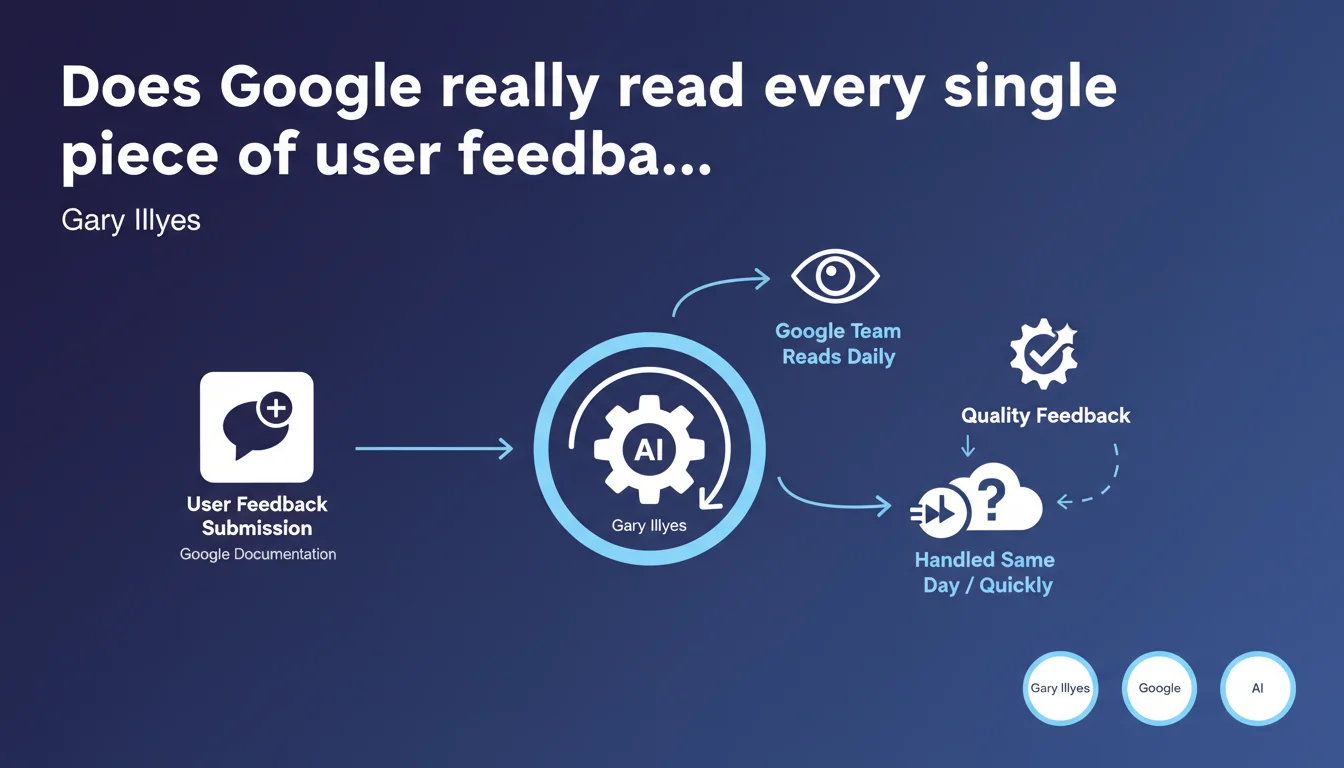
Gary Illyes confirms that the Google team reads all feedback submitted daily via the documentation feedback form. Well-crafted feedback that clearly specifies the problem is handled the same day or very quickly. This rare transparency shows that direct communication channels with Google exist — provided you know how to use them correctly.
What you need to understand
Gary Illyes has just lifted the veil on an underappreciated aspect of the Google ecosystem: the handling of user feedback on official documentation. This statement comes at a time when many SEO professionals are wondering whether their reports of technical issues or documentary inconsistencies are truly being taken into account.
Contrary to popular belief, there is indeed a direct communication channel with Google teams — not to negotiate better rankings, but to improve the quality of public documentation.
What is the feedback channel being referred to in this statement?
It's the integrated feedback form found on Google's official documentation (Search Central, in particular). This is neither Twitter, nor help forums, nor reconsideration requests — it's a specific tool, often discreet, present on technical documentation pages.
This channel is not designed for questions about your specific site. It serves exclusively to report problems within the documentation itself: factual errors, ambiguous instructions, outdated code examples, incorrect translations.
What constitutes quality feedback according to Google?
Gary Illyes clarifies that the feedback handled quickly is that which clearly specifies the problem. Good feedback isn't "your doc is terrible" but rather "section X contradicts section Y" or "the code example on line 12 generates an error in this configuration".
Vague feedback, off-topic remarks, or those turned into personal grievances probably end up in a different processing queue — or are ignored altogether. Clarity and precision are the prioritization criteria.
Why does Google invest resources in this daily review?
Because documentation quality directly impacts the quality of the indexed web. If webmasters apply vague or incorrect recommendations, Google inherits a poorly structured web. It's an upstream investment to prevent massive problems downstream.
This rare transparency also demonstrates a desire to maintain a relationship of trust with the professional ecosystem — even though this relationship remains asymmetrical.
- Google reads all feedback submitted daily via the documentation feedback form
- Quality feedback (precise, factual) is handled the same day or very quickly
- This channel is not for asking questions about your site, but for reporting documentary problems
- The clarity and precision of your feedback determines how quickly it's processed
- This investment aims to improve the overall quality of the indexed web
SEO Expert opinion
Is this statement consistent with field observations?
Yes and no. Several SEO professionals have indeed noticed rapid corrections in the documentation after submitting precise feedback — sometimes within hours. This validates the "same-day handling" part for well-formulated feedback.
But let's be honest: many relevant submissions also seem to disappear into a black hole. The nuance lies in what Google considers "quality." If your feedback is technically correct but challenges a strategic position held by Google, it's unlikely to generate visible change.
What are the practical limitations of this channel?
This feedback form does not handle individual cases. If you report that your site isn't being indexed correctly, this isn't the right channel — even if your feedback is crystal clear. Google reads, but doesn't necessarily respond, and provides no personalized follow-up.
Furthermore, "reading" doesn't mean "acting." Google can perfectly well read relevant feedback and decide it doesn't warrant a documentary change — either because the current wording is intentionally vague, or because a correction would create more confusion than it solves. [To verify]: no public metric exists to measure the conversion rate from "feedback read" to "modification made".
Why this sudden transparency?
Gary Illyes is probably communicating to channel feedback toward the right tool. Many SEO professionals saturate Twitter or public forums with reports that belong in the documentary feedback category. By redirecting these flows to the dedicated form, Google optimizes its own processing.
It's also a way to say "we're listening" without committing to changes in algorithm or policy. Documentation remains neutral ground where Google can demonstrate responsiveness without major consequences for ranking.
Practical impact and recommendations
How should you formulate feedback that will actually be processed?
Be surgical in your approach. Identify the exact page, the specific section, and describe the problem without detour: "Section X claims Y, but this contradicts section Z which says W. What's the correct information?" or "The JSON-LD example on line 15 contains a syntax error that generates a validation error".
Avoid generalizations ("your doc lacks clarity"), generic questions ("how does crawling work?"), or complaints ("you should better explain X"). Google isn't looking for editorial advice — it's looking for documentary bugs.
What types of feedback have the highest chance of being addressed?
Feedback that reports internal inconsistencies, broken code examples, or incorrect translations has a high processing rate. These are objective problems, verifiable, and without political ambiguity.
Conversely, feedback asking for clarification on algorithmic gray areas ("what exactly do you mean by 'quality content'?") has little chance of generating a public response. Google prefers to maintain a degree of opacity on these subjects.
Should you use this channel to report technical bugs on your site?
No. This form does not handle individual cases. If your site encounters indexing issues, use Search Console, the help forum, or — as a last resort — the @searchliaison Twitter account for major bugs affecting many sites.
Documentary feedback serves solely to improve the documentation itself. Confusing the two channels dilutes the effectiveness of your reports and unnecessarily overloads Google teams.
- Use the feedback form integrated into official documentation (Search Central)
- Formulate your feedback precisely: exact page, exact section, objective problem
- Prioritize reports of inconsistencies, factual errors, or broken code
- Don't use this channel for questions about your specific site
- Be focused: one feedback = one precise documentary problem
- Document your report with screenshots or examples if necessary
This statement confirms the existence of a direct communication channel with Google, but its scope is strictly limited to documentary quality. SEO professionals benefit from using it intelligently to improve the shared ecosystem — not to negotiate algorithmic favors.
Optimizing your communication strategy with Google teams, continuous documentary monitoring, and leveraging field feedback require specific expertise and significant time investment. If you manage multiple sites or if your business heavily relies on organic traffic, working with a specialized SEO agency can prove worthwhile to structure these initiatives and maximize their impact without consuming your internal resources.
❓ Frequently Asked Questions
Le formulaire de feedback documentaire permet-il d'obtenir une réponse personnalisée de Google ?
Puis-je utiliser ce canal pour signaler un concurrent qui triche ?
Combien de temps faut-il pour voir une modification documentaire après un retour ?
Les retours en langue autre qu'anglais sont-ils traités aussi rapidement ?
Vaut-il mieux soumettre un retour via ce formulaire ou via Twitter en mentionnant un Googler ?
🎥 From the same video 6
Other SEO insights extracted from this same Google Search Central video · published on 26/04/2022
🎥 Watch the full video on YouTube →
💬 Comments (0)
Be the first to comment.