
Official statement
Other statements from this video 10 ▾
- □ Does Google really analyze every element of your content during indexation?
- □ Does Google Really Fix Your HTML Errors During Indexing?
- □ Can an unsupported tag in <head> really break all your SEO metadata?
- □ How does Google decide which version of a duplicate page to index?
- □ How does Google really group pages with similar content together?
- □ How does Google weigh different SEO signals when choosing your canonical page?
- □ How does Google actually choose the canonical page in a duplicate cluster?
- □ Does Google really serve different versions of your pages based on search context?
- □ Does Google really decide which of your pages deserve to be indexed?
- □ What information does Google actually store in its index for canonical pages?
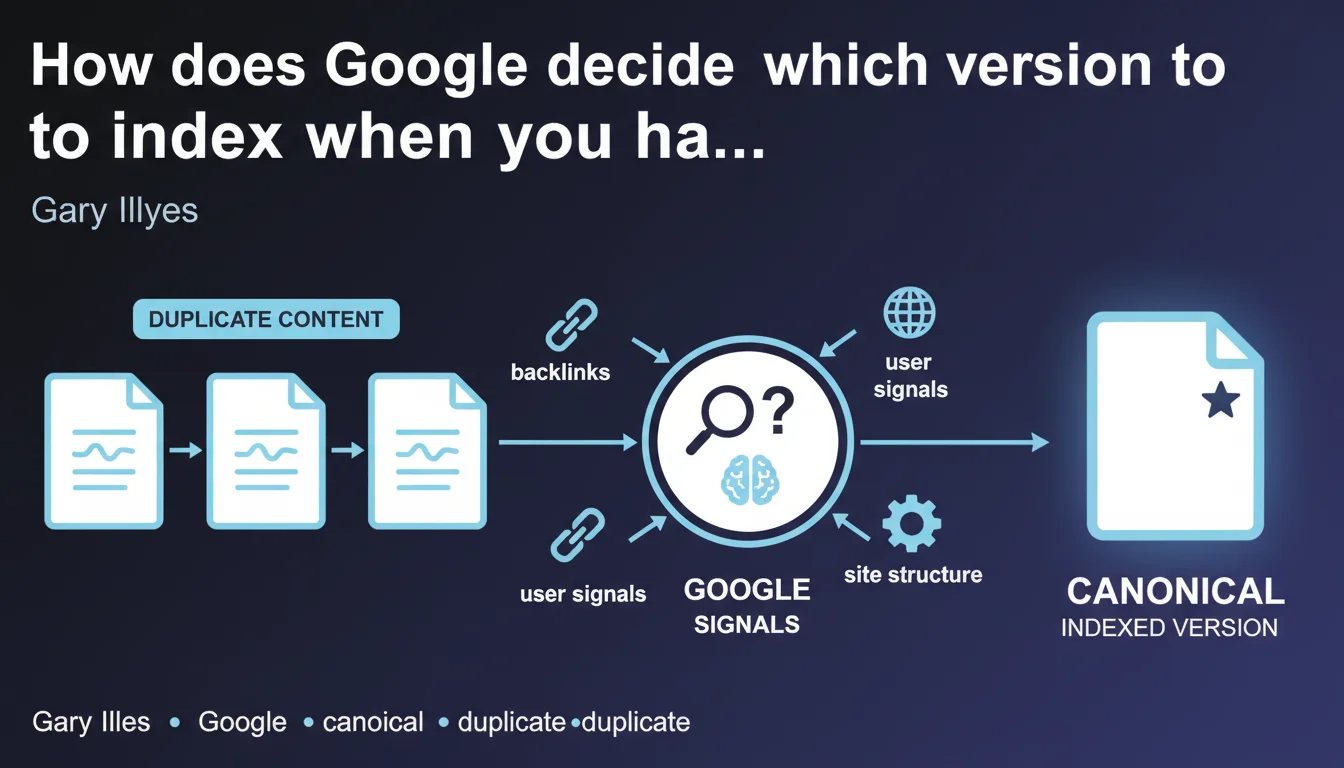
Google selects a canonical version from duplicate pages by relying on a set of signals. This canonical page becomes the only one visible in search results in the majority of cases. The decision is not solely based on your rel=canonical tag — Google retains final control over the choice.
What you need to understand
What does Google mean by "canonical version"?
The canonical version is the page that Google considers most representative of a set of similar or identical content. Contrary to what many believe, it's not necessarily the page you designated with your canonical tag.
Google collects multiple signals on each duplicate version: link popularity, internal linking consistency, URL structure, HTTPS protocol, technical performance. The algorithm aggregates this data to make its decision.
Why is this canonicalization so important?
Only the canonical page typically appears in search results. The other versions are consolidated: their signals (especially backlinks) are transferred to the chosen version, but they disappear from the visible index.
If Google chooses wrong — or if you haven't marked it correctly — you risk seeing a non-optimized version, a session URL, or even a test page appear in the SERPs.
What signals influence this decision?
- rel=canonical tag: strong signal but not binding
- 301 redirects: even more powerful signal than the tag
- Internal links: consistency of URLs pointed to
- XML Sitemap: declared URLs carry additional weight
- HTTPS vs HTTP: Google systematically prioritizes the secure version
- Technical quality: speed, accessibility, HTML structure
- External popularity: number and quality of backlinks to each version
SEO Expert opinion
Is this statement consistent with what we observe in the field?
Yes, but with important nuances. Gary Illyes confirms what practitioners observe: Google doesn't blindly follow your canonical directives. I've seen dozens of cases where the tag is ignored because other signals contradict it massively.
The problem? Google deliberately remains vague about the exact weighting of each signal. We know that 301 redirects carry weight, but what share do internal links represent versus external backlinks? Impossible to quantify. [To be verified] in each specific context.
In what cases doesn't this rule apply as expected?
When signals are contradictory. Imagine: you have a canonical tag pointing to /page-a, but 80% of your internal links point to /page-b, and /page-b receives 10 times more backlinks. Google will likely choose /page-b.
Another frequent case: multilingual sites with poor configuration. I've seen Google canonize an English version when the client wanted to push the French version, simply because technical signals (broken hreflang, inconsistent internal links) sent opposite messages.
Should you trust Google Search Console to identify issues?
Yes and no. GSC indicates which URL Google has canonicalized, but update delays are sometimes long. You fix an error, and GSC takes 3 weeks to reflect the change — meanwhile, it's impossible to know if Google has recrawled or not.
Let's be honest: GSC doesn't tell you why Google made this choice. It shows you the result, not the reasoning. To understand, you must cross-reference with server logs, crawl data, and internal linking analysis.
Practical impact and recommendations
What concretely should you do to master canonicalization?
First, audit all duplicate URLs: session parameters, variants with/without slash, HTTP vs HTTPS, www vs non-www. Identify each duplication cluster.
Next, send coherent signals across all layers: canonical tags, 301 redirects if necessary, internal linking systematically pointing to the desired version, XML sitemap declaring only canonical URLs.
What mistakes must you absolutely avoid?
Never leave canonical chains: page A canonical to B, which itself is canonical to C. Google can follow, but it dilutes the signal and slows processing.
Also avoid crossed canonicals: page A points to B as canonical, and B points to A. It sounds absurd, but I've seen it on e-commerce sites with poorly managed filters.
Another classic pitfall: declaring a URL as canonical when it returns a 404 or 301. Google will ignore the directive and choose itself.
How do you verify your site is compliant?
- Crawl your entire site with Screaming Frog or Oncrawl to detect duplicates
- Verify that each page has ONE SINGLE canonical tag (self-referencing if it's the master version)
- Check in GSC the "Coverage" tab to spot "Discovered, currently not indexed" or "Excluded by a canonical tag" URLs
- Analyze server logs to see which versions Google crawls most
- Ensure all redirects are 301s (not 302s) to canonical URLs
- Verify internal linking consistency: no links to non-canonical versions
- Test hreflang tags if multilingual: they must point to canonical URLs
❓ Frequently Asked Questions
Google suit-il toujours ma balise rel=canonical ?
Peut-on forcer Google à choisir une URL spécifique comme version canonique ?
Que se passe-t-il si Google choisit une version canonique différente de celle que j'ai déclarée ?
Combien de temps faut-il à Google pour prendre en compte un changement de canonical ?
Les pages non-canoniques transmettent-elles leur PageRank à la version canonique ?
🎥 From the same video 10
Other SEO insights extracted from this same Google Search Central video · published on 04/04/2024
🎥 Watch the full video on YouTube →
💬 Comments (0)
Be the first to comment.