
Official statement
Other statements from this video 10 ▾
- □ Comment Google analyse-t-il vraiment votre contenu lors de l'indexation ?
- □ Google corrige-t-il vraiment vos erreurs HTML pour l'indexation ?
- □ Une balise non supportée dans <head> peut-elle vraiment casser toutes vos métadonnées SEO ?
- □ Comment Google choisit-il quelle version d'une page en double indexer ?
- □ Comment Google choisit-il quelle page indexer parmi vos contenus dupliqués ?
- □ Comment Google regroupe-t-il vraiment les pages au contenu similaire ?
- □ Pourquoi Google accorde-t-il plus de poids à certains signaux SEO qu'à d'autres ?
- □ Comment Google choisit-il LA page canonique dans un cluster de doublons ?
- □ Comment Google décide-t-il vraiment si votre page mérite l'index ?
- □ Qu'est-ce que Google stocke vraiment dans son index pour une page canonique ?
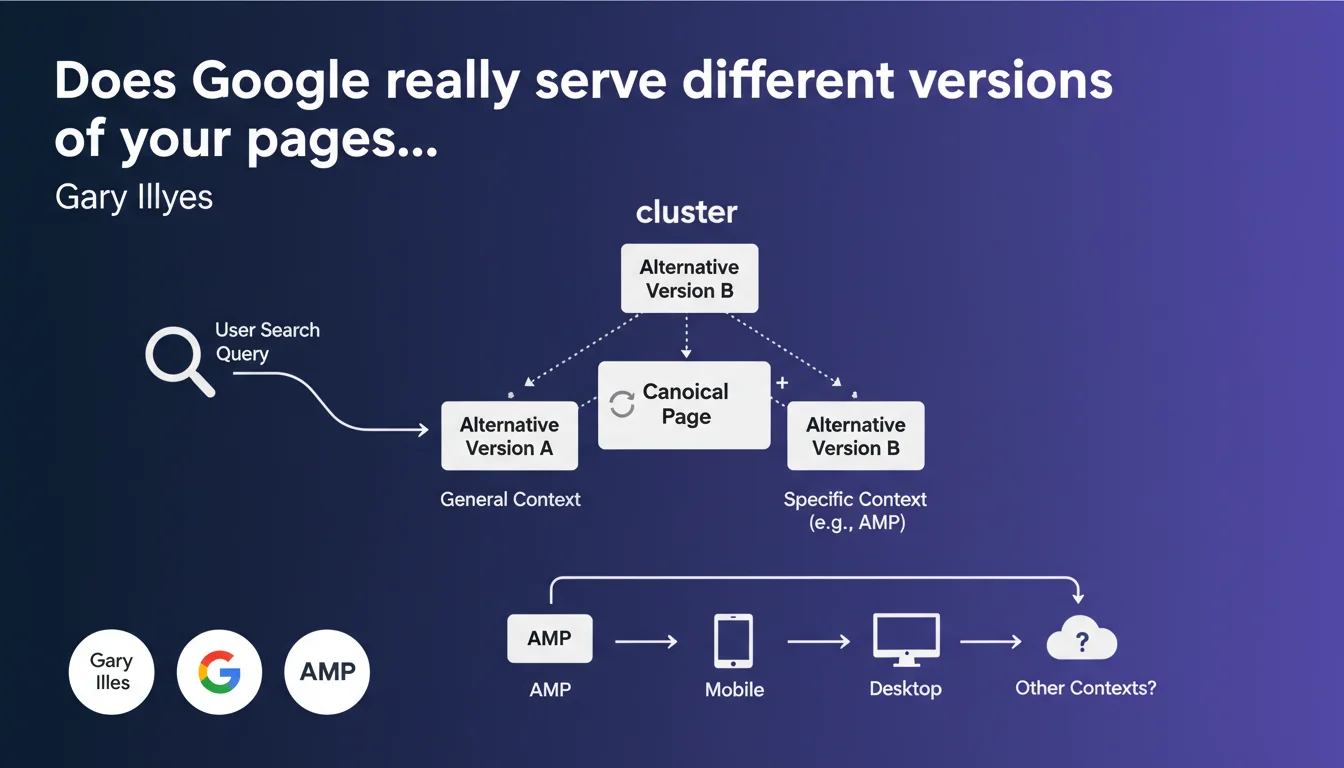
Google doesn't just rank a single version of your pages. When a user searches for something very specific within a cluster of similar content, the search engine can serve an alternative version rather than the identified "canonical" page. This mechanism challenges certain assumptions about managing canonicals and similar content.
What you need to understand
Google is talking here about page clusters — sets of content that the algorithm considers similar or redundant. Within these groups, the engine identifies a main page but keeps the others in memory.
Gary Illyes' statement suggests that these alternative versions aren't simply ignored. They remain activatable under certain conditions, particularly when the user's query is hyper-targeted.
What exactly is a page cluster in Google's logic?
A cluster is a set of URLs that Google judges similar enough not to treat as completely distinct entities. This could be product pages with minor variants, articles on related topics, or URLs with different parameters.
Google chooses a "representative" version — often the one it deems most relevant overall — but doesn't throw the others away. It keeps them in reserve.
In what contexts are these alternative versions served?
The wording remains vague. Google mentions "if the user searches for a very specific page within the cluster" without clarifying what makes a search "very specific."
We can assume this involves long-tail queries, searches with precise parameters, or contexts where user intent clearly points to a variant rather than the main page.
Why does this mechanism exist?
Google seeks to optimize relevance without sacrificing crawl efficiency. Rather than indexing all variants equally, it prioritizes but keeps exit doors open for special cases.
It's a form of compromise: don't clutter the index with duplicates while remaining able to respond precisely to specific queries.
- Google groups similar pages into clusters and selects a main version
- Alternative versions remain accessible in certain specific contexts
- This logic activates notably for highly targeted searches
- The objective is to balance crawl efficiency with result relevance
SEO Expert opinion
Is this statement consistent with real-world observations?
Yes and no. We do observe that Google can serve different URLs based on queries, even within the same site. This often happens on e-commerce sites with filters or product variants.
But the definition of "very specific" remains entirely subjective. Google provides no measurable criteria. [To verify]: how do you distinguish a "specific" search from a normal one? No public data lets us draw this boundary.
What nuances should be added to this statement?
First, this mechanism guarantees nothing. Just because a page exists in a cluster doesn't mean Google will necessarily serve it one day. Google can activate it, not "will" activate it.
Second, there's no guarantee this logic applies uniformly across all site types. News sites, e-commerce platforms, and blogs have very different structures — it's likely Google adjusts its behavior accordingly.
In what cases might this logic not apply?
If your pages are too thematically distant, Google probably won't cluster them together. If they're too similar and poorly differentiated, Google risks choosing a main version and completely ignoring the others.
Context also matters: a page with very few backlinks or low authority has less chance of being activated, even in a cluster, especially if the main page is already strong.
Practical impact and recommendations
What should you actually do to leverage this mechanism?
If you have legitimate content variants — for example guides broken down by region or user profile — ensure each version delivers clear differentiated value. Google must be able to understand how each page addresses a distinct intent.
Use canonical tags intelligently, but don't impose them systematically on all variants if they have a reason to exist. If an alternative page is truly relevant for a specific search, keep it indexable.
What mistakes should you avoid when managing clusters?
Don't create artificial variations hoping to "cover more queries." Google detects weakly differentiated content and can penalize the entire cluster.
Also avoid multiplying cross-canonicals or internal redirects that create confusion. If Google hesitates about the structure, it risks picking a page at random — and not necessarily the one you want.
- Identify your clusters of similar content via Search Console (pages competing on the same queries)
- Clearly differentiate each page: title, angle, secondary keywords, intent
- Use canonicals only when a page is genuinely duplicated, not by default
- Monitor which URLs are served for your strategic queries
- Test long-tail query variations to see if Google activates alternative versions
- Consolidate weak pages that add no distinct value
❓ Frequently Asked Questions
Google indexe-t-il toutes les pages d'un cluster ou seulement la principale ?
Comment savoir si mes pages forment un cluster aux yeux de Google ?
Faut-il canonicaliser toutes les pages d'un cluster vers une seule ?
Qu'est-ce qu'une recherche « très spécifique » pour Google ?
Cette logique s'applique-t-elle à tous les types de sites ?
🎥 From the same video 10
Other SEO insights extracted from this same Google Search Central video · published on 04/04/2024
🎥 Watch the full video on YouTube →
💬 Comments (0)
Be the first to comment.