
Official statement
Other statements from this video 11 ▾
- □ Does Google really transcribe your video audio to rank them?
- □ Does Google really analyze the text displayed in your videos for SEO rankings?
- □ Does Google really analyze video visual content for SEO purposes?
- □ Why does Google require the video file URL in structured data to boost your rankings?
- □ Could blocking your video files be secretly destroying your search visibility?
- □ Does URL cache-busting really prevent Google from indexing your videos?
- □ Should you really use reverse DNS verification to authorize Googlebot?
- □ Should you always prioritize content URL over embed URL in video structured data?
- □ Does Google really analyze video content or does it just rely on page text?
- □ Can Google really index short-form videos if they have a crawlable URL?
- □ Why is Google finally making Googlebot IP addresses publicly available?
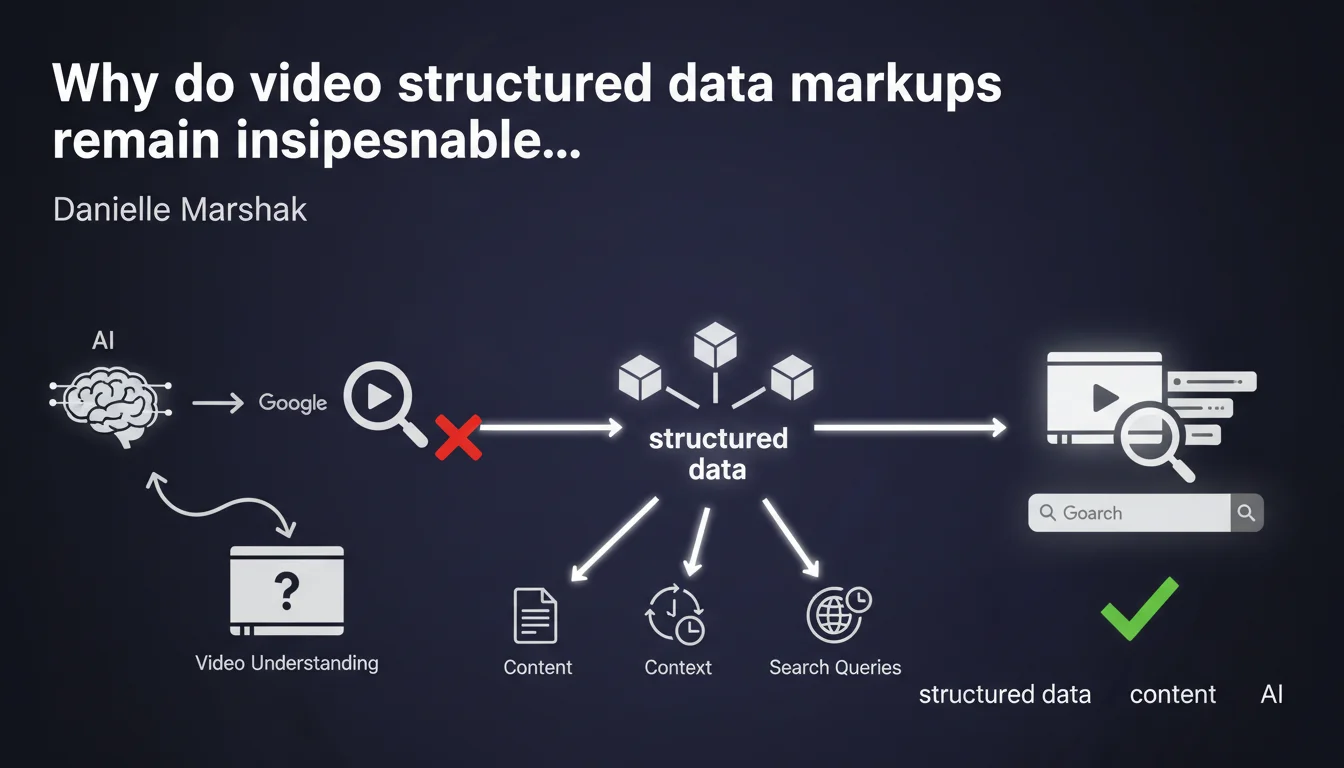
Google maintains that structured data remains crucial for video indexing, even with advancements in automatic content understanding. In practice, Schema.org VideoObject markup remains the best way to ensure your videos are properly indexed and matched to the right search queries.
What you need to understand
Can't Google analyze videos automatically now?
Yes, Google has made significant advances in computer vision and natural language processing. The engine can extract information from audio and video streams, identify objects, and understand scenes.
But Danielle Marshak makes it clear: these capabilities don't replace structured data. Automatic analysis remains imperfect at grasping the full context, the intent behind a video, or the nuances that determine its relevance to a particular search query.
What concrete benefits do structured data provide?
Explicit metadata — title, description, duration, publication date, thumbnail — gives Google a reliable interpretation framework. It eliminates ambiguity.
Take an example: a video shows someone speaking in front of a whiteboard. AI can identify "person," "whiteboard," "writing." Structured data, however, clarifies that it's an SEO tutorial on optimizing title tags, 8 minutes long, published by a recognized expert. The precision delta is massive.
What information does Google expect in video markup?
- name: the video title, optimized yet natural
- description: a clear summary of the content, not a keyword list
- thumbnailUrl: the URL of the thumbnail in high resolution
- uploadDate: the publication date in ISO 8601 format
- duration: the duration in ISO 8601 format (e.g., PT8M32S)
- contentUrl or embedUrl: the URL of the video file or embedded player
- expires (optional): if the video has an end availability date
SEO Expert opinion
Is this statement consistent with what we observe in practice?
Absolutely. Repeated tests show that videos without Schema.org VideoObject markup have a significantly lower appearance rate in rich results. Even on YouTube — Google's platform — markup remains a strong signal.
The paradox is that Google emphasizes its AI capabilities while reinforcing this dependence on explicit metadata. This reveals a reality: automatic analysis is costly in resources and isn't deployed uniformly. Structured data serves as a shortcut for crawling and indexing at scale.
In which cases is video markup insufficient?
First scenario: the video is orphaned, buried on a page without traffic or backlinks. Schema.org markup doesn't create demand — it facilitates understanding of content Google has already crawled.
Second scenario: the video is hosted on an external CDN without a dedicated video sitemap file. Google may miss the resource even if markup is present. [To verify] on large volumes: some observe that video indexing via Schema.org alone, without a video XML sitemap, remains unpredictable on medium-sized sites.
Google says "context and relevant queries" — what does that conceal?
This wording suggests that structured data helps Google match the video to search intents. In other words: markup influences ranking, not just eligibility for rich results.
But Google remains vague about the exact weight. We know that description and name are crawled and analyzed semantically. What we don't know: does Google actively penalize videos without markup, or does it simply ignore them for rich snippets? The distinction matters. [To verify] with A/B tests on identical video corpora with and without Schema.
Practical impact and recommendations
What should you implement concretely on your site?
If you host videos, each page containing a video must include Schema.org VideoObject markup in JSON-LD. Not microdata, not RDFa — JSON-LD is Google's recommended format.
The markup must be synchronized with actual content: if you change the thumbnail, update thumbnailUrl. If you remove the video, delete the markup or add an expiration date. Google detects inconsistencies and can ignore the entire markup.
How do you verify the markup is properly recognized?
Use Google's Rich Results Test. Paste your video page URL and verify that the VideoObject type is recognized without errors or warnings.
Next, check the Enhancements > Videos report in Google Search Console. If your videos don't appear there after several weeks, there's a problem — either in the markup or in the page's indexation itself.
What errors should you absolutely avoid?
- Never markup a video that isn't visible to the user (hidden video, background video, etc.)
- Don't reuse the same video markup across multiple different pages — each page URL = unique markup
- Don't omit contentUrl or embedUrl: this is the URL Google will use to access the video
- Avoid generic copy-pasted descriptions — Google values unique and descriptive descriptions
- Don't forget to submit an XML video sitemap alongside the Schema.org markup
❓ Frequently Asked Questions
Le balisage Schema.org vidéo est-il obligatoire pour apparaître dans les résultats vidéo Google ?
Faut-il un sitemap vidéo XML en plus du balisage Schema.org ?
Le balisage vidéo fonctionne-t-il aussi pour les vidéos YouTube embarquées ?
Peut-on baliser plusieurs vidéos sur une même page ?
Quels outils utiliser pour générer le balisage Schema.org vidéo ?
🎥 From the same video 11
Other SEO insights extracted from this same Google Search Central video · published on 10/03/2022
🎥 Watch the full video on YouTube →
💬 Comments (0)
Be the first to comment.