
Official statement
Other statements from this video 11 ▾
- □ Does Google really analyze the text displayed in your videos for SEO rankings?
- □ Does Google really analyze video visual content for SEO purposes?
- □ Why do video structured data markups remain indispensable despite Google's AI advances?
- □ Why does Google require the video file URL in structured data to boost your rankings?
- □ Could blocking your video files be secretly destroying your search visibility?
- □ Does URL cache-busting really prevent Google from indexing your videos?
- □ Should you really use reverse DNS verification to authorize Googlebot?
- □ Should you always prioritize content URL over embed URL in video structured data?
- □ Does Google really analyze video content or does it just rely on page text?
- □ Can Google really index short-form videos if they have a crawlable URL?
- □ Why is Google finally making Googlebot IP addresses publicly available?
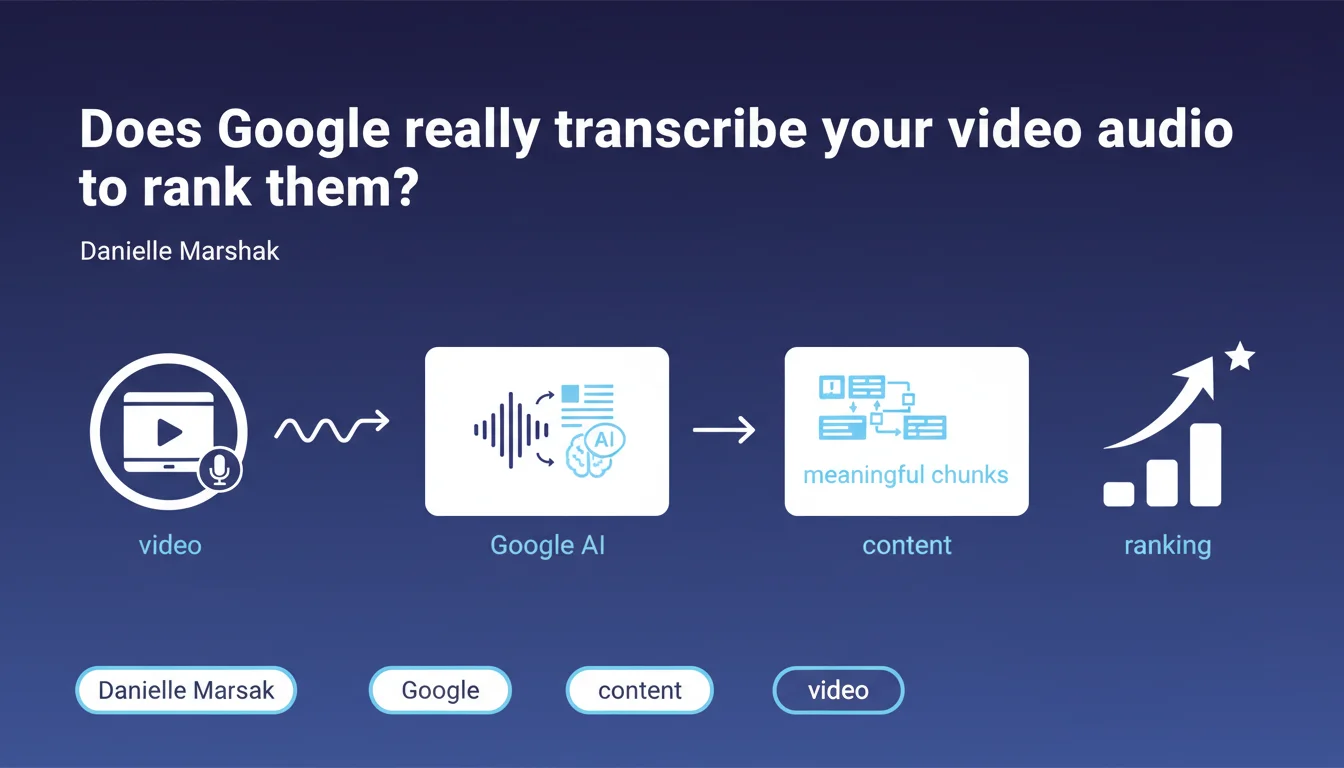
Google extracts text from video audio, transcribes spoken words and segments them to understand content. This method is one of Google's main video analysis techniques. In practice, this means the spoken content in your videos can directly influence their search rankings.
What you need to understand
Does Google really analyze what's being said in videos?
Yes. Google confirms here that it doesn't rely solely on metadata (title, description, tags) to understand a video. The audio is analyzed directly to extract text, which is then segmented into meaningful chunks.
This approach reveals that Google treats videos as enriched text content. Automatic transcription becomes a ranking signal, just like the content of a standard HTML page.
Why is this method described as "main"?
Google specifies it's "one of the main methods", which suggests others exist — likely analysis of keyframes, thumbnails, provided captions, or structured metadata.
But calling audio extraction "main" indicates that spoken content carries significant weight in the overall understanding of the video's topic. It's not a secondary or marginal signal.
What does "segment into meaningful chunks" mean?
Google doesn't limit itself to raw word-by-word transcription. It segments the extracted text to identify units of meaning: complete sentences, themes, key concepts.
This segmentation probably enables better capture of search intent and more precise matching of videos to user queries than simple keyword matching alone.
- Google transcribes video audio into exploitable text for ranking
- This method is described as "main", giving it significant weight
- The extracted text is segmented to extract units of meaning, not just isolated words
- Videos without clear spoken content risk being poorly understood by Google
- Manually provided captions likely remain a complementary signal
SEO Expert opinion
Is this statement consistent with real-world observations?
Yes, largely so. For several years now, we've observed that well-ranked videos often have rich and structured spoken content, even without manually provided captions. YouTube videos that perform well on Google Search generally contain clear speech, with strategic keywords pronounced multiple times.
This also explains why certain videos with mediocre metadata but dense oral content can outperform technically better-optimized videos with poor spoken content. [To verify]: Google doesn't specify if this transcription applies only to YouTube or also to videos hosted elsewhere (Vimeo, self-hosted).
What nuances should be added to this claim?
First nuance: Google mentions "main methods" in plural, implying other signals matter. Manually provided captions probably still carry weight — if only because they're more reliable than automatic transcription, which can make errors.
Second nuance: audio quality undoubtedly plays a role. A video with background noise, strong accent, or complex technical jargon risks being poorly transcribed. Google doesn't say how it handles these edge cases. Finally, nothing indicates whether this transcription is used for all video formats or only certain ones.
In what cases could this method fail?
Videos without speech (silent tutorials, music, ambiances) are probably analyzed differently — likely via image analysis and metadata only. Videos in less common languages or with regional dialects could also be less well understood if transcription models aren't trained on them.
Practical impact and recommendations
What should you do concretely to optimize your videos?
First action: polish your speech. Pronounce strategic keywords clearly multiple times throughout the video. Avoid overly specialized jargon if your target audience uses simpler vocabulary.
Second action: structure your oral content like you structure an article. Announce your outline at the beginning of the video, use clear transitions between sections, repeat important concepts. Google segments content — make its job easier.
What mistakes must you absolutely avoid?
Don't rely solely on metadata. A video with optimized title but off-topic or poor spoken content will be less performant than before. Google can now verify consistency between what you announce and what you actually say.
Also avoid purely visual videos without vocal accompaniment if you're targeting good organic ranking. Silent tutorials with just music miss out on this main signal.
How can you verify that Google properly understands your video content?
Enable automatic captions on YouTube to see what the AI understands from your audio. If automatic transcription is full of errors, Google will likely have the same problem. In that case, providing manual captions becomes essential.
Also check video snippets in the SERP: if Google displays timestamps that align well with your content, that's a good sign. If timestamps are misaligned or off-topic, it means automatic segmentation is malfunctioning.
- Pronounce your strategic keywords clearly multiple times throughout the video
- Structure your oral speech like an article: intro, sections, transitions, conclusion
- Test YouTube automatic captions to detect transcription errors
- Provide manual captions if your audio is complex or technical
- Avoid purely visual videos without spoken content if you're targeting SEO
- Verify consistency between your metadata and your actual spoken content
- Analyze timestamps displayed by Google in the SERP to validate understanding
❓ Frequently Asked Questions
Google transcrit-il uniquement les vidéos YouTube ou aussi celles hébergées ailleurs ?
Les sous-titres manuels sont-ils encore utiles si Google transcrit automatiquement l'audio ?
Une mauvaise qualité audio peut-elle nuire au référencement d'une vidéo ?
Faut-il répéter ses mots-clés plusieurs fois à l'oral dans la vidéo ?
Les vidéos sans parole peuvent-elles bien se référencer ?
🎥 From the same video 11
Other SEO insights extracted from this same Google Search Central video · published on 10/03/2022
🎥 Watch the full video on YouTube →
💬 Comments (0)
Be the first to comment.