
Official statement
Other statements from this video 11 ▾
- □ Google transcrit-il vraiment l'audio de vos vidéos pour les ranker ?
- □ Google analyse-t-il vraiment le texte affiché dans vos vidéos pour le référencement ?
- □ Google analyse-t-il réellement le contenu visuel des vidéos pour le SEO ?
- □ Pourquoi les données structurées vidéo restent-elles indispensables malgré les progrès de l'IA de Google ?
- □ Pourquoi Google exige-t-il l'URL du fichier vidéo dans les données structurées ?
- □ Pourquoi bloquer vos fichiers vidéo pourrait nuire gravement à votre indexation ?
- □ Pourquoi le cache-busting d'URL vidéo bloque-t-il l'indexation Google ?
- □ Faut-il vraiment utiliser la vérification DNS inversée pour autoriser Googlebot ?
- □ Faut-il toujours privilégier content URL sur embed URL dans les données structurées vidéo ?
- □ Google indexe-t-il vraiment les vidéos courtes si elles ont une URL crawlable ?
- □ Pourquoi Google publie-t-il enfin ses adresses IP Googlebot publiquement ?
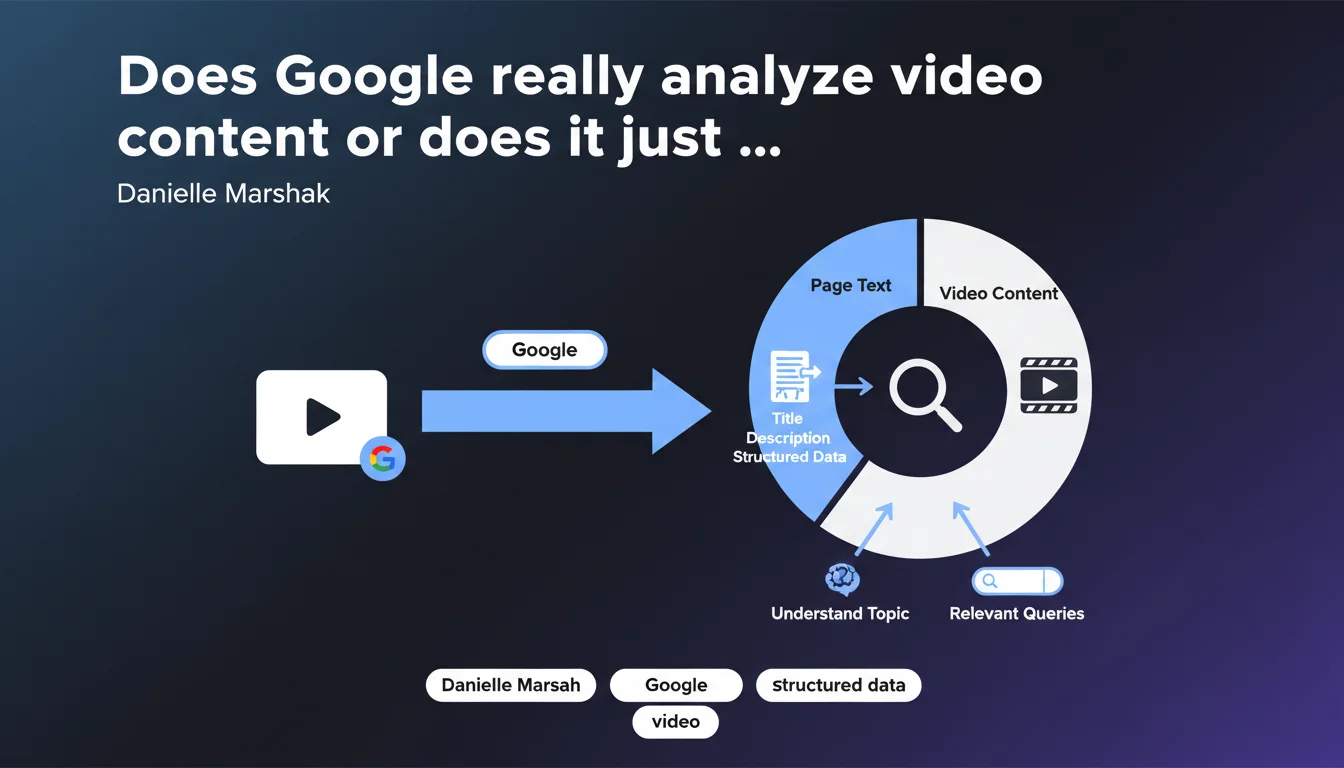
Google combines textual signals from the page (title, description, structured data) with analysis of the video content itself to understand the topic and determine relevant queries. This dual approach means that optimizing only the text around a video is no longer enough — the actual video content also matters for SEO.
What you need to understand
Does Google really analyze video content or does it just rely on metadata?
For years, video optimization for Google relied essentially on textual signals: title, description, schema.org VideoObject tags, transcripts. The common assumption was that Google "read" around the video, not inside it.
This statement confirms that Google now uses both sources — page text AND video content — to understand the topic. In concrete terms, Google can extract information directly from the video: spoken words, visual elements, even text displayed on screen.
This means that strict consistency between what the video says and what the text announces becomes a relevance criterion. If your title promises "10 technical SEO tips" but the video vaguely discusses content strategy, Google detects it.
- Google combines textual signals (title, description, structured data) and actual video content
- Video analysis likely includes speech recognition, OCR of on-screen text, visual analysis
- Consistency between text and video becomes an explicit relevance factor
- Transcripts remain useful but are no longer sufficient if video content diverges from the text
Which textual signals does Google prioritize?
Google explicitly mentions the page title, the description, and structured data. This aligns with standard recommendations: VideoObject tags with name, description, thumbnailUrl, uploadDate, contentUrl.
But be careful: these signals are no longer "labels" that Google takes at face value. They are now compared against actual content. If your schema.org announces a 10-minute duration and the video is 3 minutes long, Google sees it. If the description says "advanced tutorial" and the content is basic, relevance suffers.
What does this change for video SEO?
Video SEO becomes bidirectional. Before, you optimized "around" the video. Now, you need to optimize the video itself as a fully indexable object.
This means thinking SEO from the production stage: structure your discourse, display important keywords on screen, carefully craft the intro so the topic is immediately clear. A fuzzy, poorly structured, or off-topic video will be penalized even if the text is flawless.
For e-commerce sites or content platforms with many videos, this means rethinking editorial governance: who validates text/video consistency? Who ensures that strategic keywords are spoken in the first 30 seconds?
SEO Expert opinion
Is this statement consistent with what we observe in practice?
Yes, and it's actually confirmed by several recent observations. YouTube videos — which Google owns — appear increasingly in featured snippets and rich results, often with precise timestamps pointing to the exact moment the answer is given.
This is only possible if Google understands the temporal content of the video, not just its metadata. Same for "Key clips" carousels in SERPs: Google extracts relevant video segments for specific queries, which requires fine-grained content analysis.
However — and this is where it gets unclear — Google remains extremely vague about the technologies used. Are we talking about automatic speech recognition (ASR)? Image analysis by AI? Visual concept detection? [To verify]: no official details on Google's exact capabilities for video analysis outside YouTube.
What nuances should we add to this statement?
First nuance: this "understanding" of video content likely remains uneven depending on formats and platforms. YouTube gets preferential treatment — automatic transcripts, chapters, tags — that Google exploits heavily.
For a video hosted on a third-party server or via a custom player, the analysis is probably less advanced. Google can crawl the video file, but it doesn't have access to the same structured metadata it has on YouTube. Result: the weight of page text becomes predominant again.
Second nuance: the "relevance" of queries remains unclear. Does Google only determine if a video matches a topic, or does it also evaluate pedagogical quality, clarity, speaker authority? [To verify]: no indication of qualitative criteria beyond simple thematic matching.
In which cases does this rule not apply fully?
For very short videos (less than 30 seconds), automatic analysis is probably limited. Google can detect the topic, but granularity remains low. Page text becomes crucial again.
For videos without speech (motion design, music, ambiance), Google must rely almost exclusively on visual signals and accompanying text. Object/concept recognition by AI exists, but is less reliable than ASR on spoken content.
Finally, for videos in uncommon languages or with heavy accents, the quality of automatic speech recognition can be poor. In this case, providing a clean transcript becomes essential — don't rely solely on automatic analysis.
Practical impact and recommendations
What should you concretely do to optimize your videos?
First step: strictly align video content and page text. If your title announces "5 SEO mistakes to avoid", the video must actually list these 5 mistakes, preferably in the announced order and with exact terms.
Second action: structure your discourse so that strategic keywords are spoken clearly in the first few seconds. Google won't analyze 20 minutes of video with the same attention it reads 500 words of text — the intro counts enormously.
Third point: display text on screen (titles, subtitles, key points). Google can read these elements via OCR, which reinforces thematic relevance. This is especially useful for lists, definitions, and key figures.
- Write title and description with exact keywords spoken in the video
- Implement schema.org VideoObject with name, description, thumbnailUrl, uploadDate, duration, contentUrl
- Add a complete transcript in HTML on the page (not just hidden VTT)
- Structure the video into clear chapters with timestamps if possible (via schema.org Clip or YouTube Chapters)
- Perfect the first 30 seconds: topic stated clearly, keywords spoken, on-screen text
- Verify consistency: what the video says must exactly match what the metadata announces
- Host on YouTube if possible to maximize indexation (or provide a detailed video sitemap)
- Track video performance in Search Console (Appearance in search results tab > Rich results)
What mistakes should you absolutely avoid?
Mistake #1: Recycle generic video content with ultra-optimized text. Google will detect the divergence and relevance will drop. If the video is off-topic, it hurts more than it helps.
Mistake #2: Neglect audio quality. A video with saturated sound, background noise, or an incomprehensible accent will be poorly transcribed by Google's automatic ASR. Result: flawed analysis.
Mistake #3: Think the transcript is enough. A transcript is good, but if the video content itself is disjointed, unclear, or poorly structured, Google will "see" it. The transcript doesn't hide a mediocre video.
How do you verify that your videos are well optimized?
Use Google Search Console to track impressions and clicks generated by your videos. The "Appearance in search results" tab tells you if your videos appear as rich results.
Test your pages with Google's rich results testing tool to verify that VideoObject structured data is properly detected and valid. Also check that Google can access the video file (no robots.txt block, no paywall).
Finally, perform manual searches on your target keywords to see if your videos appear, in what format (carousel, featured snippet, classic result with thumbnail), and how they rank against YouTube and other platforms.
❓ Frequently Asked Questions
Google analyse-t-il le contenu vidéo même si j'ai fourni une transcription complète ?
Les vidéos hébergées hors YouTube sont-elles analysées de la même manière ?
Faut-il toujours intégrer schema.org VideoObject même pour des vidéos courtes ou secondaires ?
Si le texte de page et le contenu vidéo divergent légèrement, lequel Google privilégie-t-il ?
Google peut-il détecter la qualité pédagogique ou la clarté d'une vidéo, ou seulement son sujet ?
🎥 From the same video 11
Other SEO insights extracted from this same Google Search Central video · published on 10/03/2022
🎥 Watch the full video on YouTube →
💬 Comments (0)
Be the first to comment.