
Official statement
Other statements from this video 10 ▾
- □ Does Google really analyze every element of your content during indexation?
- □ Does Google Really Fix Your HTML Errors During Indexing?
- □ Can an unsupported tag in <head> really break all your SEO metadata?
- □ How does Google decide which version of a duplicate page to index?
- □ How does Google decide which version to index when you have duplicate content?
- □ How does Google really group pages with similar content together?
- □ How does Google actually choose the canonical page in a duplicate cluster?
- □ Does Google really serve different versions of your pages based on search context?
- □ Does Google really decide which of your pages deserve to be indexed?
- □ What information does Google actually store in its index for canonical pages?
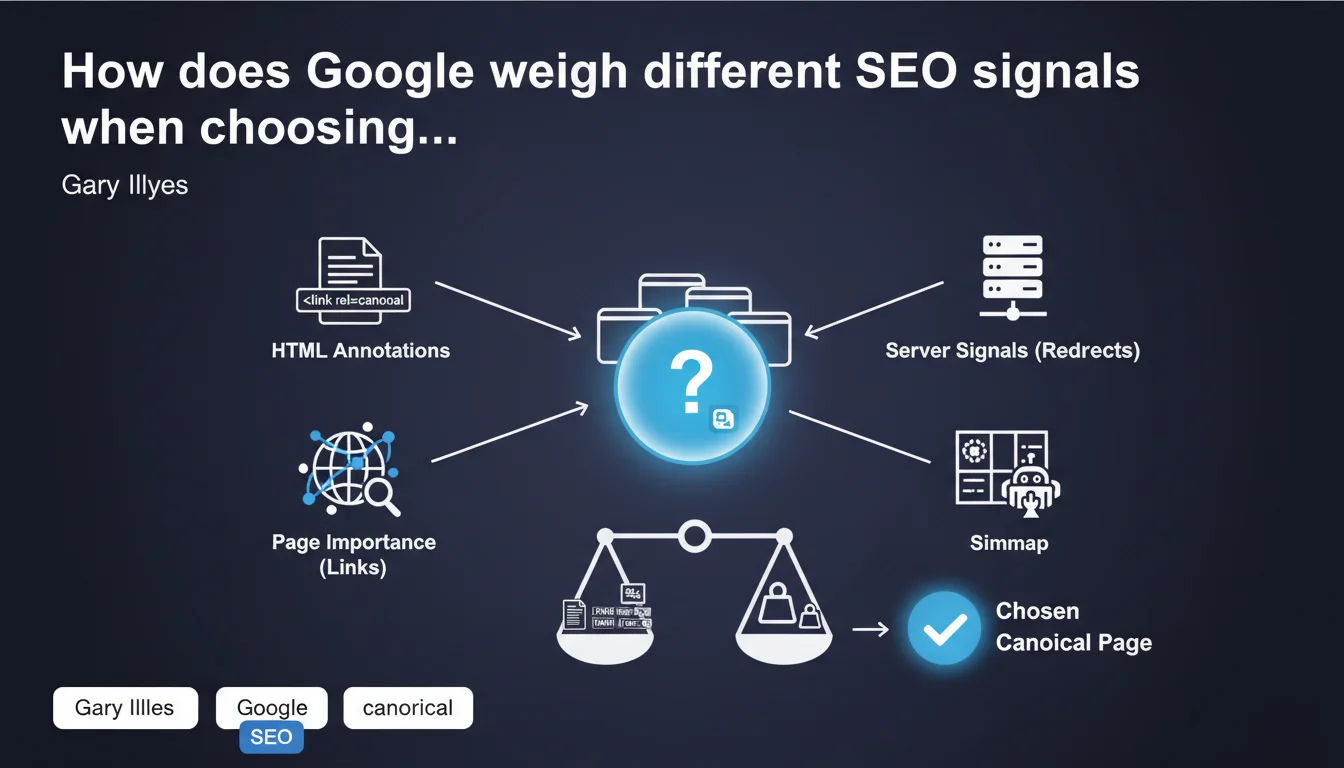
Google uses a hierarchy of signals to determine the canonical version of a page. Explicit annotations like rel=canonical are "simple" signals, while metrics such as a page's importance across the internet are "complex" signals that can carry more weight in the final decision. This statement confirms that Google does not blindly follow technical directives — it weighs them against other factors.
What you need to understand
What does Google mean by "simple signals" and "complex signals"?
Google distinguishes two categories of signals in its canonicalization process. Simple signals are explicit annotations left by site owners: rel=canonical tags, 301 redirects, hreflang tags, parameters in Search Console.
Complex signals stem from algorithmic analysis: page authority, volume of backlinks pointing to one URL rather than another, engagement signals, internal linking consistency. These signals don't depend on a webmaster's declaration — Google calculates them itself.
Why is this distinction important in practice?
Because it reveals that Google doesn't always follow your technical directives. If your rel=canonical tag points to URL A, but the vast majority of backlinks and internal linking point to URL B, Google may decide that B is the canonical version.
This is particularly common in syndicated content scenarios, pages with UTM parameters that accumulate links, or migrations where the old URL retains more authority than the new one.
Which signals carry the most weight?
Google doesn't provide an exact ranking, but real-world experience suggests an implicit hierarchy:
- 301/308 redirects: very strong signal, rarely ignored unless major inconsistency
- Rel=canonical: strong signal, but can be dismissed if other signals massively contradict it
- Backlinks and internal linking: considerable weight, especially if there's a marked asymmetry
- URL structure: preference for short URLs without parameters
- Content and publication date: in case of duplication, the oldest or most comprehensive version may be favored
SEO Expert opinion
Is this statement consistent with real-world observations?
Yes, and it confirms what many SEO practitioners have observed for years. Google doesn't mechanically follow rel=canonical tags — it treats them as a recommendation, not an imperative directive.
I've seen dozens of cases where Google ignored a rel=canonical because the backlink profile contradicted the directive. Typical example: a syndicated article on a third-party site accumulates links, and Google eventually considers this version canonical despite the rel=canonical pointing to the original. [To verify]: Google doesn't publish a precise threshold at which a "complex" signal overrides a "simple" signal — it's a fuzzy weighting system.
What nuances should we add to this claim?
The notion of "a page's importance across the internet" remains vague. We can assume it's a mix of PageRank, traffic volume, content freshness, and thematic authority signals. But Google never details the exact recipe.
Let's be honest: this opacity makes diagnosis complicated. When Google ignores your rel=canonical, you need to investigate all competing signals — backlinks, internal linking, indexation history, forgotten intermediate redirect. It's rarely a 5-minute diagnosis.
In which cases does this rule not apply?
301 redirects remain the most reliable signal. If you properly redirect URL A to URL B with a 301, Google will follow this directive in the vast majority of cases — except for major technical inconsistencies (redirect chains, redirect loops).
Rel=canonical is more fragile. It works well in pagination contexts, AMP/mobile versions, or light tracking parameters. But as soon as there's content duplication across different domains, or accumulation of contradictory signals, the risk of Google ignoring the tag increases sharply.
Practical impact and recommendations
What should you do concretely to avoid canonicalization conflicts?
Start with an audit of contradictory signals. Identify URLs that receive backlinks when they're not supposed to be the canonical version. Verify that your internal linking points massively to the version you want indexed.
Then clean up parasitic versions. If a URL with UTM parameters accumulates links, redirect it with a 301 to the clean version. If syndicated content creates confusion, add a rel=canonical on the third-party editor's side + a noindex if you control this version.
Which mistakes should you absolutely avoid?
Never create rel=canonical chains: A→B→C. Google can get lost and pick a random version. A rel=canonical should point directly to the final version you want.
Avoid flagrant inconsistencies: rel=canonical to one URL, but 301 redirect to another. Google will prioritize the redirect, but this technical muddiness harms the clarity of your architecture.
How do you verify that Google respects your canonicalization directives?
Use Search Console, in the "Coverage" or "URL Inspection" section. For each important page, verify which URL Google considers canonical. If it differs from your rel=canonical tag, investigate the backlinks and internal linking.
- Regularly audit indexed URLs via Search Console
- Verify consistency between rel=canonical, redirects, and internal linking
- Analyze the backlink profile of competing versions with a tool like Ahrefs or Majestic
- Remove or redirect parasitic versions that accumulate links
- Document your canonicalization choices in a tracking spreadsheet
❓ Frequently Asked Questions
Google peut-il ignorer une balise rel=canonical même si elle est techniquement correcte ?
Quels signaux pèsent plus lourd qu'un rel=canonical dans le choix de la version canonique ?
Comment savoir si Google a ignoré mon rel=canonical ?
Faut-il privilégier les redirections 301 plutôt que le rel=canonical pour éviter les duplications ?
Que signifie « importance d'une page sur Internet » dans cette déclaration de Google ?
🎥 From the same video 10
Other SEO insights extracted from this same Google Search Central video · published on 04/04/2024
🎥 Watch the full video on YouTube →
💬 Comments (0)
Be the first to comment.