
Official statement
What you need to understand
Why Does Google Consider a 2010 Guide Still Relevant?
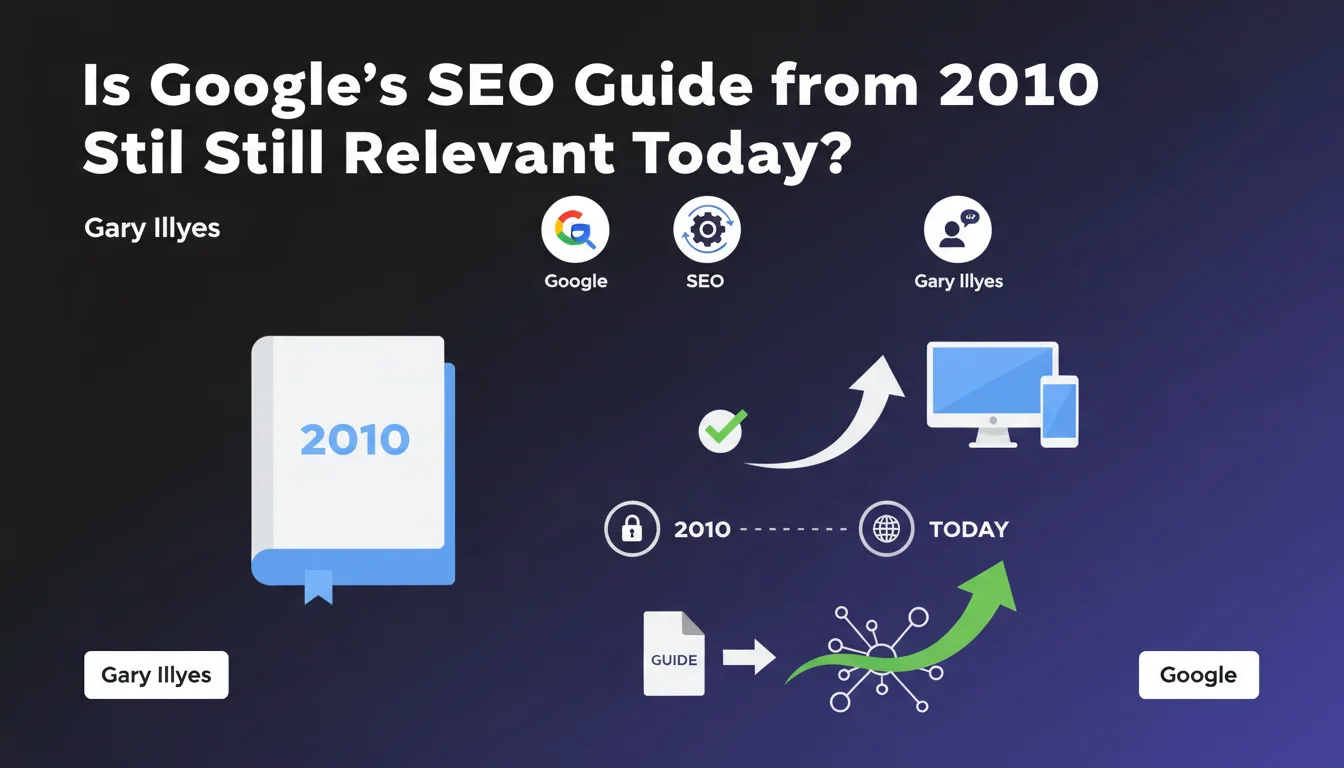
Gary Illyes, Senior Analyst at Google, confirmed that the SEO starter guide published in PDF format in 2010 remains current. This statement may surprise in a field as rapidly evolving as search engine optimization.
The reason is simple: this guide covers the fundamentals of SEO, those basic principles that haven't changed in over a decade. Title tags, meta descriptions, URL structure, and the importance of quality content remain essential pillars.
Which Fundamental Principles Stand the Test of Time?
Certain aspects of SEO constantly evolve (algorithms, technical criteria), but structural foundations remain stable. A well-organized site with clear architecture and relevant content stays performant regardless of the era.
These fundamentals notably include understanding search intent, basic on-page optimization, and creating content that meets user needs. These are universal and timeless concepts.
- SEO fundamentals (tags, structure, content) have remained valid for over 10 years
- Google confirms the relevance of its 2010 guide for SEO basics
- Structural principles of SEO are more stable than algorithmic aspects
- A dated guide can remain relevant if it focuses on essentials
SEO Expert opinion
Does This Statement Mean There's Nothing New to Learn in SEO?
Absolutely not. While the fundamentals remain valid, SEO has considerably evolved since 2010. The arrival of mobile-first, Core Web Vitals, generative AI, BERT, MUM, and now SGE have profoundly transformed practices.
Limiting yourself to a 2010 guide would be a major strategic mistake. It would miss crucial elements: user experience, loading speed, mobile optimization, HTTPS, schema.org structured data, and E-E-A-T.
In Which Cases Is This 2010 Guide Still Sufficient?
For a completely new site or a very basic project, this guide indeed covers the essential first steps. If your site doesn't even respect these fundamentals, they should be your absolute priority.
However, as soon as you aim for real competitiveness on competitive queries, these basics alone won't suffice. Your competitors already apply these principles AND all modern optimizations.
What's the Real Value of This Statement from Google?
This communication reminds us of an essential truth: before chasing the latest SEO trends, ensure that fundamentals are solidly in place. Too many sites still neglect the basics.
It's also a reassuring message: SEO isn't just a frantic race toward novelties. Structural principles offer stability on which to build. But be careful not to confuse stability of fundamentals with strategic immobility.
Practical impact and recommendations
What Should You Concretely Do with This Information?
Start with a fundamentals audit of your site. Verify that all basics mentioned in this type of guide are actually applied: unique and descriptive title tags, meta descriptions, coherent heading structure, clean URLs.
Then, imperatively supplement with modern standards: mobile optimization, Core Web Vitals, HTTPS, structured data, search intent optimization, work on E-E-A-T.
What Mistakes Should You Avoid Following This Statement?
Don't fall into the trap of thinking 2010 SEO is sufficient in 2024. Fundamentals are necessary but not sufficient. They constitute the foundation, not the complete edifice.
Also avoid neglecting continuous SEO monitoring. Algorithmic updates, new SERP features, and evolving user behaviors require permanent adaptation of your strategy.
How Do You Build a Complete and Modern SEO Strategy?
Adopt a three-layer approach: timeless fundamentals (2010 guide), current technical standards (2024), and prospective monitoring of emerging trends.
- Audit fundamentals: title tags, meta descriptions, heading structure, URLs, internal linking
- Verify mobile-first compliance and Core Web Vitals of your site
- Implement schema.org structured data relevant to your sector
- Optimize E-E-A-T: experience, expertise, authoritativeness, and trustworthiness
- Work on search intent and content quality according to current standards
- Establish regular SEO monitoring on algorithmic developments
- Analyze competition to identify modern differentiating factors
💬 Comments (0)
Be the first to comment.