
Official statement
Other statements from this video 4 ▾
- □ Does declaring the primary language of each page really matter for SEO?
- □ Can you really mix multiple languages on the same page without SEO penalties?
- □ Do you really need a meta tag to declare your site's language to Google?
- □ How should you structure a language learning website to maximize SEO performance and avoid Google's ranking confusion?
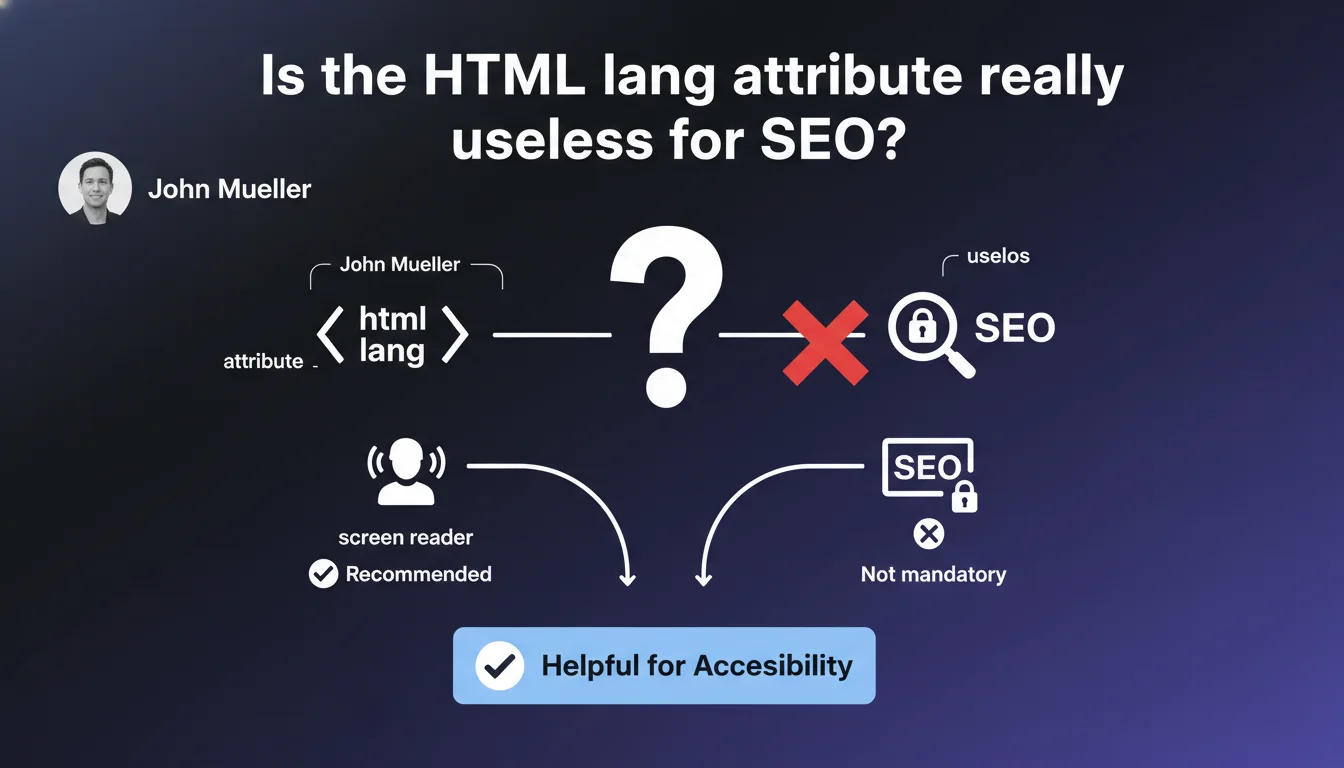
John Mueller confirms that the HTML lang attribute is not mandatory for SEO, but remains recommended for screen reader accessibility. Google can identify a page's language without this attribute, but its presence facilitates the user experience for certain audiences.
What you need to understand
Why does Google say the lang attribute is not mandatory?
Google uses its own language detection algorithms to identify the language of a web page. The search engine analyzes the text content, linguistic patterns, and other signals to determine what language a page is written in.
The lang="fr" or lang="en" attribute in the HTML tag is therefore not a direct ranking factor. Google doesn't need it to understand your content or to make it appear in localized search results.
If it's not for SEO, what is this attribute used for?
The lang attribute plays a crucial role in web accessibility. Screen readers (used by visually impaired or blind people) rely on this attribute to adjust their pronunciation and intonation.
Without this attribute, a screen reader configured in English could attempt to read French content with English pronunciation—making the text incomprehensible. This is a problem of user experience, not pure search engine optimization.
What is the indirect connection to SEO?
Even though Google states that the lang attribute does not directly impact rankings, accessibility influences behavioral metrics. An inaccessible site generates frustration, increases bounce rate, and degrades engagement.
These behavioral signals can, in turn, have an impact on your visibility. Not to mention that Core Web Vitals and user experience are confirmed ranking factors.
- Language detection: Google identifies the language without the lang attribute
- Accessibility: Essential for screen readers and users with disabilities
- User experience: Indirect impact on behavioral metrics
- Best practices: Recommended by W3C and WCAG standards
- International SEO: Does not replace hreflang for geographic targeting
SEO Expert opinion
Is this statement consistent with what we observe in the field?
Yes, absolutely. For years now, we've observed that sites without the lang attribute rank perfectly in their respective languages. Google truly has the technical means to identify a content's language without an HTML crutch.
Where it gets interesting: this statement highlights a gradual shift by Google towards a holistic vision of SEO. Accessibility is no longer a peripheral topic—it's a pillar of user experience, and therefore modern search engine optimization.
What nuances should be added to this position?
First point: don't confuse the lang attribute with hreflang tags. The latter are crucial for international SEO and tell Google which language version of a page to serve based on the user's location. [To be verified] If you manage a multilingual site, hreflang remains non-negotiable.
Second nuance—which Mueller doesn't explicitly state: the lang attribute can help in certain edge cases. Pages with little text, mixed-language content (French/English), or pages in rare languages where the detection algorithm could hesitate. In these situations, the attribute serves as a confirmation signal.
Should you still implement it?
Let's be honest: yes. Even if it's not a direct ranking factor, the implementation effort is virtually zero and the accessibility benefits are real.
If you manage a site with serious quality standards, ignoring the lang attribute amounts to ignoring users with disabilities. And that's a choice I would never recommend—from both an ethical and strategic standpoint.
<blockquote lang="en">). Screen readers need it to properly switch between languages.Practical impact and recommendations
What should you do concretely on your sites?
Implement the lang attribute in the <html> tag of all your pages. It's one line of code: <html lang="fr"> for French, <html lang="en"> for English, etc.
If you use a CMS like WordPress, Shopify, or Prestashop, verify that your theme already includes this attribute (it's often the default). For custom-built sites, add it manually to your main template.
What mistakes should you absolutely avoid?
Don't mix the lang attribute with hreflang tags. The former declares the language of HTML content, while the latter tells Google about alternative versions of a page for international targeting. Both have distinct roles.
Avoid approximate language codes. Use standard ISO 639-1 codes: "fr" not "french", "en" not "anglais". You can specify the region if relevant: "fr-FR" (France), "fr-CA" (Canada), "en-GB" (United Kingdom), "en-US" (United States).
How do you verify that your implementation is correct?
Inspect your source code (right-click > View page source) and look for the <html> tag. The lang attribute should appear immediately: <html lang="fr">.
Run your pages through an HTML validator like the W3C Validator. It will flag if the lang attribute is missing or improperly formatted. For more in-depth accessibility checking, use tools like WAVE or Axe DevTools.
- Add
lang="[language-code]"to the<html>tag of each template - Use standard ISO 639-1 codes (fr, en, es, de, etc.)
- For multilingual content within a page, tag sections with their own lang attribute
- Verify implementation with the W3C validator
- Test with a screen reader (NVDA, JAWS, VoiceOver) if possible
- Don't confuse with hreflang tags for international SEO
- Document language choices in your technical style guide
❓ Frequently Asked Questions
L'attribut lang impacte-t-il le classement dans les résultats de recherche ?
Dois-je quand même ajouter l'attribut lang sur mon site ?
Quelle est la différence entre l'attribut lang et les balises hreflang ?
Quel code langue dois-je utiliser pour un site français ?
Comment gérer une page avec du contenu dans plusieurs langues ?
🎥 From the same video 4
Other SEO insights extracted from this same Google Search Central video · published on 06/09/2022
🎥 Watch the full video on YouTube →
💬 Comments (0)
Be the first to comment.