
Official statement
Other statements from this video 4 ▾
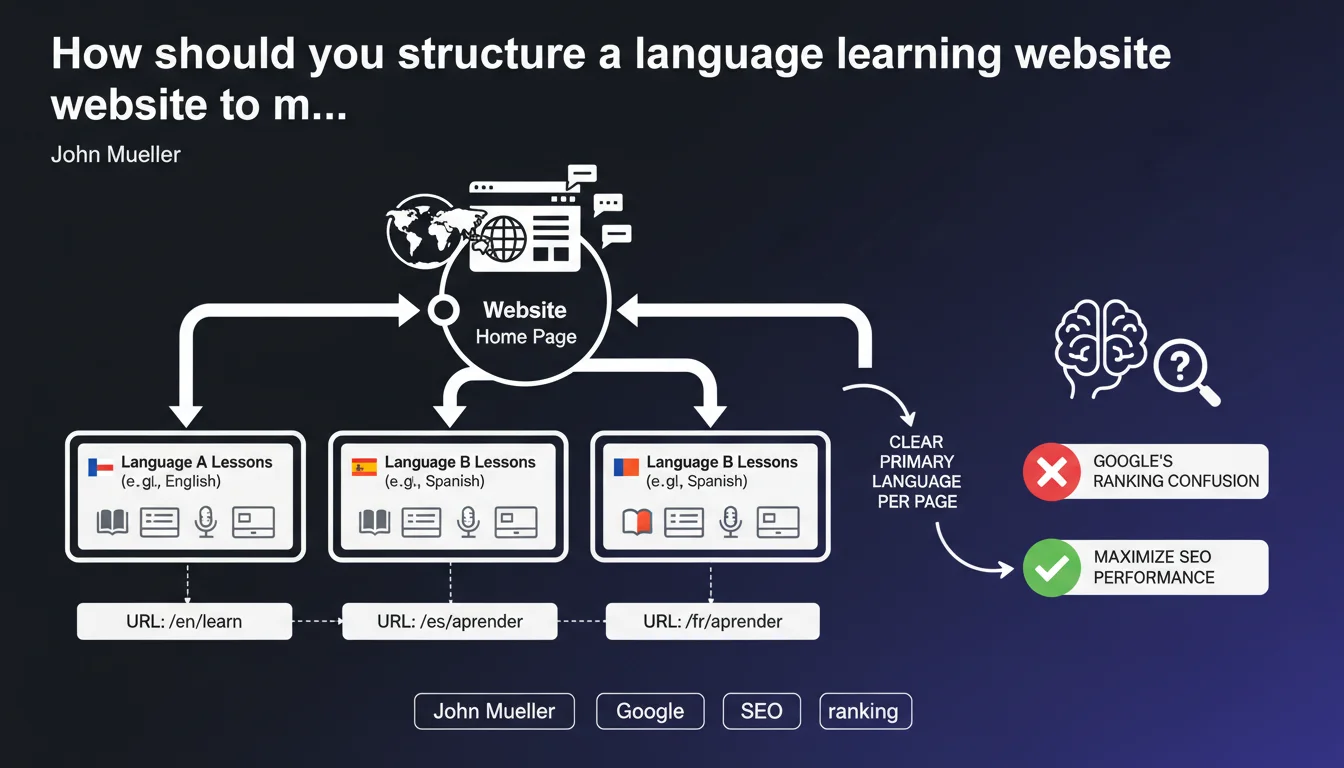
Google recommends assigning a clear primary language to each page on a language learning website, while allowing the creation of separate pages for other languages on the same domain. This approach prevents algorithmic confusion and promotes better geographic and linguistic targeting.
What you need to understand
Why does Google insist on one primary language per page?
Google's algorithm needs to quickly identify the dominant language of a page to serve it to the right users. On a language learning website, the risk is twofold: mixing multiple languages in the main content (French and English for example) can create ambiguity that disrupts ranking.
Concretely? If your page teaches English to French speakers, French must be the primary language detectable through hreflang tags, the HTML lang attribute, and the majority of content. English examples remain secondary elements, not the dominant editorial structure.
Can you have multiple language versions on the same domain?
Yes, and it's even encouraged. Mueller clarifies that it's possible to create separate pages for other languages on the same website. There's no need to multiply domains or subdomains if your architecture is clear.
The key is that each URL has one unambiguous primary language. A site can offer /fr/learn-english/ and /en/learn-french/ without problem, as long as the technical signals (hreflang, lang, content) are consistent.
What technical pitfalls should you avoid?
- Mixing languages in the main body text without clear hierarchy
- Omitting hreflang tags to indicate alternative language versions
- Using an HTML lang attribute that doesn't match the actual content
- Creating bilingual content in the same block without structural separation
- Forgetting to declare the primary language in metadata
SEO Expert opinion
Is this directive consistent with real-world practices?
Absolutely. Poorly structured multilingual websites have suffered from relevance penalties for years without understanding why. Google can't guess whether your page targets French speakers learning English or English speakers learning French when both languages are intertwined.
A/B tests conducted on learning platforms show that adding correct hreflang tags and clarifying the primary language generate visibility gains of 20 to 40% on localized queries. This is significant.
What nuances should be added to this recommendation?
Mueller remains vague on one point: what proportion of secondary content is acceptable? [To verify] A language course necessarily contains examples, dialogues, and exercises in the target language. What French/English ratio triggers algorithmic ambiguity?
Based on field observations, as long as structural content (navigation, instructions, explanations) remains in the primary language and linguistic examples are semantically marked (tags like span lang="en" for example), Google manages. But as soon as explanation paragraphs alternate between two languages, problems begin.
In what cases does this rule create problems?
Sites offering comparative courses (e.g., differences between French and Italian) are trapped. It's impossible to maintain ultra-dominant language when pedagogical content requires constant comparisons.
Solution observed on performing sites: structure into clearly delimited sections with lang attributes at each block level, and strengthen hreflang signals to indicate the primary target language. But let's be honest, it's complex and fragile.
Practical impact and recommendations
What should you do concretely on a language learning website?
Start with a technical audit of lang and hreflang tags. Verify that each page declares its primary language consistently in the HTML, metadata, and HTTP headers if you manage multiple versions.
Next, analyze your content: instructions, menus, explanations should represent at least 60-70% of visible text in the primary language. Examples in the taught language can be marked with <span lang="xx"> or <blockquote lang="xx"> to signal their secondary status.
What errors should you absolutely avoid?
Don't create "hybrid" pages where paragraphs alternate between interface language and taught language without clear logic. Google won't know how to rank you and you'll lose traffic on both targets.
Also avoid hreflang chains: if you have FR, EN, ES versions of the same content, each page must point to all others, including itself. Configuration errors are the leading cause of failure on multilingual sites.
How do you verify your site is compliant?
- Use Google Search Console to detect hreflang errors (International Targeting section)
- Test your URLs with an hreflang validator (e.g., Aleyda Solis Hreflang Tags Testing Tool)
- Verify that the <html lang="xx"> tag matches the primary content language
- Check text ratio: primary language must dominate visually
- Analyze your rankings on localized queries: a sudden drop often signals linguistic confusion
- Inspect source code to identify secondary text blocks and add lang tags if necessary
The linguistic structure of a language learning site demands technical rigor that many underestimate. One page = one clearly identifiable primary language. Alternative versions are managed via hreflang and separate URLs.
This architecture prevents algorithmic confusion and improves geographic targeting. But implementation requires pointed expertise in international SEO, especially if your catalog contains dozens of languages or pedagogical combinations. Hreflang configuration errors are frequent and costly in visibility — in this context, support from an SEO agency specialized in international SEO helps you avoid technical pitfalls and secure your multilingual architecture from the start.
❓ Frequently Asked Questions
Peut-on utiliser un sous-domaine par langue ou faut-il privilégier les sous-répertoires ?
Les plugins de traduction automatique posent-ils problème pour le SEO ?
Comment baliser les citations ou exemples dans une langue différente de la page ?
Faut-il créer des versions linguistiques même si le contenu est presque identique ?
Google Search Console signale des erreurs hreflang, est-ce grave ?
🎥 From the same video 4
Other SEO insights extracted from this same Google Search Central video · published on 06/09/2022
🎥 Watch the full video on YouTube →
💬 Comments (0)
Be the first to comment.