
Official statement
What you need to understand
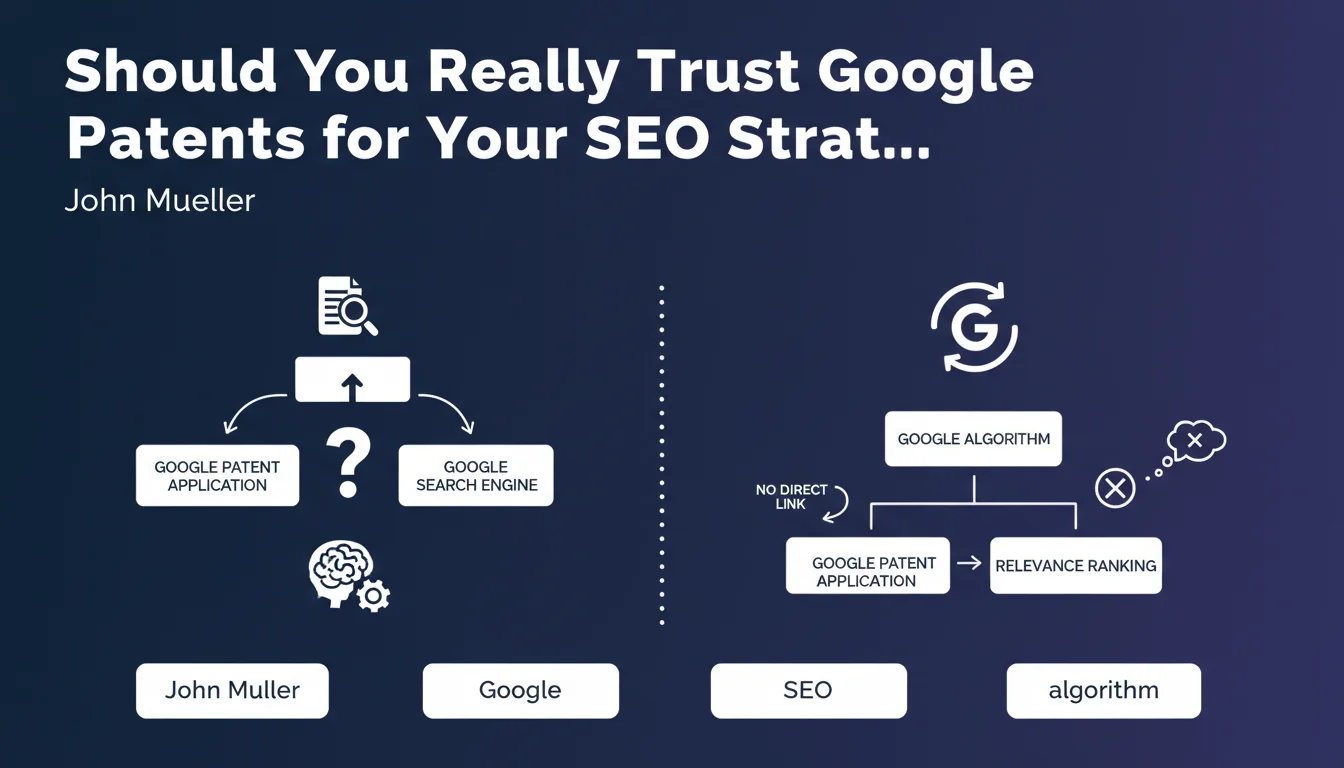
When Google files a technology patent, it absolutely does not guarantee that the technology described is actually used in the search algorithm. This distinction is crucial for SEO practitioners who regularly scrutinize patents to anticipate developments.
Patents can serve several purposes: protecting a future innovation, blocking competition, or simply documenting exploratory research. The gap between filing a patent and its actual implementation can be several years, or even infinite.
This statement reminds us that there is a fundamental difference between what Google explores theoretically and what is deployed in production on billions of daily queries.
- A filed patent does not mean immediate or even future implementation
- Patents also serve as legal protection without technical application
- The time lag between patent and deployment can be considerable
- Some patented technologies will never see the light of day in the algorithm
SEO Expert opinion
This position from John Mueller is perfectly consistent with the reality observed in the field. As an expert having analyzed dozens of Google patents over 15 years, I regularly observe that certain patented innovations have never been detected in search results.
However, patents remain valuable indicators of Google's research directions. Even if not immediately implemented, they reveal the issues the company is trying to solve: natural language understanding, spam detection, content quality evaluation.
The real value of patents lies in the philosophical understanding of Google's approach rather than in direct optimization tactics. They illuminate the long-term vision without guaranteeing short-term application.
Practical impact and recommendations
- Never modify your SEO strategy solely based on a recently discovered patent
- Use patents as general knowledge to understand the issues Google is trying to solve
- Prioritize officially confirmed signals by Google (Core Web Vitals, HTTPS, mobile-first, etc.)
- Cross-reference patent analysis with concrete A/B tests and correlation observations on your projects
- Document your own field observations rather than speculating on potential technologies
- Stay informed about recent patents to anticipate trends 2-3 years out, not for immediate optimizations
- Focus 80% of your efforts on proven SEO fundamentals: quality content, user experience, solid technical architecture
The strategic analysis of patents, putting them into perspective with actual algorithm evolutions, and developing a balanced SEO roadmap require deep expertise and constant monitoring. These skills are acquired through years of practice and experimentation.
For companies wishing to build a robust SEO strategy without getting lost in technological speculation, surrounding yourself with experienced professionals allows you to quickly distinguish real opportunities from false leads and allocate resources to truly impactful actions.
💬 Comments (0)
Be the first to comment.