
Official statement
What you need to understand
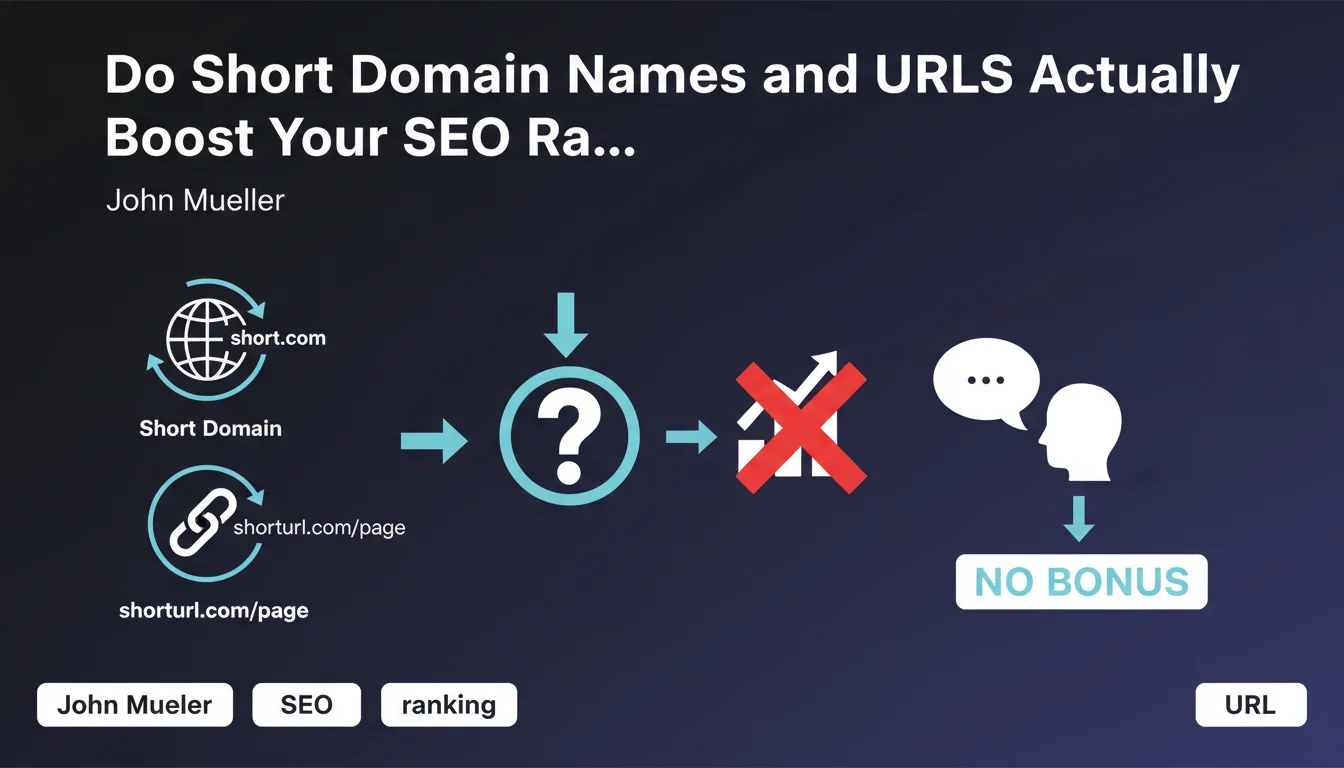
Google officially confirms that the length of domain names and URLs provides no particular SEO advantage. Contrary to popular belief, having a short domain or URLs with few characters will not give you a "bonus" in search result rankings.
This clarification puts an end to a recurring debate in the SEO community. Many practitioners believed that a short URL was favored by the algorithm, particularly for reasons of readability or memorability. Google confirms that this is not a criterion considered in its ranking system.
It's important to understand that the weight of keywords in URLs is already very low according to repeated statements from Google. Whether your URL is 30 or 80 characters long, this has virtually no influence on the relevance perceived by the search engine.
- The length of a domain name or URL is not a ranking factor
- No SEO advantage to favoring short URLs over long ones
- The weight of keywords in URLs remains marginal in the algorithm
- URL structure should primarily serve the user, not the search engine
SEO Expert opinion
This statement is perfectly consistent with field observations over the past several years. Sites with long, descriptive URLs rank just as well as those with ultra-short URLs, provided the content is relevant and high quality.
An important nuance to note: length has no direct SEO impact, but it can have an indirect impact on user experience. An unreadable 200-character URL can reduce click-through rates in SERPs or generate distrust. The issue is therefore more UX than pure SEO.
In certain specific cases such as URLs shared on social media or printed on physical media, brevity remains a practical asset. But this falls under marketing and usability, not natural search engine optimization.
Practical impact and recommendations
- Stop wasting time artificially shortening your existing URLs for SEO reasons
- Focus on creating descriptive and user-friendly URLs
- Prioritize a logical URL structure that reflects your content architecture
- Don't buy a new short domain name thinking you'll gain an SEO advantage
- Keep your keywords in URLs if it helps comprehension, but without obsession
- Avoid URLs with strings of incomprehensible parameters, for UX more than for SEO
- Prioritize consistency of your URL structure across the entire site
- Test the readability of your URLs in mobile search results
💬 Comments (0)
Be the first to comment.