
Official statement
What you need to understand
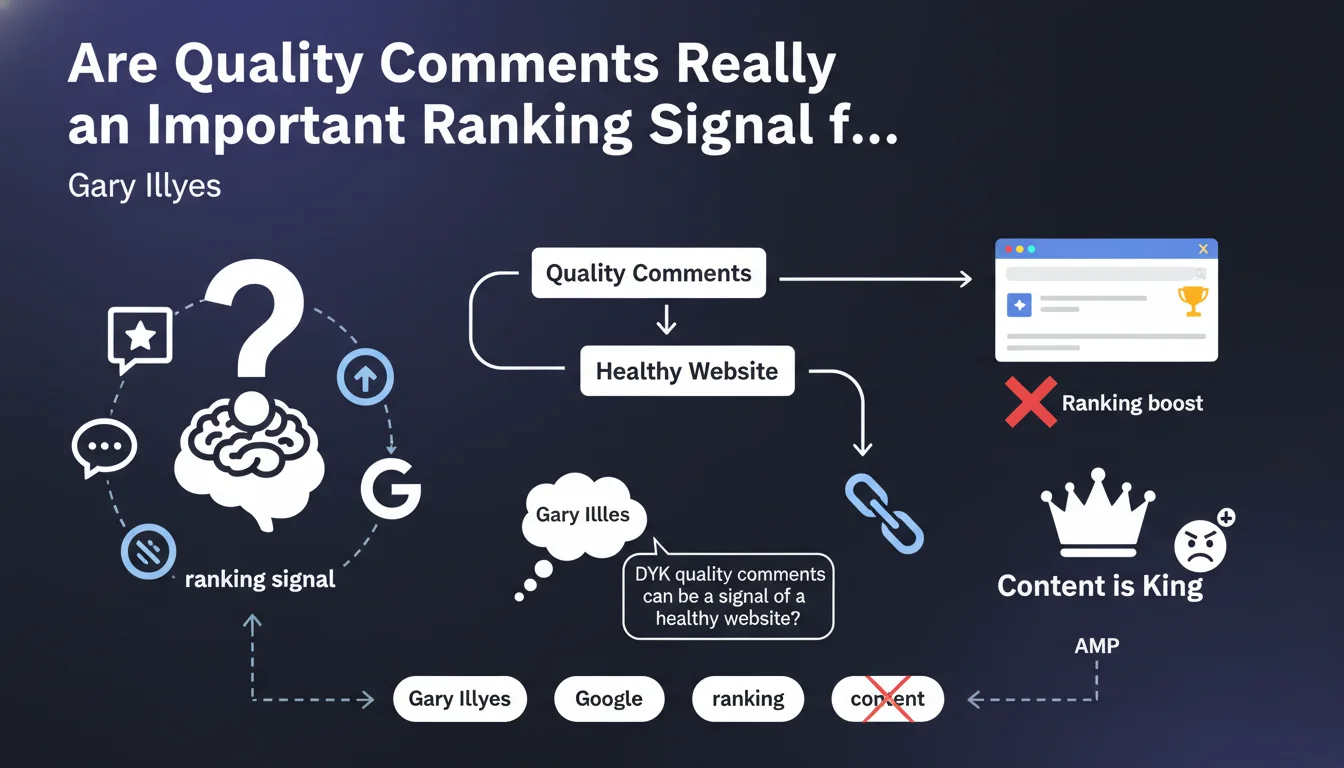
Google considers comments as an integral part of the page content. This official statement confirms that the search engine indexes and analyzes user comments in the same way as the main content, even though it identifies them as a distinct section.
Concretely, this means that keywords present in comments can contribute to your page's ranking on certain queries. If users search for specific terms that only appear in your comments, Google can position your page on those queries thanks to this user-generated content.
Removing comments therefore mechanically leads to a modification of the page's semantic footprint. You lose indexable content volume, potential keywords, and freshness signals if the comments were regularly updated.
- Comments are indexed and analyzed by Google as content
- Google can identify the comments section and apply specific treatment to it
- Removing comments necessarily impacts ranking, either positively or negatively
- Comments can make a page rank on specific long-tail queries
- User-generated content brings semantic diversity to the page
SEO Expert opinion
This statement is perfectly consistent with field observations. Many sites have experienced traffic variations after modifying their comment management, whether by removing them, hiding them, or moderating them more strictly.
However, an important nuance must be made: the impact can be positive or negative depending on the quality of the comments. Spam, off-topic, or low-quality comments dilute the thematic relevance of the page and can even harm ranking. Conversely, rich and relevant comments genuinely enrich the content.
In certain specific cases, removing comments can prove beneficial: sites with massive spam, toxic comments, or sections that have become obsolete. The important thing is to analyze the quality and real relevance of this user-generated content before making any decision.
Practical impact and recommendations
- Audit the quality of your existing comments: analyze whether they bring semantic value or are primarily spam
- Don't massively delete comments without having analyzed their contribution to organic traffic via Google Search Console
- Implement effective moderation rather than completely disabling comments on your strategic pages
- Identify pages that rank thanks to comments by analyzing long-tail queries in GSC
- Encourage quality comments by asking relevant questions or facilitating discussion
- Use the rel="ugc" attribute on links in comments to signal to Google that this is user-generated content
- Consider lazy-loading comments if you're concerned about loading speed impact, while keeping them accessible to crawling
- Analyze before/after impact if you need to remove comments, monitoring your rankings for several weeks
- Favor archiving over deletion for old comments that have generated historical traffic
In summary: Comments are an SEO lever not to be overlooked, but their management requires a strategic approach. Quality takes precedence over quantity, and any modification must be preceded by a thorough impact analysis.
Optimizing user-generated content strategy requires advanced technical and analytical expertise. Between semantic auditing, Search Console data analysis, implementing effective moderation systems, and tracking impacts, these optimizations can quickly become complex. Working with a specialized SEO agency allows you to benefit from personalized support to maximize the value of your comments while avoiding pitfalls that could harm your visibility.
💬 Comments (0)
Be the first to comment.