
Official statement
What you need to understand
What exactly is Passage Indexing and how does it work?
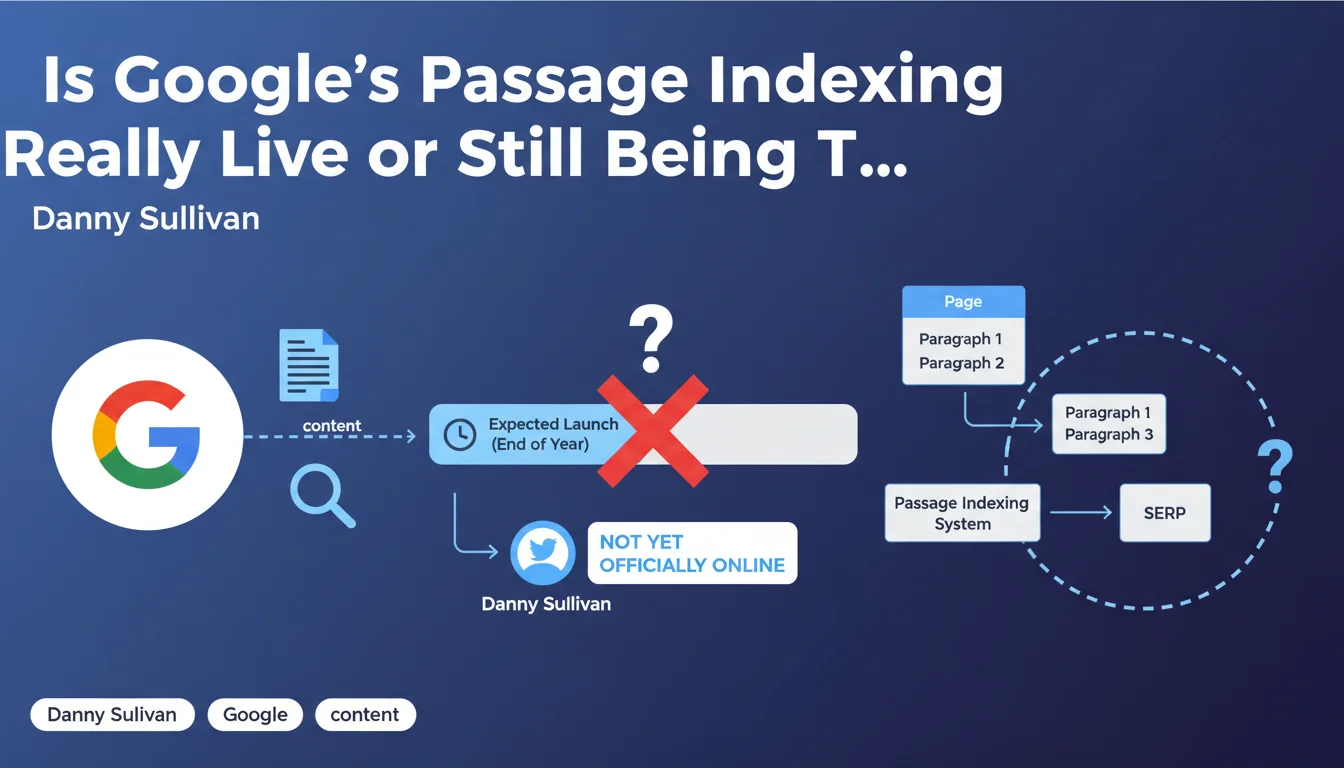
Passage Indexing represents a major evolution in how Google analyzes and indexes web content. Rather than evaluating only a page as a whole, this system allows the search engine to identify and rank specific passages within a page.
Concretely, a page dealing mainly with gardening could be surfaced for a query about watering tomatoes, even if this topic only occupies a single paragraph of the article. This technology enables Google to better respond to long-tail queries and very specific questions.
Why is there confusion about the rollout of this feature?
Danny Sullivan, Google's official spokesperson, stated that Passage Indexing was not yet officially deployed as of his statement. However, this announcement seems to contradict field observations made in France.
Typical Passage Indexing results were identified in French SERPs a few days before this declaration. This situation suggests that Google may have conducted regional tests or progressive rollouts without official communication.
What are the implications of this uncertain timeline for SEO professionals?
This uncertainty creates a delicate situation for search engine optimization professionals. It becomes difficult to know whether Passage Indexing-specific optimizations should be prioritized immediately or can wait for a confirmed deployment.
However, the observed tests suggest that full deployment is imminent. It would therefore be prudent to anticipate this evolution rather than wait for an official announcement that could arrive belatedly.
- Passage Indexing allows Google to index specific sections of a page, not just the entire page
- Official deployment appears delayed despite observations of real-world testing
- This feature will favor long-form content that is structured with distinct sections
- Long-tail and highly specific queries will benefit most from this system
- The contradiction between official statements and field observations is characteristic of Google's testing phases
SEO Expert opinion
Does this statement align with Google's typical practices?
The described situation is actually perfectly consistent with Google's usual deployment strategy. The company regularly conducts geographic tests or tests on user samples before a global launch.
Danny Sullivan's caution is likely explained by the desire not to communicate officially as long as the deployment is not generalized and stable. The tests observed in France correspond to a technical validation phase before international rollout.
This approach allows Google to adjust the algorithm based on real feedback without creating immediate expectations in the global SEO community.
What nuances should be applied to Danny Sullivan's announcement?
It is important to distinguish "not officially online" from "not active at all". Passage Indexing may very well be partially deployed in certain regions, for certain queries or certain types of content.
The history of Google updates shows that deployments often span several weeks or even several months. Danny Sullivan's statement likely reflects a state at a specific moment, but does not exclude tests already underway.
How will this feature truly transform SEO strategies?
Passage Indexing will fundamentally rehabilitate long-form, in-depth content. For years, the standard advice was to create one page per search intent. Now, a comprehensive page covering multiple sub-topics will be able to rank for multiple queries.
This evolution will favor sites offering dense, structured pillar content, provided that each section is sufficiently autonomous and provides a complete answer to a specific question.
Paradoxically, this does not make the strategy of dedicated pages per topic obsolete. Both approaches will coexist, and Google will choose depending on context and the comparative quality of content.
Practical impact and recommendations
What should you do concretely to optimize your content for Passage Indexing?
The absolute priority is to strengthen the semantic structure of your long-form content. Each section must be clearly identifiable with appropriate heading tags (H2, H3) and address a specific sub-topic autonomously.
Adopt a micro-answers approach in your content: each passage of 100 to 300 words should be able to completely answer a precise question, even when taken out of its overall context.
Enrich your existing pages rather than always creating new pages. A well-structured 3000-word article with 5-6 distinct sections can now capture as many queries as 5-6 separate pages.
What mistakes should you avoid in this transition?
Do not fall into the trap of creating artificially lengthened content without added value. Passage Indexing rewards qualitative depth, not simply length.
Also avoid neglecting overall thematic coherence. Even though Google can extract passages, your page must maintain an overall editorial logic. An article mixing completely disparate topics will be penalized.
Do not forget that the surrounding context always influences Google's understanding of a passage. An isolated passage is never completely independent of the content that surrounds it.
How can you verify and measure the impact on your visibility?
Monitor the evolution of your impressions on highly specific long-tail queries that did not correspond to the main theme of your pages. A significant increase would indicate that Passage Indexing is working for your site.
In Google Search Console, analyze the queries generating impressions to identify very specific questions associated with pages with broader themes. This is the clearest signal of Passage Indexing.
Use position tracking tools to monitor the evolution of long-form pages across multiple semantic variations. If the same page begins to rank for more variations, Passage Indexing is probably active.
- Audit your existing long-form content and strengthen their structure with explicit headings
- Identify pages that can be enriched with additional sections on related sub-topics
- Rewrite key passages so they are understandable out of context while remaining coherent
- Implement appropriate schema.org markup, notably FAQPage and HowTo to facilitate passage identification
- Create a content matrix identifying which pillar pages can absorb sub-topics currently on separate pages
- Monitor monthly new impressions on long-tail queries in Search Console
- Test different passage lengths (150-200 words vs 300-400 words) to identify the optimal format for your niche
- Document your observations to adjust strategy as the progressive rollout continues
Passage Indexing represents a major strategic opportunity for sites capable of producing in-depth, structured content. Although its official deployment is not yet confirmed, signals indicate imminent activation.
Optimization for this feature requires a methodical overhaul of editorial approach: strengthened structure, autonomous passages, enrichment of existing content. These transformations demand sharp technical and editorial expertise.
Faced with the complexity of these optimizations and the uncertainty of the deployment timeline, many businesses find that specialized support allows them to significantly accelerate compliance. An experienced SEO agency can perform a precise audit of your situation, prioritize actions according to your specific context, and implement optimizations with the appropriate methodology, enabling you to quickly capitalize on this major algorithmic evolution.
💬 Comments (0)
Be the first to comment.