
Official statement
What you need to understand
What is Passage Indexing and how does it appear in search results?
Passage Indexing is a Google system that enables the indexing and ranking of specific passages from a web page, rather than just the page as a whole. This technology aims to improve relevance for very specific queries.
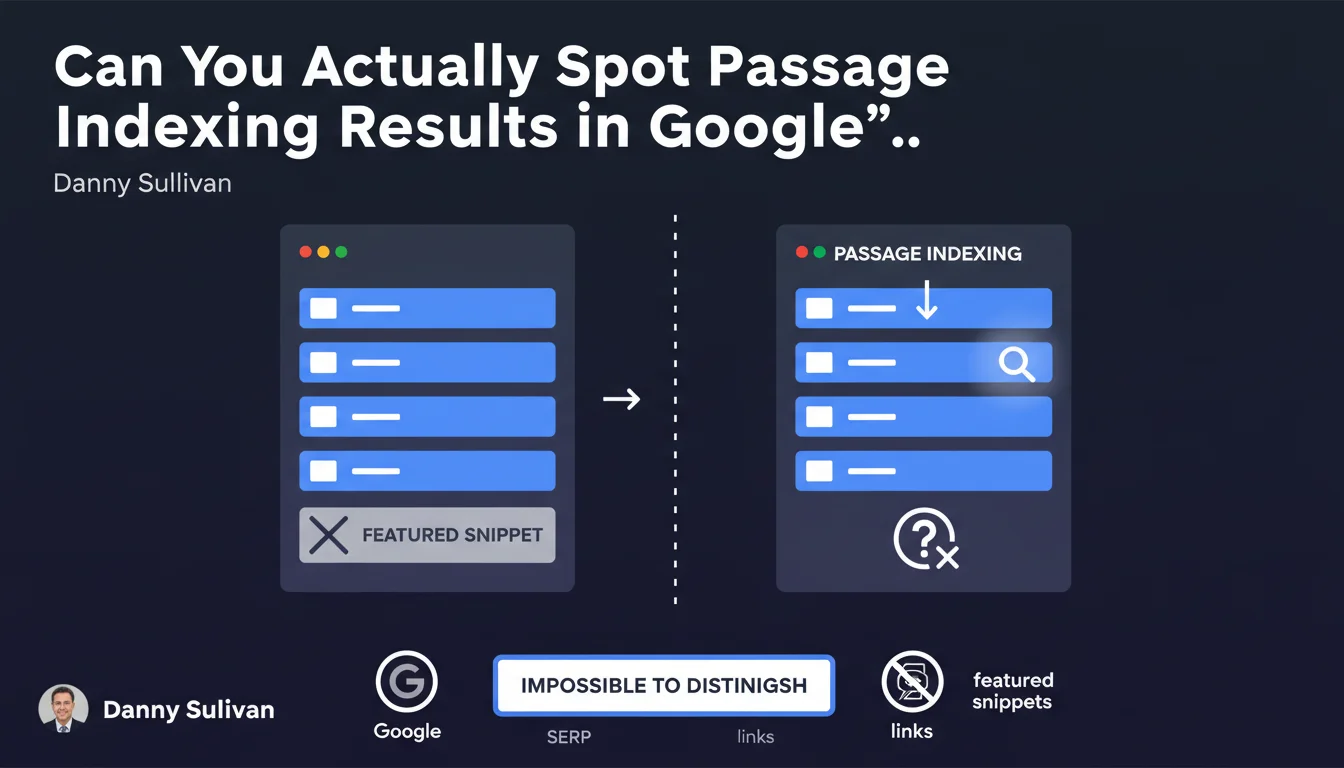
Contrary to what Google's initial official illustrations suggested, these results do not display as featured snippets. They appear in the standard blue links, meaning among the traditional 10 organic results in the SERP.
Why is it impossible to visually differentiate these results?
Google has clearly indicated that results from Passage Indexing will have exactly the same visual display as standard organic results. No badge, no specific formatting will allow them to be identified.
This initial confusion stems from the illustration used in Google's official communication, which resembled a modified featured snippet. Danny Sullivan had to publicly correct this misunderstanding on Twitter.
What are the key takeaways about this system?
- Passage Indexing allows Google to understand and rank specific sections of a long page
- These results appear in standard organic positions (1 to 10), not as featured snippets
- It is visually impossible to know whether a result comes from Passage Indexing
- Only Google knows internally which results use this technology
- This does not create a new type of result, but a new way of analyzing content
SEO Expert opinion
Is this statement consistent with Google's algorithm evolution?
This clarification from Danny Sullivan is completely consistent with Google's current philosophy. The goal is to improve content understanding, not to multiply display formats in SERPs.
Passage Indexing follows in the footsteps of BERT and MUM, technologies that aim to better understand natural language and semantic nuances. Google is seeking to refine its ability to extract relevance, even from long and complex content.
What implications does this transparency have for SEO practitioners?
The impossibility of distinguishing these results creates an interesting situation: we cannot directly measure the impact of Passage Indexing on our pages. This makes performance analysis more complex.
However, this approach is logical. If Google displayed a specific visual indicator, it would create a new category of results to "optimize for," which is not the objective. Google simply wants to better serve existing content.
In what cases does this system truly make a difference?
Passage Indexing is particularly relevant for long, comprehensive content that covers multiple sub-topics. Previously, a page could be penalized if it wasn't sufficiently "focused" on a single subject.
Now, Google can identify that a specific passage from your 3000-word page perfectly answers a precise query, even if the rest of the page discusses something else. This rewards complete and well-structured content.
Practical impact and recommendations
What should you do concretely to benefit from Passage Indexing?
The first action is to improve the semantic structure of your long-form content. Use clear and descriptive H2 and H3 headings that frame each thematic section distinctly.
Ensure that each section or passage of your content can stand on its own and answer a specific question. Write coherent paragraphs with a clear introduction to the topic being covered.
Favor a thematic silo content approach within a single page. Each block should have its own semantic coherence while contributing to the page's overall subject.
What mistakes should you avoid in content structuring?
Don't try to artificially create "optimized passages." Google detects manipulation attempts and always prioritizes natural content quality.
Avoid overly fragmented or redundant content. If you repeat the same information across multiple passages, Google might struggle to identify the most relevant passage to display.
Don't neglect the overall coherence of the page on the grounds that Google can now index isolated passages. The page must remain relevant as a whole.
How can you adapt your long-term content strategy?
- Create comprehensive pillar content that's well-structured rather than multiplying short pages
- Use appropriate HTML5 semantic markup (article, section) to delimit passages
- Incorporate specific questions in subheadings to target long-tail queries
- Regularly audit existing long-form pages to improve their structure
- Analyze average positions and CTR to detect potential visibility improvements
- Maintain coherent internal linking between thematic sections of your content
- Test different paragraph lengths and structures to optimize comprehension
Passage Indexing represents a major evolution in how Google analyzes and ranks content. Although invisible to users, this system rewards long-form, structured, and comprehensive content.
Adapting to this technology requires a potential overhaul of your content strategy and information architecture. This transformation can prove complex, especially for sites with a large volume of existing content.
Given these technical and strategic challenges, support from a specialized SEO agency can facilitate the implementation of a coherent and effective approach, drawing on deep expertise in the latest algorithmic developments.
💬 Comments (0)
Be the first to comment.