
Official statement
What you need to understand
What Exactly Is Passage Indexing and How Does It Work?
Passage Indexing is a Google feature that allows the search engine to identify and rank specific passages within a web page, rather than only considering the page as a whole. This means that a particular section of your content can be highlighted to answer a precise query, even if the rest of the page deals with a different topic.
This technology aims to improve search result relevance by enabling Google to understand that different sections of the same page can answer distinct search intents. The algorithm therefore analyzes the semantic structure of your content in a more granular way.
Why Doesn't the nosnippet Tag Block Passage Indexing?
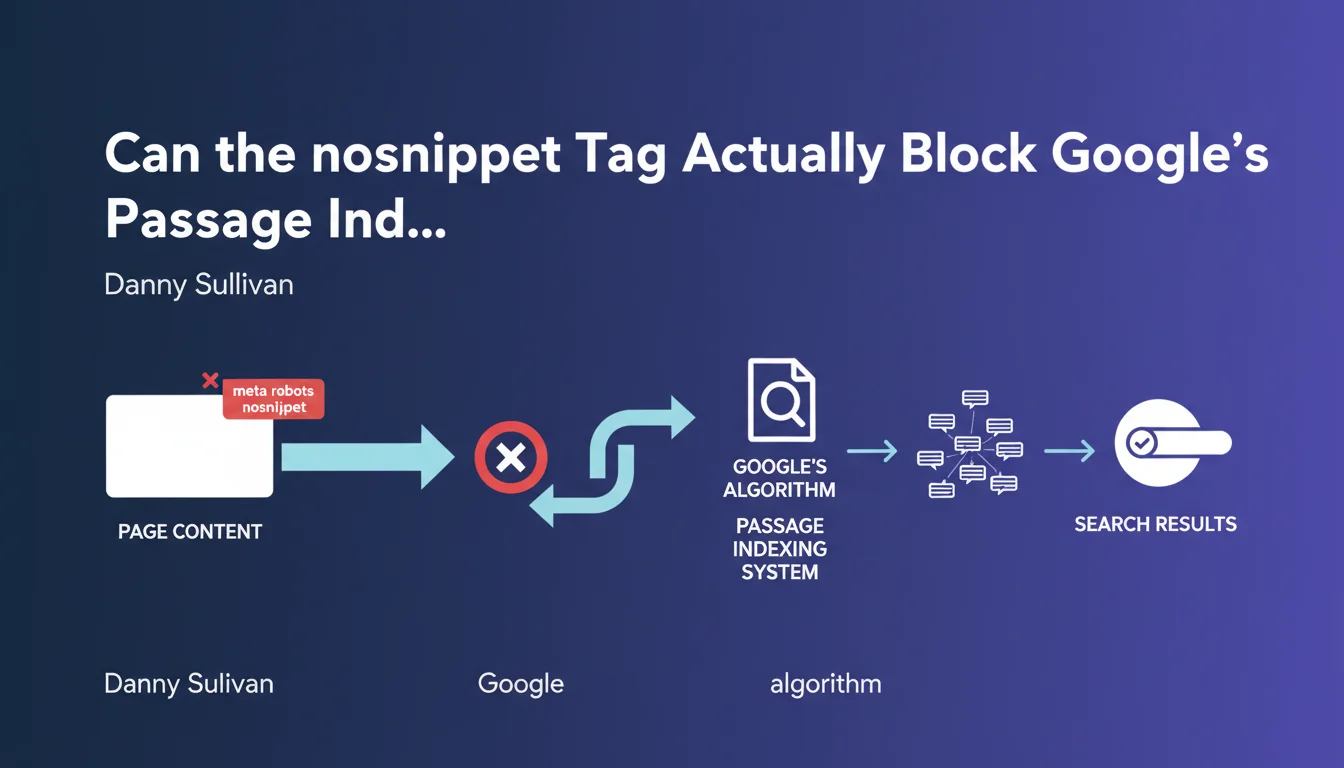
Danny Sullivan clarified that using the meta robots nosnippet tag does not prevent Google from applying Passage Indexing. This clarification is important because it reveals a fundamental distinction between two separate processes.
The nosnippet tag prevents the display of snippets in search results, but it does not block the analysis of content by Google's algorithms. Passage Indexing is part of the indexing and content understanding process, not its display in the SERPs.
What's the Real Difference Between Analysis and Display of Content?
It's important to understand that Google operates on two distinct levels: analysis for ranking and display in results. Passage Indexing belongs to the first category, while nosnippet concerns the second.
Concretely, Google will continue to analyze your passages to determine their relevance and potential ranking, but if you use nosnippet, no excerpt from these passages will be displayed in search results. You therefore benefit from the ranking potential without the snippet display.
- Passage Indexing allows Google to rank specific sections of a page
- The nosnippet tag only blocks the display of snippets in the SERPs
- Content analysis by algorithms continues even with nosnippet
- There is a clear distinction between indexing/ranking and display
- This clarification reveals Google's sometimes confusing communication about this feature
SEO Expert opinion
Does This Statement Align with Google's Overall Functioning?
This clarification from Danny Sullivan is perfectly consistent with the global architecture of Google's systems. Meta robots directives have always been designed to control display and behavior in the SERPs, not upstream algorithmic analysis processes.
However, this distinction is not always obvious to SEO practitioners. Google's communication around Passage Indexing has indeed lacked clarity from its launch, creating legitimate confusion. It is therefore normal that clarifications are needed to understand the real limitations of meta robots tags.
What Are the Implications of This Distinction for Content Control?
This situation reveals a significant limitation in webmasters' ability to finely control how Google processes their content. If you want to prevent Google from analyzing certain sections for Passage Indexing, the nosnippet tag will not be the solution.
In reality, there is no official mechanism to specifically disable Passage Indexing on your pages. Your only option to completely block content analysis remains noindex, but this removes the entire page from the index, which is a radical measure and often counterproductive.
When Does This Nuance Actually Become Important?
This distinction becomes particularly important for sites with long and diverse content on the same page. If you publish comprehensive guides, extensive FAQs, or in-depth articles covering multiple aspects of a topic, Passage Indexing will be active.
For e-commerce sites with detailed product descriptions, or information sites with comprehensive articles, understanding that nosnippet doesn't block analysis allows you to adjust your strategy. You can hide snippets for display strategy reasons, while knowing that Google will continue to evaluate the relevance of your passages for ranking.
Practical impact and recommendations
What Should You Actually Do With This Information?
Don't rely on nosnippet to disable Passage Indexing. If you are currently using this tag hoping to block passage-based analysis, know that it has no effect on this process.
Focus instead on optimizing your content while accounting for the fact that Google will analyze your pages in a granular way. Structure your content with clear headings, well-defined sections, and a coherent semantic hierarchy to take advantage of Passage Indexing rather than trying to block it.
How Should You Optimize Your Content Strategy in Light of Passage Indexing?
Adopt a strong semantic structuring approach. Use appropriate HTML tags (H2, H3, etc.) to clearly delineate your sections. Each passage should ideally be able to autonomously answer a specific question.
Think of your content as a collection of micro-answers rather than a monolithic block. This not only improves your chances with Passage Indexing, but also the overall user experience. Write section introductions that immediately contextualize the topic being covered.
- Verify that your long pages use a coherent heading hierarchy (H2, H3, H4)
- Structure content into autonomous sections each answering a specific question or need
- Don't use nosnippet hoping to block Passage Indexing
- Reserve nosnippet for cases where you want to control snippet display for strategic reasons
- Optimize each section with specific keywords and clear semantic context
- Test the readability of each passage in isolation to verify it remains understandable
- Monitor your Search Console performance to identify which passages are generating traffic
What Common Mistakes Should You Avoid Following This Clarification?
Don't attempt to circumvent Passage Indexing using obsolete or counterproductive techniques. Some SEOs might be tempted to reduce the length of their content or fragment it excessively, which would harm overall quality.
Also avoid multiplying meta robots directives through misunderstanding of their actual functions. Each directive has a specific purpose: nosnippet for snippets, noindex for complete indexing, nofollow for links, etc. Confusing them or stacking them without a clear strategy can create unintended blockages.
💬 Comments (0)
Be the first to comment.