
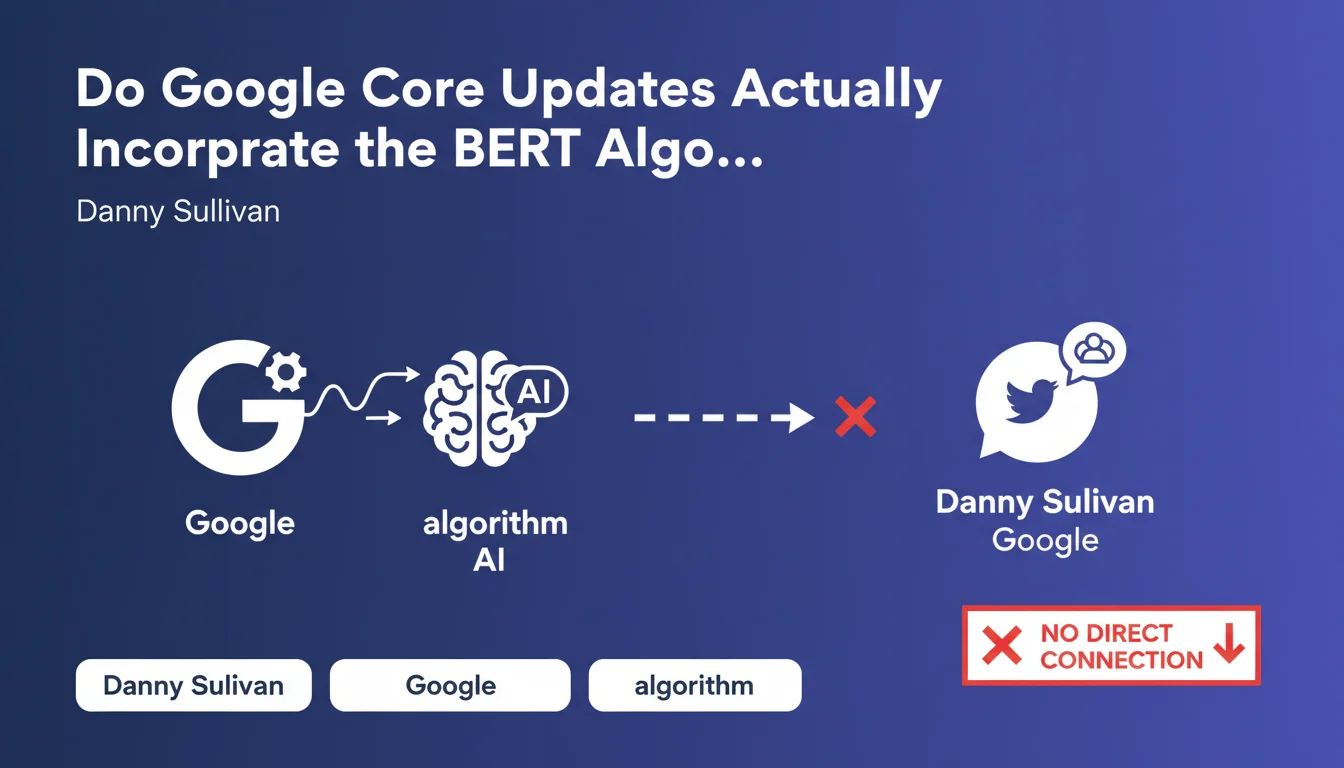
Official statement
What you need to understand
What's the Real Difference Between a Core Update and the BERT Algorithm?
It is essential to distinguish these two distinct components of Google's algorithm. A Core Update represents a global update to the ranking system, affecting numerous relevance signals simultaneously.
BERT (Bidirectional Encoder Representations from Transformers) is a specific natural language understanding technology. It helps Google better interpret complex queries and the context of words within content.
Why Does Google Specify That This Core Update Doesn't Use BERT?
This clarification from Danny Sullivan aims to avoid confusion within the SEO community. Too often, practitioners attempt to attribute ranking fluctuations to a single technology.
In reality, Core Updates are multifactorial and adjust the balance between hundreds of signals. BERT may be active in the background without necessarily being the primary cause of observed changes.
Could BERT Be Integrated Into Future Core Updates?
Google leaves the door open to this possibility. BERT improvements could theoretically influence future global updates.
This means that semantic content quality remains a strategic long-term investment, even if it doesn't explain immediate variations.
- Core Updates: global multi-signal updates to the ranking system
- BERT: specific natural language understanding technology
- Both systems operate independently but can coexist
- No direct link doesn't mean no possible future interaction
- Semantic optimization remains relevant in the long term
SEO Expert opinion
Is This Separation Between Core Updates and BERT Consistent With Real-World Observations?
My experience analyzing hundreds of websites confirms this distinction. Sites impacted by Core Updates generally present varied issues: domain authority, overall content quality, information architecture.
BERT adjustments, on the other hand, primarily affect complex long-tail queries and conversational questions. Fluctuation patterns are different and more targeted on specific traffic segments.
What Nuances Should We Apply to This Statement?
Even if a Core Update isn't directly related to BERT, this doesn't mean that semantic understanding is unimportant. Google uses multiple language processing systems simultaneously.
The boundary between different algorithms is becoming increasingly blurred and interconnected. Content optimized for contextual understanding will benefit from both BERT improvements and Core Updates focused on quality.
How Should We Interpret Google's Future Communications on This Topic?
Google communicates in a deliberately compartmentalized manner to avoid over-interpretation. When they announce a Core Update, they're talking about the global ranking system.
Evolutions of BERT or other technologies like MUM or Passage Ranking are generally announced separately. This taxonomy helps understand which dimension of your SEO strategy requires adjustments.
Practical impact and recommendations
What Content Strategy Should You Adopt Given This Distinction?
Don't try to optimize differently depending on whether you're targeting BERT or Core Updates. Both systems fundamentally reward the same thing: quality content that precisely answers search intent.
Favor a holistic and user-centric approach. Create content that covers topics in depth, uses natural and rich vocabulary, and structures information logically.
- Write content that answers complex search intents with precision
- Use a rich and natural semantic field rather than keyword repetition
- Structure your content with clear hierarchies (H1, H2, H3) to facilitate understanding
- Favor complete and contextualized sentences rather than telegraphic style
- Work on your overall topical authority rather than isolated pages
How Can You Monitor the Impact of Different Updates on Your Site?
Implement differentiated monitoring of your traffic segments. Observe performance separately on short generic queries versus long conversational queries.
During an announced Core Update, analyze global visibility fluctuations. For BERT, focus on traffic variations on specific questions and natural language expressions.
What Should You Concretely Do After a Core Update?
If your site is negatively impacted by a Core Update, conduct a comprehensive quality audit. Examine demonstrated expertise, domain authority, content freshness, and overall user experience.
Don't focus solely on semantic optimization. Core Updates evaluate the overall value of your site compared to your competitors on the same topics.
💬 Comments (0)
Be the first to comment.