
Official statement
What you need to understand
What is Google's official position on Core Updates?
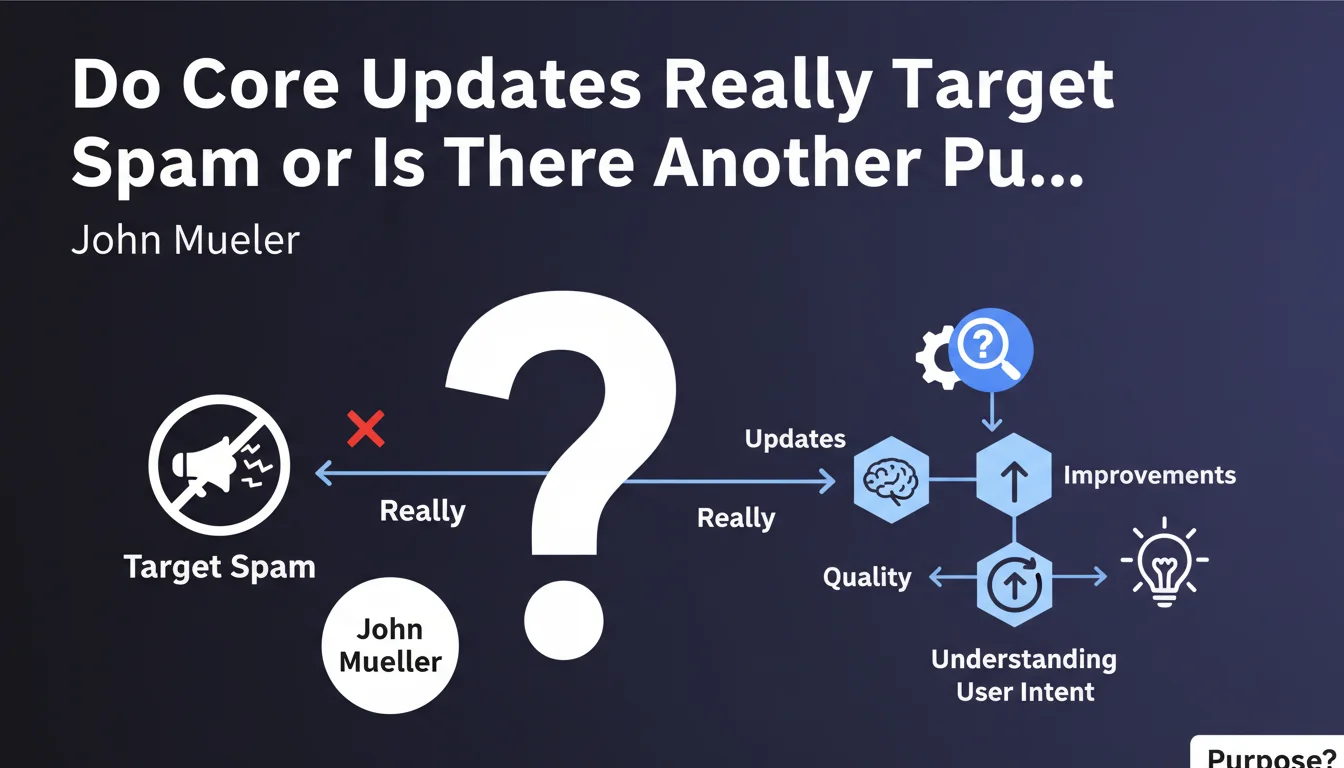
According to official statements, Core Updates are not primarily designed as anti-spam weapons. Their true mission is to improve the valorization of quality content in search results.
Google primarily seeks to refine its algorithms to better identify and reward content that provides real added value to users. The fight against spam remains the domain of other specific updates.
Why are spam sites still impacted by these updates anyway?
The effect on spam is indirect but real. By increasing the visibility of high-quality content, Google mechanically lowers the ranking of low-quality content, of which spam is naturally a part.
This is a logical consequence: if the best content rises, the worst content falls. Spam sites, which rarely produce quality content, therefore find themselves penalized without being directly targeted.
What's the difference between a Core Update and an anti-spam update?
Anti-spam updates target specific manipulative techniques: artificial links, automatically generated content, cloaking, etc. They sanction practices contrary to the guidelines.
Core Updates reassess the relevance and overall quality of content without targeting particular techniques. They adjust how the algorithm understands and rewards quality.
- Core Updates favor quality content rather than penalizing spam
- The impact on spam is an indirect consequence, not the main objective
- These updates affect all sites, not only those with questionable practices
- Content quality becomes the major differentiating criterion
SEO Expert opinion
Is this statement consistent with field observations?
In the field, the data confirms this nuanced vision. Core Updates do indeed affect many spam sites, but they also impact legitimate sites that suffer from content quality issues.
I've observed during recent updates that technically "clean" sites have lost traffic simply because their content had become less relevant or less comprehensive than that of their competitors. The opposite is true: sites with some technical weaknesses but exceptional content have progressed.
What nuances should be added to this communication?
Google's rhetoric deserves to be decoded. By stating that Core Updates don't target spam, Google positions itself on a positive rather than punitive approach. This is strategically more acceptable.
In practice, the effect remains similar: low-quality sites lose ground. The difference is philosophical: Google prefers to say it rewards quality rather than punishes mediocrity. For SEO professionals, the result is identical.
How should you interpret traffic fluctuations after a Core Update?
A drop after a Core Update doesn't necessarily mean your site is spam. It rather indicates that competitors now offer content judged more relevant by the algorithm.
Conversely, an increase doesn't validate all your SEO practices. It simply confirms that your content better meets Google's current quality criteria, which constantly evolve. Vigilance remains necessary to maintain these positions.
Practical impact and recommendations
What should you do concretely to prepare for Core Updates?
The absolute priority is to invest in the quality and depth of your content. Each page must provide real added value, fully answer users' questions and demonstrate genuine expertise.
Regularly audit your existing content. Identify superficial or outdated pages and enrich them or remove them. The quantity of pages doesn't take precedence over their individual quality.
Monitor user engagement signals: visit time, bounce rate, interactions. These metrics indicate whether your content truly satisfies visitors, which is what Google seeks to measure with its Core Updates.
What mistakes should you avoid to not be negatively impacted?
Avoid mass content production without real added value. A high volume of average pages performs less well than a reduced number of excellent and comprehensive content pieces.
Don't rely solely on technical optimization. Without quality content, even a perfect infrastructure won't protect you from fluctuations during Core Updates.
Be careful with automatically generated content or content that's too similar between pages. Google favors demonstrable originality and expertise. Duplication or generic content becomes a major handicap.
How can you verify that your site meets quality criteria?
Use Google's Quality Raters Guidelines as a reference framework. Evaluate your content according to E-E-A-T criteria: Experience, Expertise, Authoritativeness and Trustworthiness.
Seek external feedback. Have your pages tested by real users who don't know your sector. Their questions and misunderstandings reveal the weaknesses of your content.
- Audit all your content to identify pieces that lack depth
- Enrich or remove superficial pages that don't provide unique value
- Develop content based on real and verifiable expertise
- Monitor user engagement metrics (visit time, interactions)
- Compare your content with that of better-ranked competitors
- Implement a regular update schedule for existing content
- Document the expertise and experience of content authors
- Create original content that reflects hands-on knowledge
💬 Comments (0)
Be the first to comment.