
Official statement
Other statements from this video 43 ▾
- 2:22 What should you do if your site lost traffic after a Core Update without making any mistakes?
- 2:22 Are Core Web Vitals Really Going to Transform Your SEO Strategy?
- 3:50 Does a ranking drop after a Core Update really indicate an issue with your site?
- 3:50 Should You Really Wait Before Optimizing Core Web Vitals?
- 3:50 Why is Google delaying the complete transition to the Mobile-First Index?
- 7:07 Can Google really delay Mobile-First Indexing indefinitely?
- 11:00 Why doesn't Google canonicalize URLs with fragments in sitelinks and rich results?
- 11:00 Do URLs with fragments (#) in Search Console mean you need to rethink your tracking and analysis strategy?
- 14:34 Why do the numbers from Analytics, Search Console, and My Business never match?
- 14:35 Why do your Google metrics never align between Search Console, Analytics, and Business Profile?
- 16:37 How are FAQ clicks really counted in Search Console?
- 18:44 Are mobile and desktop accordions really neutral for SEO?
- 18:44 Is it true that mobile accordion hidden content is indexed as visible content?
- 29:45 Does the rel=canonical via HTTP header really still work?
- 30:09 Does the HTTP header rel=canonical really work to manage duplicate content?
- 31:00 Why does Search Console still show 'PC Googlebot' on recent sites when Mobile-First Index is supposed to be the standard?
- 31:02 Is it true that all sites indexed after July 2019 default to Mobile-First Indexing?
- 33:28 Why does Google emphasize textual context in Search Console feedback?
- 33:31 Are Search Console tools really enough to solve your indexing problems?
- 33:59 Why are your pages still not indexed after 60 days in Search Console?
- 37:24 What happens when Google occasionally indexes HTTP instead of HTTPS even after an SSL migration?
- 37:53 Is it really necessary to combine both 301 redirections AND canonical tags for an HTTPS migration?
- 39:16 What really causes your sitemap to fail in Search Console and how can you effectively resolve the issue?
- 41:29 Is your brand disappearing from the SERPs for no apparent reason: can Google feedback really fix it?
- 44:07 Should you choose a subdomain or a new domain for launching a service?
- 44:34 Subdomain or New Domain: What Does Google Really Think for SEO?
- 44:34 Do Google penalties really transfer between domains and subdomains?
- 45:27 Do Google penalties really spread between domains and subdomains?
- 48:24 Should you really overlook PageRank when deciding between a domain and a subdomain?
- 48:33 Do links between root domains and subdomains really pass PageRank?
- 49:58 Should you really be worried about duplicate content from scraping?
- 50:14 Can you relaunch an old domain without being penalized for duplicate content by spammers?
- 50:14 Should you really report every scraping URL via the Spam Report to prompt action from Google?
- 57:15 Is it really necessary to report spam URL by URL to assist Google?
- 58:57 Why does Google refuse to show your FAQs in rich results despite perfect markup?
- 59:54 Why doesn't Google display your FAQ rich results even with perfect markup?
- 65:15 Is it possible to add FAQs to your pages just to secure rich results in SEO?
- 65:45 Can you really add a FAQ just to get the rich result without risking penalties?
- 67:27 Should you still optimize rel=next/prev tags for pagination?
- 67:58 Should you really submit all paginated pages in the XML sitemap?
- 70:18 Should you really stop placing category pages in noindex?
- 72:04 Does the number of JavaScript files really slow down Google indexing?
- 72:24 Does Googlebot really render all JavaScript in a single pass?
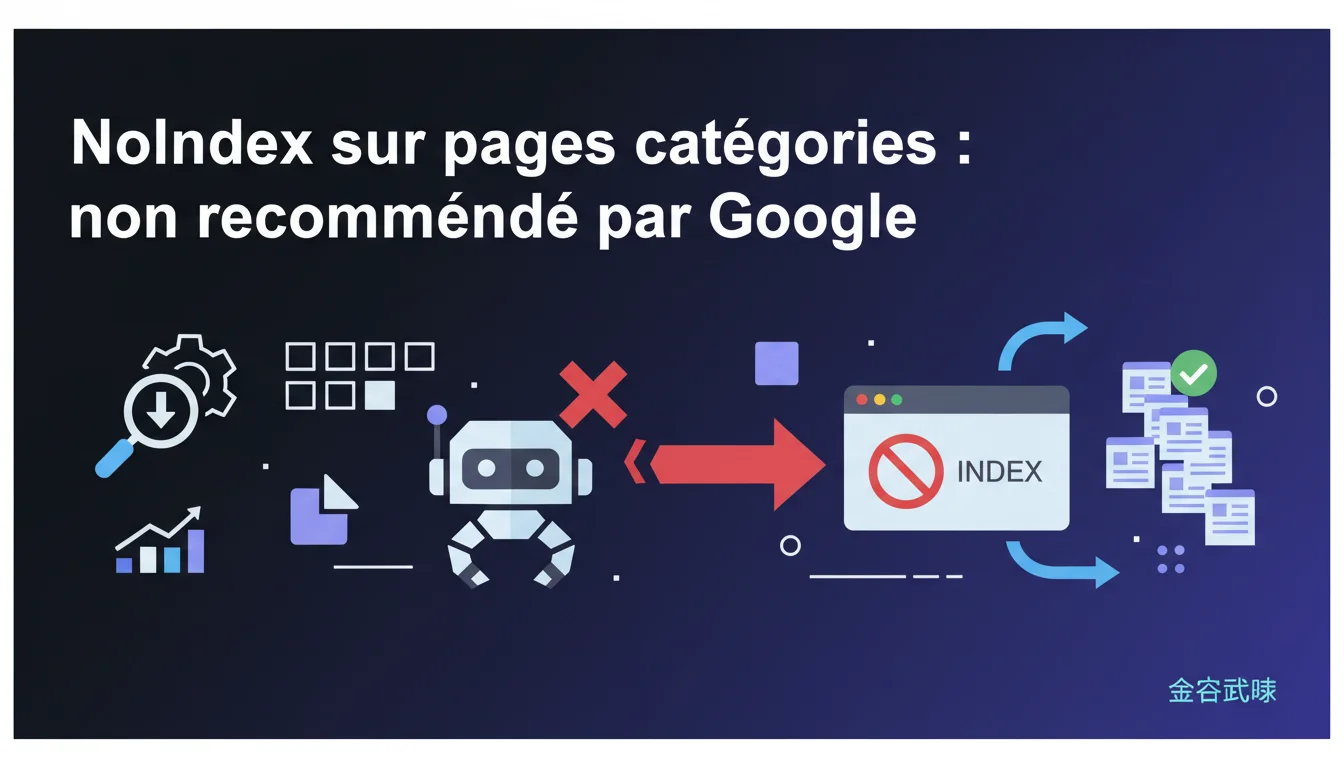
Google explicitly discourages the use of noindex on category or listing pages, even for crawl optimization. The reason given: the engine needs to crawl and index these pages to understand the overall architecture of the site and display the most relevant results. This position implies rethinking some crawl budget optimization strategies that previously advocated massive noindexing of less strategic facets and categories.
What you need to understand
Why does Google insist on indexing category pages?
The statement by 金谷武明 (Takeaki Kanaya), head of Search Relations at Google Japan, questions a common SEO practice: noindexing category or listing pages deemed less strategic to save crawl budget. Google claims it needs these pages to map the site’s architecture.
The engine uses category pages as semantic connection points between different sections. Without them indexed, the algorithm loses signals about how you organize your content, which can degrade the overall understanding of your site and, paradoxically, the visibility of your product or article pages.
Does this recommendation apply to all types of sites?
Google does not differentiate between a blog with 10 categories and a e-commerce site generating 50,000 facet URLs. This is where the advice becomes vague for practitioners facing real scale issues.
For a classic editorial site with a simple hierarchy (Home > Category > Article), the recommendation makes sense: category pages have a clear structural meaning. But for a site with combinatorial filters (brand + color + size + price), the blind indexing of all combinations can create massive duplicate content and dilute PageRank.
What is the real reason behind this directive?
Google wants to ensure that its crawlers have access to the entire internal link structure to effectively distribute PageRank and discover deep content. A noindexed page can still be crawled and follow its links, but Google prefers to index it to evaluate its contextual relevance.
This approach allows the engine to decide for itself which pages to display in the SERPs rather than relying on webmaster judgment. Let's be honest: Google wants to maintain control over indexing and limit manipulations through tactical noindexing.
- Google favors full indexing to understand the site's topology and semantic priorities
- Category pages serve as internal link hubs that distribute PageRank to final content
- Tactical noindexing on categories may deprive Google of significant contextual signals for ranking
- This directive does not distinguish between simple sites and complex platforms with millions of combinatorial URLs
- Google prefers to decide for itself which pages to index rather than follow the webmaster's noindex directives
SEO Expert opinion
Is this position consistent with real-world observations?
On editorial sites or medium-sized shops (a few thousand pages), full indexing of categories does indeed enhance content discoverability and semantic coherence. It is observed that Google uses these pages to display sitelinks and rich results.
However, on heavy e-commerce sites with multiple facets, this recommendation conflicts with reality: indexing tens of thousands of filter combinations generates massive duplicate content, dilutes crawl budget on low-value URLs, and creates cannibalization issues. [To verify] whether Google actually has the resources to intelligently index millions of facets without degrading index quality.
What nuances should be added to this directive?
Google's statement does not mention alternatives such as URL parameters declared in Search Console, canonical tags, or targeted robots.txt rules. An expert knows that it is possible to prevent indexing without blocking crawl through a combination of robots.txt + X-Robots-Tag.
Google deliberately confuses “not indexing” and “not crawling.” One can perfectly allow a page to be crawlable to transmit PageRank through its internal links, while noindexing it to prevent it from appearing in the SERPs and diluting the visibility of strategic pages. This nuance is absent from the official communication.
In what cases does this rule not apply?
Sites with automatically generated URLs (combinatorial filters, sorting by price/date/popularity, infinite pagination) must balance Google's directive and the actual health of their index. If you have 500 products but 100,000 facet URLs, indexing everything is like shooting yourself in the foot.
Likewise, empty, outdated, or under-construction category pages do not provide any positive signal to Google. Indexing them creates thin content and degrades the overall site assessment by the algorithm. In these cases, noindex remains the relevant tool, despite what the official communication states.
Practical impact and recommendations
What should you concretely do on an existing site?
Start with a complete indexing audit via Search Console and a crawler (Screaming Frog, Oncrawl, Botify). Identify all category pages currently noindexed and assess their potential organic traffic, their position in the architecture, and their unique content.
For editorial sites or reasonably sized shops (fewer than 10,000 total pages), remove noindex tags on main and secondary categories. Ensure that each category page has unique text content (introduction, description) and a coherent internal link structure to subcategories and final content.
What mistakes should you avoid when re-indexing categories?
Do not re-index in bulk without prior auditing. Empty, duplicated, or automatically generated content category pages will pollute your index and degrade the quality signals of the site. Google will crawl these pages, notice their low value, and reduce the overall crawl frequency.
Avoid also re-indexing combinatorial facets without a strategy for canonicals or URL parameters. If you have “red shoes size 42” and “shoes size 42 red” displaying the same content, Google will waste time crawling duplicates and your crawl budget will explode for no reason.
How can you check if the indexing strategy is optimal?
Use the Coverage and Crawl Statistics reports in Search Console to track the evolution of the indexed page volume and the consumed crawl budget. A sudden increase in the number of crawled pages without an improvement in organic traffic signals a an issue.
Compare the performances of indexed versus noindexed category pages over a test period of at least 3 months. Measure organic traffic, click-through rate, impressions, and conversions. If indexing the categories does not improve any KPI, it is not suited to your specific context.
- Audit the current state of category indexing through Search Console and a crawler
- Identify strategic categories with unique content and traffic potential
- Gradually remove noindex from main categories, measuring the impact over 3 months
- Use canonicals and URL parameters to manage combinatorial facets without noindexing
- Monitor the evolution of crawl budget and organic traffic via Search Console
- Avoid indexing empty, duplicated, or low-value pages
❓ Frequently Asked Questions
Peut-on bloquer le crawl des catégories sans les noindexer ?
Les canonical tags sont-ils une alternative au noindex sur les facettes ?
Faut-il indexer les pages de pagination des catégories ?
Comment gérer les catégories vides ou temporairement sans produits ?
L'indexation des catégories améliore-t-elle réellement le ranking des produits ?
🎥 From the same video 43
Other SEO insights extracted from this same Google Search Central video · duration 1h14 · published on 04/06/2020
🎥 Watch the full video on YouTube →
💬 Comments (0)
Be the first to comment.