
Official statement
Other statements from this video 5 ▾
- □ Faut-il vraiment supprimer l'ancien site après une migration SEO ?
- □ Combien de temps faut-il vraiment maintenir une redirection 301 après une migration ?
- □ Que faire quand une redirection est techniquement impossible lors d'un changement de domaine ?
- □ Faut-il vraiment supprimer un ancien site quand les redirections sont impossibles ?
- □ Peut-on migrer un site sans redirections sans risquer de pénalité Google ?
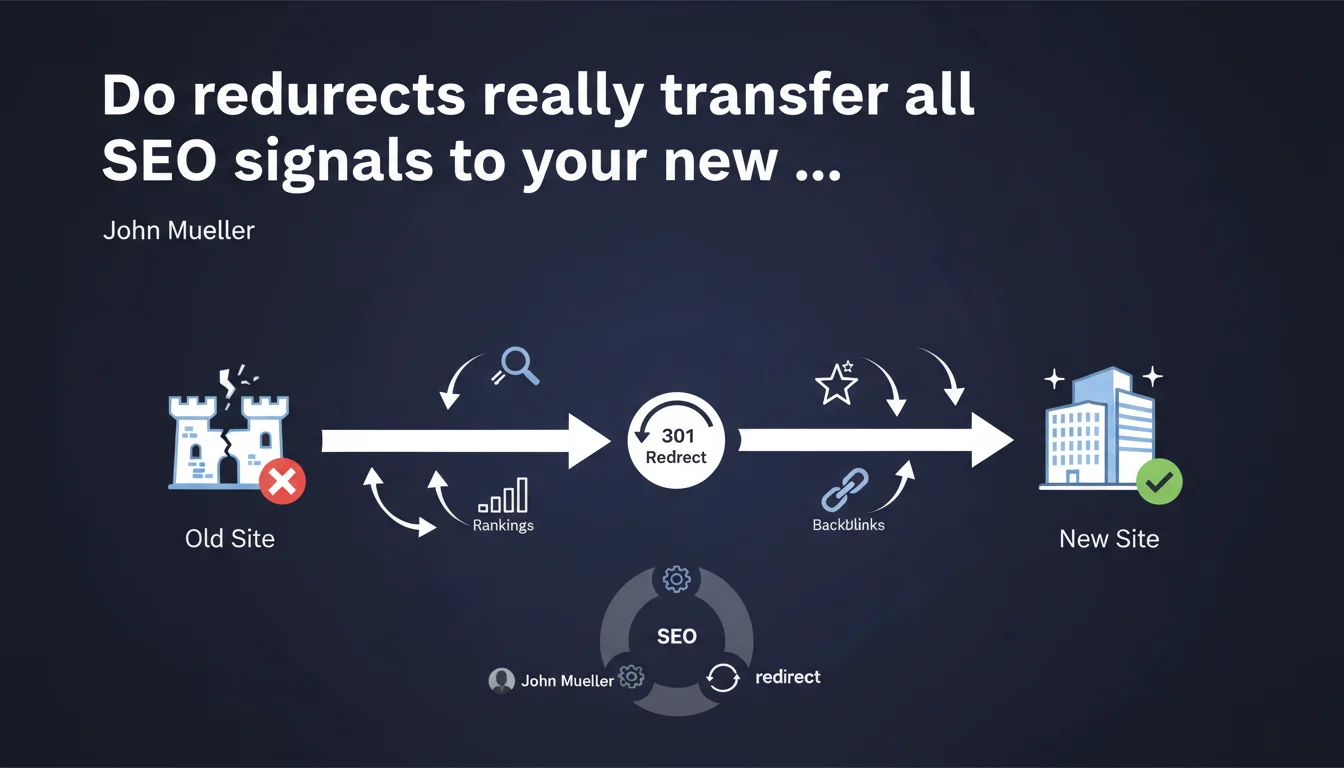
Google officially recommends redirecting the old site to the new one to transfer existing SEO signals. This practice improves the new site's rankings by preserving accumulated authority and history. However, signal transfer is neither instantaneous nor complete.
What you need to understand
Why does Google insist on the importance of redirects?
When a site migrates to a new architecture or domain, search engines must understand the mapping between old and new URLs. Without redirects, Google treats the new site as a separate entity with no history or authority.
301 or 308 redirects act as a signal transfer bridge: domain authority, link profile, behavioral data, and content freshness history. This continuity avoids starting from scratch and preserves acquired rankings.
Which SEO signals are affected by this transfer?
The term "signals" encompasses several dimensions. We're primarily talking about PageRank transmitted through backlinks, accumulated domain trust, and content quality metrics. Google consolidates these indicators toward the new URLs.
Behavioral signals — click-through rate, session duration, bounce rate — don't transfer directly, but recognition of editorial continuity helps preserve established reputation. Core Web Vitals and other technical metrics must be reworked on the new site.
Is signal transfer immediate and complete?
No, and it's a crucial point that Mueller doesn't clarify here. Transfer requires Googlebot to recrawl all old URLs, notice the redirects, and recalculate signal attribution. This process takes time — sometimes several weeks.
Moreover, no redirect transfers 100% of signals. Even with a perfectly configured 301, you typically observe marginal losses in the first weeks while Google reevaluates the contextual relevance of new pages.
- 301/308 redirects are the standard mechanism for signaling permanent moves
- Signal transfer includes link authority, domain trust, and content history
- The transfer process is neither instantaneous nor 100% complete
- Technical metrics (CWV, mobile-friendliness) must be optimized on the new site
- Without redirects, the new site starts from zero in terms of rankings
SEO Expert opinion
Does this recommendation match real-world observations?
Absolutely. Migrations without redirects systematically result in catastrophic organic traffic losses. We regularly observe drops of 60 to 90% that never fully recover. Redirects are not optional — they're the foundation of any successful migration.
However, Mueller remains vague about the actual transfer rate. In practice, a well-executed migration preserves between 85 and 95% of organic traffic at 6 months. The 5-15% loss comes from multiple friction points: recrawl time, marginal PageRank loss, mismatch between old and new pages.
What nuances does Google omit from this statement?
First point: not all redirects are equal. A 1:1 redirect to an equivalent page transfers much better than a redirect to the homepage or a generic category. Google evaluates thematic coherence and penalizes "catch-all" redirects.
Second point: timing matters. If you leave redirects active for a few weeks then remove them, the transfer aborts. Google recommends maintaining redirects for at least 1 year, ideally indefinitely for URLs with active backlinks. [To verify]: no official communication specifies the exact minimum duration.
Third point: redirect chains dilute transfer. If A redirects to B which redirects to C, each hop slightly degrades transmission. Absolutely avoid chains beyond 2 levels.
In which cases does this rule not work as expected?
Redirects fail when semantic correspondence is broken. If you redirect a detailed product page to a generic category, Google may partially or entirely ignore signal transfer. Contextual relevance takes priority.
Another problematic scenario: domain migrations between radically different sectors. If you redirect an old e-commerce site to a personal blog, Google may interpret this as an attempted manipulation and downgrade the transfer. Thematic coherence remains an implicit but real criterion.
Practical impact and recommendations
How to correctly configure redirects to maximize transfer?
First step: exhaustively map all URLs from the old site. Use server logs, Google Search Console, and your crawl tool to identify every indexed URL or URL that received traffic in the past 12 months.
Second step: create a 1:1 mapping between old and new URLs. Each old page should redirect to the thematically and structurally closest equivalent. If a page has no equivalent, redirect to the most relevant parent category, never to the homepage.
Third step: implement 301 (or 308 for POST methods) redirects. 302s signal temporary moves and block signal transfer. Verify implementation with tools like Screaming Frog or Oncrawl to detect configuration errors.
What critical errors must you absolutely avoid?
First error: massively redirecting to the homepage. Google detects this pattern as a disguised soft 404 and may refuse signal transfer. Each redirect must have individual logic.
Second error: implementing redirects after the new site goes live. The delay between old site deindexing and new site recognition creates a SEO black hole. Redirects must be active from the very first second of migration.
Third error: neglecting redirects for non-HTML resources (PDFs, images, videos). If these files have backlinks or generate direct traffic, their redirect contributes to overall transfer. A comprehensive redirect plan covers all resource types.
How to monitor signal transfer effectiveness?
Monitor Google Search Console for 404 errors post-migration. A sudden spike signals missing or broken redirects. Correct each identified error immediately.
Analyze organic traffic evolution by segment (branded vs non-branded, key pages vs long tail). A localized drop indicates a redirect or equivalence problem for certain sections. Tools like Google Analytics 4 and rank tracking platforms enable granular monitoring.
Check recrawl speed in server logs. If Googlebot doesn't actively recrawl old redirected URLs, transfer stalls. Submitting an XML sitemap of the old site with new URLs can accelerate the process.
- Create a complete old site → new site mapping with 1:1 correspondences
- Implement 301 redirects (not 302) for each URL
- Activate redirects before or simultaneously with new site launch
- Avoid redirect chains (A→B→C) — always target A→C directly
- Maintain redirects active for at least 12 months, ideally indefinitely
- Monitor Google Search Console for 404s post-migration
- Analyze organic traffic evolution segment by segment
- Check recrawl speed in server logs
A successful migration relies on an exhaustive and precise redirect plan. SEO signal transfer is neither automatic nor complete — it requires continuous monitoring and post-migration adjustments to bridge gaps.
These operations demand pointed technical expertise and constant vigilance. Many businesses underestimate migration complexity and end up with traffic losses that are difficult to recover. Working with a specialized SEO agency can make all the difference: pre-migration audit, custom redirect plan, post-migration monitoring, and rapid corrective optimizations. The investment in professional support pays for itself quickly when you avoid mistakes that cost months of recovery.
❓ Frequently Asked Questions
Les redirections 302 transfèrent-elles des signaux SEO comme les 301 ?
Combien de temps faut-il maintenir les redirections actives après une migration ?
Peut-on rediriger plusieurs anciennes pages vers une seule nouvelle page ?
Les redirections JavaScript transfèrent-elles les signaux SEO ?
Que faire si une ancienne page n'a pas d'équivalent direct sur le nouveau site ?
🎥 From the same video 5
Other SEO insights extracted from this same Google Search Central video · published on 16/01/2024
🎥 Watch the full video on YouTube →
💬 Comments (0)
Be the first to comment.