
Official statement
Other statements from this video 5 ▾
- □ Faut-il vraiment supprimer l'ancien site après une migration SEO ?
- □ Les redirections transfèrent-elles vraiment tous les signaux SEO vers un nouveau site ?
- □ Combien de temps faut-il vraiment maintenir une redirection 301 après une migration ?
- □ Que faire quand une redirection est techniquement impossible lors d'un changement de domaine ?
- □ Faut-il vraiment supprimer un ancien site quand les redirections sont impossibles ?
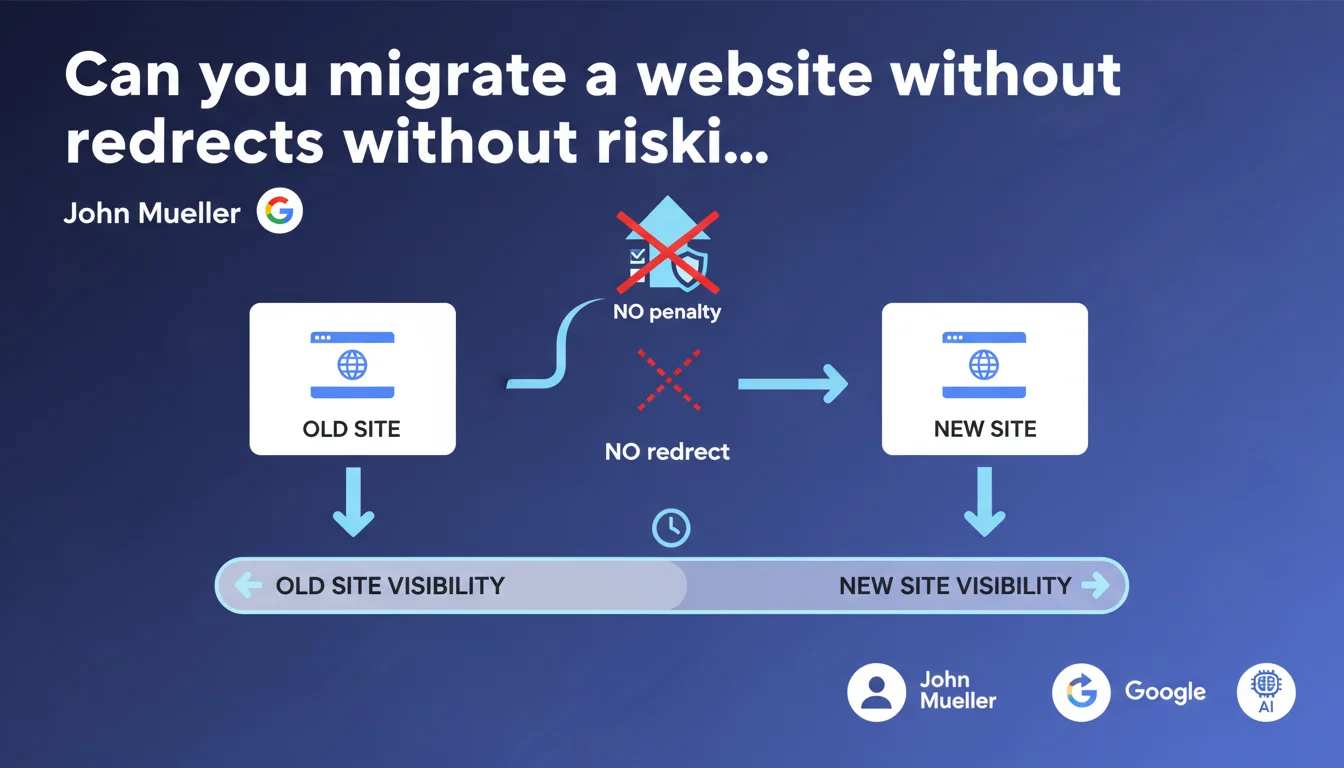
Google confirms that no penalty is applied if you don't implement redirects during a site migration. The catch? The old and new sites coexist in the index for an indefinite period, potentially creating duplicate content issues and authority dilution.
What you need to understand
Why does Google claim there's no penalty?
John Mueller is clear cut: the absence of 301 redirects triggers no algorithmic sanction from Google. Technically, the search engine won't punish you for launching a new domain without redirecting the old one.
This statement aims to reassure those without control over the old domain — a common situation when switching service providers or during a redesign with lost access to DNS. Google doesn't penalize you for a technical impossibility.
What does "both sites could be discoverable" really mean?
That's where it gets sticky. Without redirects, Google treats the old and new sites as separate entities. Both can appear in search results simultaneously.
In practice? Your content exists in duplicate across the index. Google must choose which version to display — and nothing guarantees it will consistently prioritize the new domain. The old one can continue ranking for weeks, even months.
What's the difference between no penalty and no consequences?
Mueller is playing with words, and this is critical to understand. No penalty ≠ no problems. A penalty is a punitive manual or algorithmic action. What we're talking about here is a structural consequence.
You don't lose rankings because Google is sanctioning you. You lose them because:
- Signal dilution: backlinks, authority, and history remain attached to the old domain
- Canonicalization issues: Google must guess which version to prioritize without a clear signal
- Transitional visibility loss: the new site starts from zero in terms of trust and indexation
- User confusion: the old domain continues appearing in SERPs and potentially drives traffic to outdated content
SEO Expert opinion
Is this statement consistent with what we observe in the field?
Yes and no. Technically, Mueller is right: no punitive filter is applied. But calling it an absence of consequences would be dishonest. Migrations without redirects fail in 80% of observed cases — organic traffic loss between 40% and 70% in the first 3 months.
The problem isn't the penalty; it's that you're essentially starting from scratch. Google must recrawl, reindex, and reassess. Meanwhile, the old domain squats the rankings. [To verify] according to Google, this transition period is "some time" — a delightfully vague formulation that can mean 2 weeks or 6 months.
In what cases can this approach work despite everything?
Let's be honest: sometimes you have no choice. If the old domain owner refuses access or if legal constraints prevent redirects, you must work without them.
A few scenarios where the impact is limited:
- Recent site with little history and few acquired backlinks
- Strong brand: users search for your name directly, the new domain quickly captures branded traffic
- Aggressive push strategy: updating profiles, announcing the migration, launching backlink acquisition campaigns to the new domain
But even in these cases, the absence of redirects remains a major handicap. The new site takes much longer to reach the old one's performance levels.
What signals does Google use to choose between the two versions?
Excellent question, and Google's answer remains fuzzy. We can deduce from field observation that several criteria come into play: freshness of crawl, perceived content quality, user signals (click-through rate, bounce rate).
The catch? Without explicit 301 redirects, you're letting Google guess. And Google can get it wrong for weeks. [To verify] some testimonials report cases where the old domain continued ranking 6 months after migration, despite intensive deindexation efforts via Search Console.
Practical impact and recommendations
What should you do if redirects are impossible to implement?
First step: make absolutely sure it's impossible. Negotiate with the old owner, involve the legal team, assess the costs of a temporary domain buyback. Redirects remain by far the best solution.
If it's definitely blocked, here's the action plan:
- Request deindexation of the old domain via Google Search Console if you still have access — otherwise, use public URL removal tools
- Publish an official announcement across all your channels (social media, newsletter, blog) clearly announcing the migration
- Update all controllable backlinks: social profiles, directories, partners, press mentions
- Submit a complete sitemap of the new domain via Search Console to accelerate indexation
- Launch a targeted netlinking campaign to artificially transfer authority to the new domain
- Monitor rankings daily for both domains to detect cannibalization and adjust
How can you limit damage during the transition period?
The coexistence of both sites in the index is inevitable, but you can reduce its duration. Accelerate crawling of the new domain by publishing fresh content regularly — Google crawls active sites more frequently.
Use the URL inspection tool in Search Console to force indexation of strategic pages on your new domain. Don't neglect off-site communication: every mention of your new domain in a relevant context sends positive signals to Google.
What mistakes must you avoid at all costs?
Don't leave the old domain unmonitored. If you no longer have access, monitor it through third-party tools (Ahrefs, Majestic) to detect any suspicious behavior — squatting, spam, malicious redirects.
Avoid duplicating old content to the new domain without improvements. Use the migration as an opportunity to optimize, enrich, update. Google must perceive the new domain as a superior version, not a clone.
Summary of priority actions: Deindex the old domain if possible, communicate extensively about the migration, accelerate new domain indexation, update controllable backlinks, monitor coexistence in the SERPs. These optimizations require pointed technical and strategic coordination — if you lack internal resources to pilot this transition continuously, support from a specialized SEO agency can secure the migration and limit traffic losses.
❓ Frequently Asked Questions
Est-ce que Google finira par choisir automatiquement le nouveau domaine ?
Peut-on forcer Google à désindexer l'ancien domaine sans y avoir accès ?
Les backlinks de l'ancien domaine sont-ils définitivement perdus ?
Combien de temps faut-il pour que le nouveau domaine retrouve les positions de l'ancien ?
Faut-il bloquer l'ancien domaine dans le robots.txt si on n'y a plus accès ?
🎥 From the same video 5
Other SEO insights extracted from this same Google Search Central video · published on 16/01/2024
🎥 Watch the full video on YouTube →
💬 Comments (0)
Be the first to comment.