
Official statement
What you need to understand
What Did Google Just Clarify About Author Signatures?
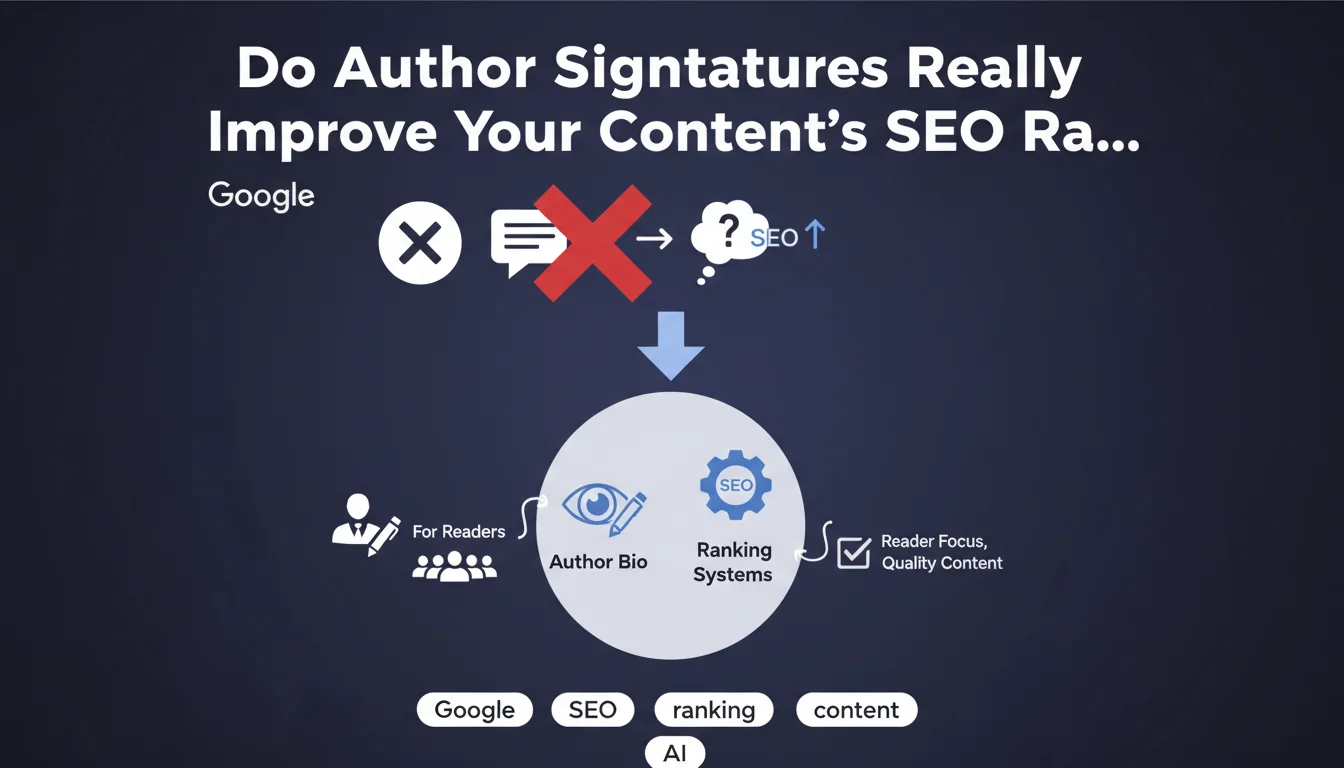
Google recently debunked a widespread belief in the SEO community: author signatures or bios are not a direct ranking factor. This clarification follows an influential publication that suggested otherwise.
According to Google Search Liaison, these elements are intended for readers, not the algorithm. However, sites that use them often display other quality characteristics that ranking systems do indeed value.
Why Does This Confusion Exist in the SEO Industry?
The confusion stems from an observed correlation without causal relationship. Well-ranked sites often display detailed author signatures, but that's not what causes their good positioning.
In reality, these sites generally apply a comprehensive editorial quality approach that includes transparency, demonstrated expertise, and in-depth content. It's this complete approach that Google values, not simply the presence of a bio.
What's the Difference Between Correlation and a Ranking Factor?
A ranking factor directly influences a page's position in search results. A correlation is simply an observation: two elements appear together without a cause-and-effect relationship.
Author signatures fall under correlation. They often accompany quality content, but their presence alone guarantees no direct SEO benefit.
- Author signatures are not a direct ranking factor according to Google
- They address readers to establish credibility and transparency
- Sites that use them often present other quality signals valued by Google
- Google does not use these descriptions to evaluate an author's expertise
- The confusion comes from a correlation misinterpreted as causality
SEO Expert opinion
Is This Statement Consistent With What We Observe in Practice?
Absolutely. Since the removal of Google Authorship in 2014, no technical element allows Google to directly exploit author signatures. There is no longer any specific markup or automated recognition.
Tests conducted on thousands of pages confirm that adding or removing a signature does not impact rankings. On the other hand, sites demonstrating real expertise through their content perform better, whether or not they display biographies.
What Important Nuances Should Be Added to This Statement?
The essential nuance concerns the concept of E-E-A-T (Experience, Expertise, Authoritativeness, Trustworthiness). Signatures contribute indirectly to trust and transparency, criteria evaluated by Google through other signals.
In certain sectors like health or finance (YMYL), author credibility matters enormously to users. Google can detect this credibility through external mentions, citations, authoritative backlinks, or professional recognition.
How Does Google Really Evaluate Author Expertise?
Google uses external and behavioral signals rather than self-proclaimed declarations. This includes: mentions of the author on other authoritative sites, backlinks to their content, academic or professional citations, and user engagement.
The intrinsic quality of content remains the primary signal. An article demonstrating a deep understanding of the subject, with original data, relevant analysis, and clear structure, signals expertise much more effectively than a biography.
Practical impact and recommendations
What Should You Actually Do With Author Signatures?
Continue using complete and authentic author signatures, but for the right reasons: to reassure your readers, establish your credibility, and respect editorial transparency principles.
Focus your SEO efforts on elements that have a direct measurable impact: content depth, keyword research, information architecture, user experience, and acquiring quality backlinks.
How Can You Really Demonstrate Expertise in Google's Eyes?
Produce content that proves your expertise rather than simply claiming it. Include original data, detailed case studies, in-depth analysis, and unique insights based on your experience.
Develop your author presence across the web: profiles on recognized professional platforms, contributions to reference publications, conference presentations, and citations by other domain experts.
- Maintain author signatures for transparency, but don't rely on them for SEO
- Invest in creating content that demonstrates real and deep expertise
- Build your authors' authority through external mentions and backlinks
- Prioritize intrinsic content quality over cosmetic elements
- In YMYL sectors, document your authors' real qualifications
- Track user engagement metrics as indicators of perceived quality
- Don't rely on correlations without understanding causality mechanisms
💬 Comments (0)
Be the first to comment.