
Official statement
What you need to understand
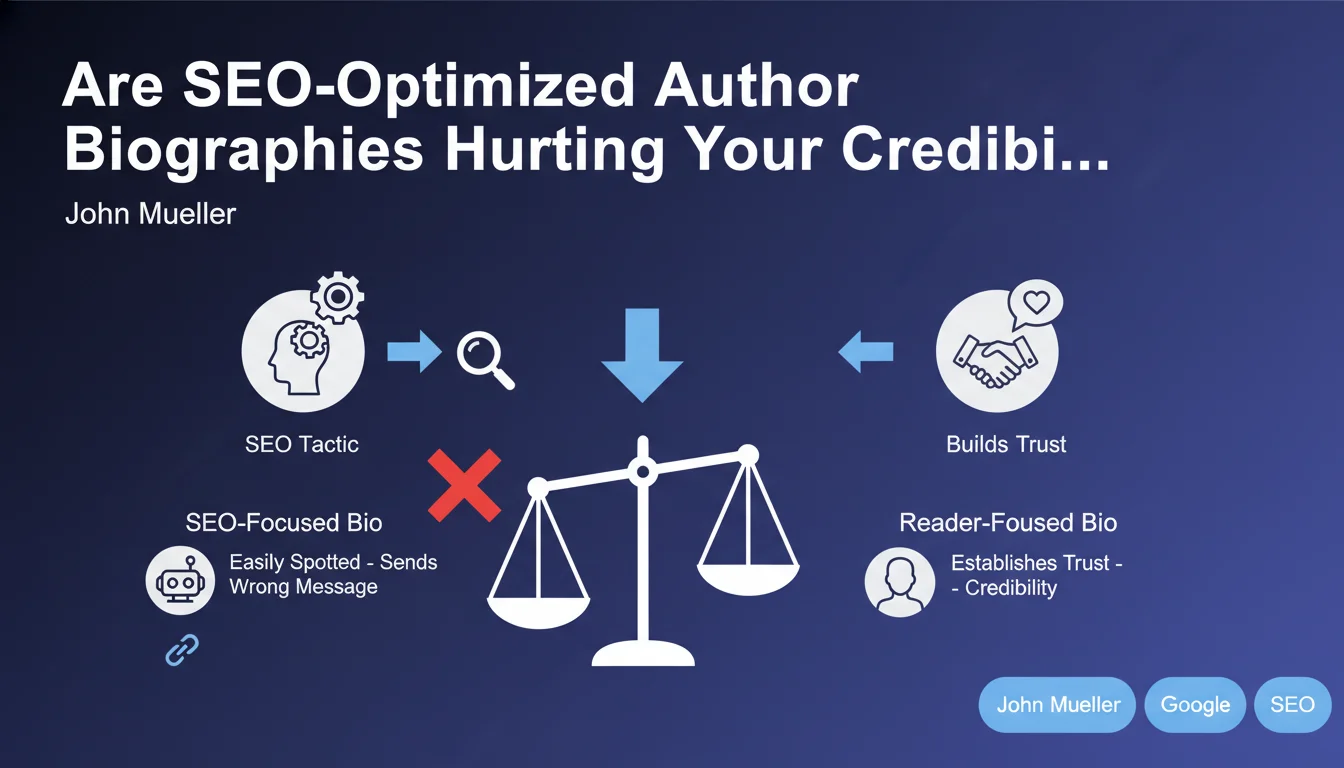
Google is warning against a widespread practice: creating author biographies designed primarily to improve search rankings rather than to inform readers. This statement aligns with the logic of valuing expertise and authenticity promoted by the E-E-A-T criteria (Experience, Expertise, Authoritativeness, Trustworthiness).
The message is clear: biographies stuffed with keywords, strategic internal links, or information of little relevance to the reader are easily identifiable. They create a breach of trust with the audience and can send negative signals to Google about the overall content quality.
The main issue concerns sites that publish editorial content, particularly in YMYL (Your Money Your Life) sectors such as health, finance, or legal. In these areas, author authenticity is an important ranking factor.
- Biographies should serve to establish the author's legitimacy, not to manipulate algorithms
- Readers quickly detect artificial or over-optimized biographies
- This approach aligns with the E-E-A-T criteria valued by Google
- Authenticity takes precedence over technical optimization in this context
SEO Expert opinion
This position from Google is perfectly consistent with the algorithm's evolution toward valuing authentic content and real expertise. In my audits, I regularly observe that sites with authentic and detailed biographies perform better on competitive queries, particularly in YMYL.
However, there is an important nuance to add: a biography can be both authentic AND optimized. The problem arises when optimization becomes the primary objective. Naturally including links to the author's professional networks, mentioning their real qualifications or publications remains relevant if it provides value to the reader.
In less sensitive sectors (e-commerce for non-YMYL products, lifestyle blogs), the impact is probably less critical. Nevertheless, building a genuine trust relationship with your audience always remains a profitable long-term investment.
Practical impact and recommendations
- Audit your existing author biographies: identify those that seem artificial or stuffed with keywords without real value for the reader
- Rewrite biographies by prioritizing authenticity: highlight genuine qualifications, experiences, and achievements relevant to your topic
- Add proofs of legitimacy: links to external publications, verifiable degrees, professional profiles (LinkedIn, institutional websites)
- Remove keyword stuffing: adopt a natural and conversational tone rather than a list of optimized skills
- Differentiate according to context: invest more in biographies for YMYL content where expertise is critical
- Implement Schema.org Author markup appropriately without over-optimization
- Include an authentic professional photo: this reinforces the author's human credibility
- Avoid duplicated generic biographies: personalize each author profile if you have several
In summary: Always prioritize the human element and transparency in your author biographies. The goal is to reassure the reader about the legitimacy of the person behind the content, not to manipulate algorithms.
Redesigning your author pages according to these authenticity criteria often requires a thorough strategic analysis of your editorial architecture and a deep understanding of the E-E-A-T signals valued by Google. This optimization is part of an overall quality approach that can prove complex to orchestrate internally. Working with a specialized SEO agency can allow you to benefit from a personalized diagnosis and methodological support to transform your author pages into genuine credibility assets, while preserving your internal resources for your core business.
💬 Comments (0)
Be the first to comment.