
Official statement
Other statements from this video 5 ▾
- □ Faut-il vraiment supprimer l'ancien site après une migration SEO ?
- □ Les redirections transfèrent-elles vraiment tous les signaux SEO vers un nouveau site ?
- □ Que faire quand une redirection est techniquement impossible lors d'un changement de domaine ?
- □ Faut-il vraiment supprimer un ancien site quand les redirections sont impossibles ?
- □ Peut-on migrer un site sans redirections sans risquer de pénalité Google ?
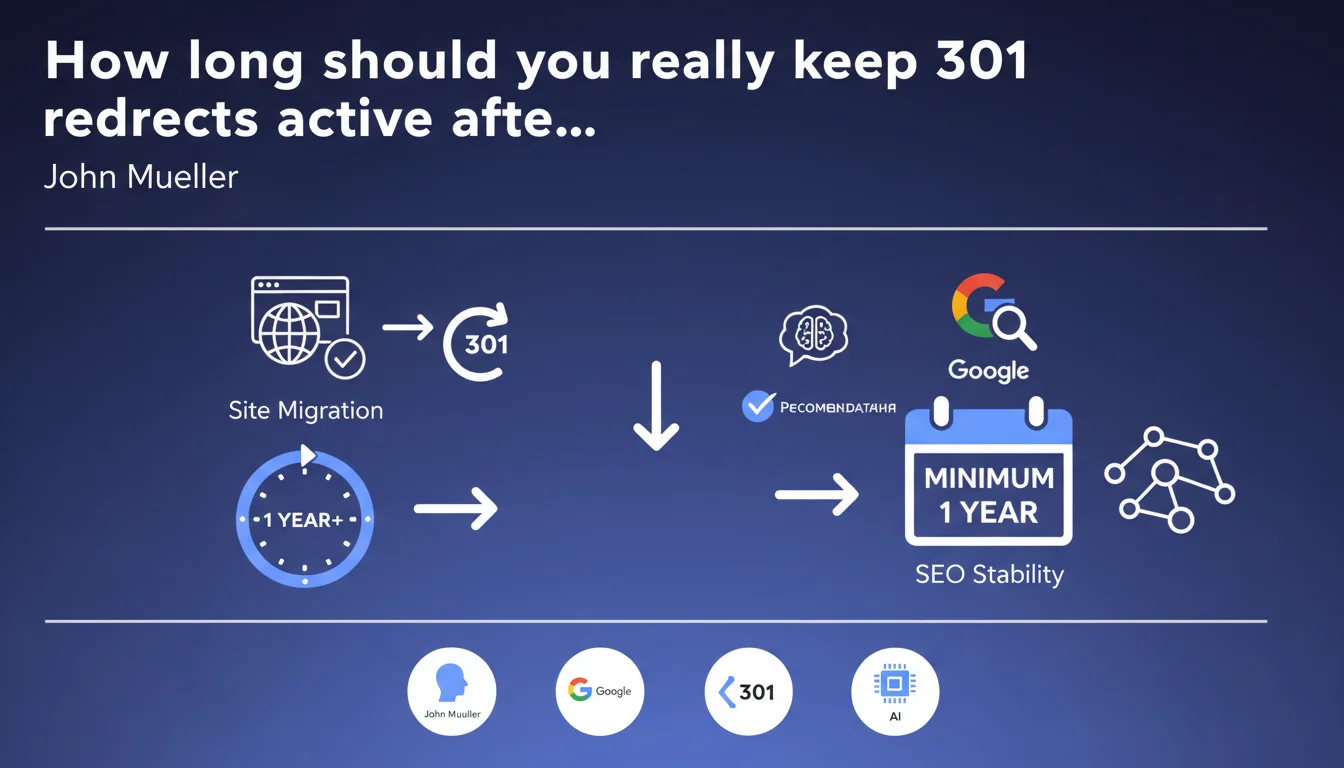
Google officially recommends keeping your 301 redirects in place for at least one year following a site migration. This timeframe allows the search engine to consolidate ranking signals (backlinks, crawl history) toward the new URLs. Beyond that period, redirects can theoretically be removed — but real-world reality is more nuanced.
What you need to understand
Why does Google impose a minimum one-year timeline?
When you migrate a site, each redirected URL carries with it ranking signals: domain authority, backlink anchor text, crawl history, behavioral data. Google needs time to recalculate and consolidate these signals toward the new URLs.
The one-year timeline isn't arbitrary. It corresponds to the complete recrawl cycle of an average site, including infrequently visited pages. Removing redirects too early is like cutting bridges before Google finishes transferring value — you then lose part of the SEO equity you've accumulated.
What actually happens during this period?
In the first few weeks, Google discovers the redirects and begins transferring signals. Backlinks pointing to old URLs gradually pass their juice to the new ones. This process isn't instantaneous — some external links take months to be recrawled.
Between 6 and 12 months, the majority of the transfer is completed. However, certain rarely visited URLs or those buried deep in the site structure may require more time. This is why the prudent recommendation is to wait at least 12 months before considering anything else.
Does this rule apply to all types of redirects?
Google is specifically referring to permanent 301 redirects. For temporary redirects (302, 307), the behavior differs: Google doesn't transfer signals the same way, since it considers the old URL may return.
The recommendation primarily concerns site migrations (domain changes, redesigns with URL modifications). For a simple page removal with redirect to a similar page, the timeline can be more flexible — though Google remains vague on this point.
- Minimum recommended duration: 12 months after complete migration
- Signal transfer: progressive, can take 6 to 12 months depending on site size
- Redirect type: 301 permanent, not 302 or 307 temporary
- Context: domain migrations or redesigns with URL changes
- Risk: loss of SEO equity if redirects are removed prematurely
SEO Expert opinion
Does this recommendation reflect real-world reality?
Yes and no. On average-sized sites (thousands of pages, standard backlink profile), the one-year timeline holds up fairly well. We observe ranking stabilization between 8 and 12 months post-migration — provided the redirect is clean and the new URLs have been actively crawled.
However, on large sites (hundreds of thousands of pages, massive backlink profiles), the transfer can take longer. Some URLs buried deep or linked from rarely-crawled sites may take 18 months or more to fully transfer their signals. [Needs verification]: Google provides no metrics to measure transfer progress — you're navigating blind.
After 12 months: can you really remove the redirects?
Technically, yes. In practice, it's rarely a good idea. Even after a year, some external backlinks continue pointing to the old URLs. If you remove the redirects, these links return 404 errors — you permanently lose their value.
Moreover, Google may cache or store references to old URLs for years. Removing redirects means cutting a safety net with no tangible gain. The only case where it makes sense: a site with thousands of redirects that slow down the server (rare, but it happens).
What nuances doesn't Google mention?
Mueller remains vague on several critical points. First, no guidance on how to measure whether the transfer is complete. You must rely on rankings, traffic, and Search Console — but these metrics don't directly show the state of signal transfer.
Second, the recommendation doesn't distinguish between partial migrations (some sections) and full migrations (entire site). Yet the impact isn't the same. Third, nothing about redirect chains: if you migrate twice within two years, how long should you maintain the first redirect? Google doesn't say. [Needs verification] through specific real-world testing.
Practical impact and recommendations
What should you do concretely during a migration?
Before anything else, map your redirects exhaustively. Each old URL should point to the most relevant new URL — never to the homepage by default. Use server-side 301 redirects (Apache, Nginx), never JavaScript or meta refresh.
Monitor Search Console to catch crawl errors post-migration. 404s or redirect loops signal mapping problems. Fix them immediately — every day Google encounters an error delays signal transfer.
How do you verify the transfer is going smoothly?
Compare rankings before/after on your strategic keywords. A temporary drop (2-4 weeks) is normal. If it persists beyond 6 weeks, dig deeper: redirect problem, degraded content, or incorrect canonicalization.
Use a crawler (Screaming Frog, Botify) to verify all your redirects are in place and returning a 301 code. Also check there are no chains (A → B → C): Google follows redirects, but each hop slightly dilutes juice transfer.
What mistakes should you avoid at all costs?
Never remove redirects before 12 months, even if rankings seem stable after 3 months. The transfer continues in the background. Don't redirect hundreds of URLs to a single generic page — Google detects this practice and may ignore the redirects.
Also avoid modifying new URLs during the transition period. If you redesign again within 12 months, you fragment signals and complicate Google's work. Let the transfer time complete.
- Maintain 301 redirects for at least 12 months after migration
- Map each old URL to a relevant new URL (1:1 if possible)
- Use server redirects (301), never JavaScript or meta refresh
- Monitor Search Console to detect crawl errors post-migration
- Verify absence of redirect chains (A → B → C)
- Crawl the site 1 month after migration to validate redirects
- Don't remove redirects before complete ranking stabilization
- Consider maintaining indefinitely redirects for sites with strong history
- Measure organic traffic and keyword ranking changes over time
❓ Frequently Asked Questions
Peut-on retirer les redirections après un an si les rankings sont stables ?
Que se passe-t-il si je retire les redirections avant 12 mois ?
Les redirections 302 temporaires suivent-elles la même règle ?
Comment savoir si le transfert des signaux est complet ?
Faut-il maintenir les redirections pour un simple changement de quelques URLs ?
🎥 From the same video 5
Other SEO insights extracted from this same Google Search Central video · published on 16/01/2024
🎥 Watch the full video on YouTube →
💬 Comments (0)
Be the first to comment.