
Official statement
Other statements from this video 5 ▾
- □ Does Google really ignore detectable SEO manipulation without penalizing your entire site?
- □ How can you lift a Google manual penalty without wasting months of your time?
- □ Does Google really tolerate unintentional SEO errors?
- □ Can a single SEO mistake permanently tank your Google rankings?
- □ Does Google really overlook poor SEO practices if your site has quality content elsewhere?
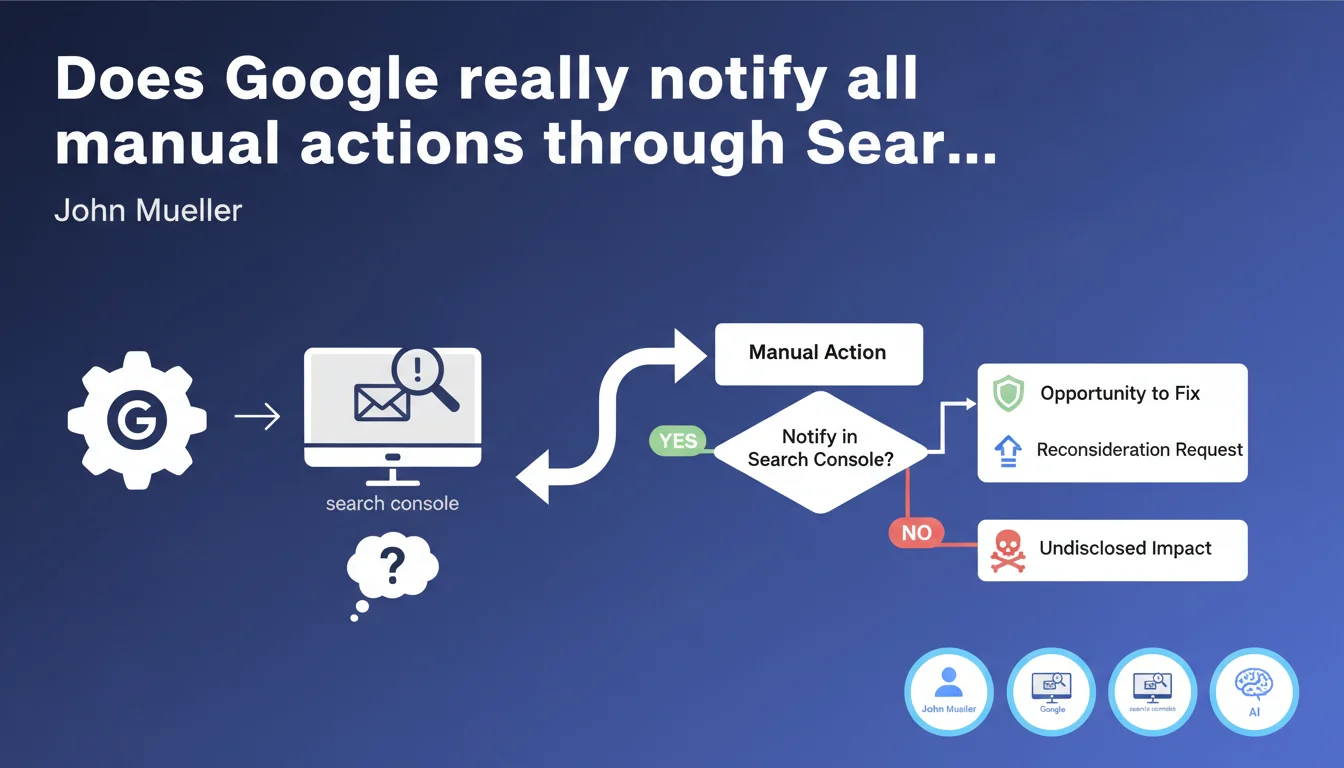
Google claims to systematically notify site owners via Search Console when a manual action is applied, allowing them to fix the issue and submit a reconsideration request. This claimed transparency contrasts with certain real-world situations where unexplained traffic drops occur without official notification.
What you need to understand
What exactly is a manual action?
A manual action occurs when a member of Google's team manually reviews your site and finds a violation of their guidelines. Unlike algorithmic penalties (Penguin, Panda, etc.) which apply automatically, a manual action results from human review.
Common reasons include artificial links, low-quality content, automatically generated spam, cloaking, or manipulation techniques. The notification appears in the "Manual actions" section of Search Console with the type of violation detected.
Why does Google communicate about these notifications?
This statement addresses a recurring question: how do I know if my site is penalized? Google positions itself as transparent about manual actions, unlike algorithmic adjustments which generate no alerts.
The stated goal is to give webmasters the opportunity to fix problems rather than permanently sanction them. The reconsideration process is supposed to be fair and accessible, but its effectiveness depends on the quality of the corrections made.
What's the difference from algorithmic filters?
Here's the crucial point: a traffic drop doesn't automatically mean a manual action. Algorithmic filters (algorithm update, relevance change, silent demotion) trigger no notification.
A site can lose 70% of its traffic without ever receiving a message in Search Console. That's where diagnosis becomes complex — distinguishing a manual action from an algorithmic adjustment requires in-depth analysis of signals.
- Manual action: notification visible in Search Console, reason clearly stated, reconsideration procedure available
- Algorithmic filter: no notification, diagnosis by elimination, recovery dependent on structural corrections
- Reconsideration process: available only for manual actions, variable timeframe (a few days to several weeks)
- Limited transparency: Google doesn't detail all problematic links or content, the webmaster must identify the scope of the problem
SEO Expert opinion
Is this transparency as systematic as claimed?
On paper, the statement is clear. In practice, certain grey areas persist. Sites experience sudden drops without any manual action visible in Search Console, fueling speculation about possible "silent penalties."
Let's be honest: Google probably distinguishes several levels of sanctions. Formal manual actions are indeed notified, but quality adjustments (quality updates, soft bans, trust degradation) don't fall into this category. [To verify]: no official documentation confirms or denies the existence of intermediate unapplied penalties.
Does the reconsideration process actually work?
Yes, but with important nuances. Well-documented reconsideration requests, clearly showing corrections made, generally receive a response within 2 to 4 weeks. Vague or incomplete requests are rejected quickly.
The problem? Google only provides a sample of problematic links or content. If your site contains 10,000 toxic backlinks and Search Console only mentions 50, you need to identify the other 9,950 yourself. That's where it gets tricky.
What are the limitations of this statement?
It only covers a fraction of visibility issues. A site can be perfectly compliant according to Search Console and yet invisible in search results for algorithmic reasons.
The distinction between "manual action" and "algorithmic relevance adjustment" remains fuzzy for most webmasters. Google deliberately maintains this ambiguity — probably to prevent SEOs from systematically trying to circumvent algorithmic criteria.
Practical impact and recommendations
How do I check if my site is subject to a manual action?
First step: log into Google Search Console and check the "Manual actions" section (Menu > Security and manual actions). If a penalty is active, it appears here with the violation type and sometimes example URLs or links involved.
If no manual action is listed but your traffic has dropped sharply, you're probably facing an algorithmic adjustment. Compare the timeline of the drop with algorithm update dates (Core Updates, Helpful Content, Product Reviews, etc.).
What should I do if a manual action is notified?
Don't rush. A poorly prepared reconsideration request can delay lifting the penalty by several weeks. First document all corrections made before submitting.
Identify all problematic elements, not just those mentioned in the notification. Google only gives you a sample — you need to clean up everything. Use tools like Google Search Console (Links section), Ahrefs, Majestic, or SEMrush to audit your backlinks.
- Check the "Manual actions" section in Search Console daily
- Document all corrections (link disavowal, content removal, practice modification) with dates and screenshots
- Analyze your entire backlink profile, not just the examples provided by Google
- Submit a detailed reconsideration request explaining exactly what measures you've taken
- Don't submit a reconsideration request until corrections are complete
- Monitor responses in Search Console (average timeframe: 2 to 4 weeks)
- If the request is rejected, analyze the reasons and identify what was missed
How can I prevent manual actions?
The best strategy remains preventive. Strictly adhere to the Google Search Essentials (formerly Webmaster Guidelines) and avoid any borderline practice, even if it seems to work short-term.
Regularly audit your backlink profile and preemptively disavow suspicious links. It's better to be proactive than reactive. Prioritize quality over quantity in your link-building strategy.
❓ Frequently Asked Questions
Une baisse de trafic sans notification dans Search Console signifie-t-elle que je ne suis pas pénalisé ?
Combien de temps faut-il pour qu'une demande de réexamen soit traitée ?
Google fournit-il la liste complète des liens ou contenus problématiques ?
Peut-on contester une action manuelle si on la juge injustifiée ?
Les actions manuelles affectent-elles tout le site ou seulement certaines pages ?
🎥 From the same video 5
Other SEO insights extracted from this same Google Search Central video · published on 01/02/2022
🎥 Watch the full video on YouTube →
💬 Comments (0)
Be the first to comment.