
Official statement
Other statements from this video 5 ▾
- □ Does Google really ignore detectable SEO manipulation without penalizing your entire site?
- □ Does Google really notify all manual actions through Search Console?
- □ How can you lift a Google manual penalty without wasting months of your time?
- □ Does Google really tolerate unintentional SEO errors?
- □ Can a single SEO mistake permanently tank your Google rankings?
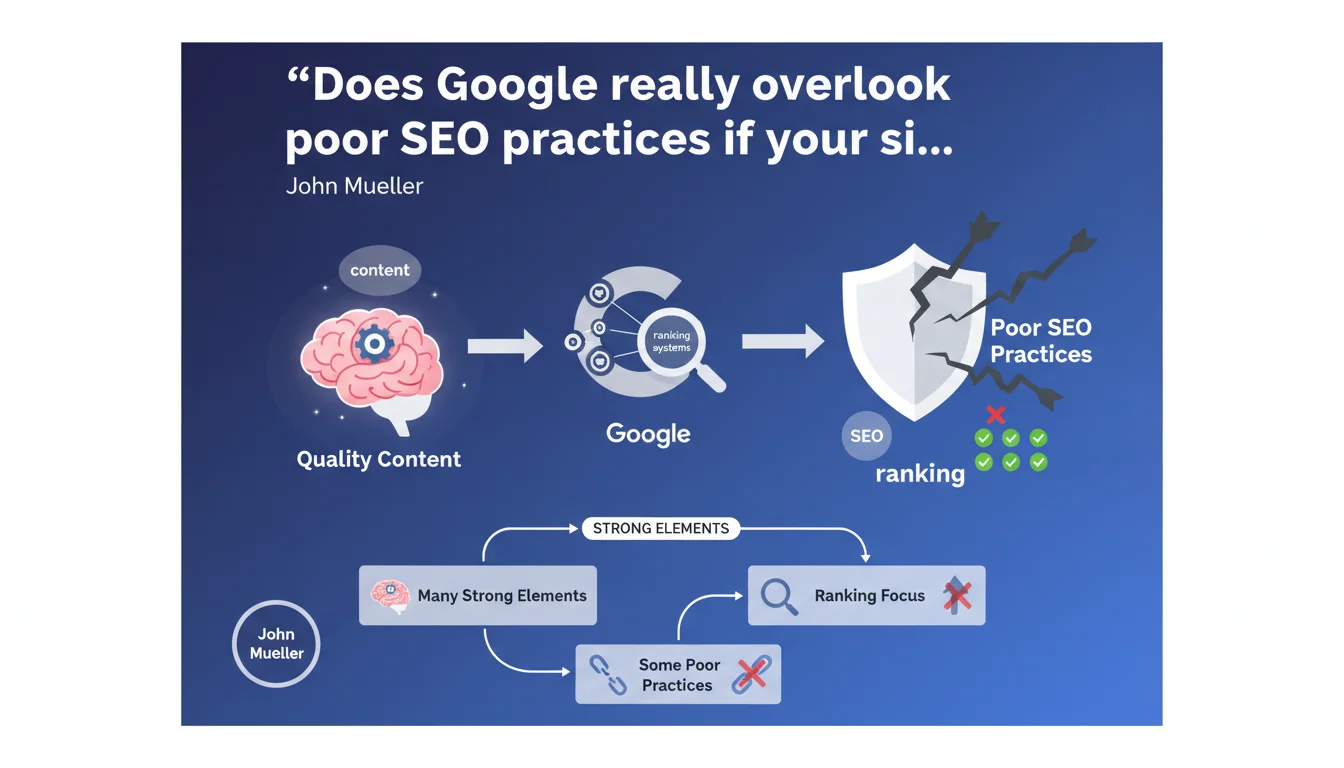
Google claims its algorithms can rely on a website's strong elements even when some questionable practices are present. In other words, a few technical errors or borderline tactics wouldn't condemn a site that excels in other areas. This statement raises questions about the algorithm's real tolerance threshold and what Google actually considers "a few" bad practices.
What you need to understand
Does Google really apply a "forgiving" approach to mistakes?
Mueller suggests that ranking systems prioritize positive signals rather than penalizing every minor error. In practical terms, a site with quality content, clear structure, and high-quality backlinks won't be demoted because of a few poorly hierarchized Hn tags or average loading times on a handful of pages.
This approach aligns with the logic of modern ranking systems that weight hundreds of signals. The algorithm seeks to identify what a site does best rather than systematically punishing every flaw.
What are the "strong elements" that Google prioritizes?
Mueller remains vague—typical—but we can infer that these are the fundamental E-E-A-T principles: demonstrated expertise, original content, logical architecture, smooth user experience. Reputation signals (natural backlinks, mentions) also carry significant weight.
A site that masters these pillars can afford some approximations on secondary criteria without seeing its rankings collapse.
Where is the line between "a few" and "too many" bad practices?
Google obviously provides no numerical threshold. The boundary remains opaque. A site that combines massive duplicate content, cloaking, purchased links, and automated content crosses the line—but a clean site with a few 302 redirects instead of 301s or slight keyword stuffing in places? Probably tolerated.
The risk: this tolerance varies by industry. A YMYL site (finance, health) will have a much narrower margin for error than a lifestyle blog.
- Google weights strong signals positively rather than penalizing every minor technical error
- Fundamentals (content, authority, experience) take priority over marginal optimizations
- Tolerance for "bad practices" is neither uniform nor quantifiable—it depends on the sector and competitive context
- No official threshold is communicated, which leaves considerable room for interpretation
SEO Expert opinion
Is this statement consistent with what we observe in the field?
Yes and no. We do see sites with glaring technical errors (redirect chains, missing tags) ranking correctly if their content and authority are solid. But we also see technically flawless sites stagnate because they lack E-E-A-T signals.
The problem: Mueller doesn't specify the scale. A few isolated errors? Tolerated. Systemic technical debt? It stalls. The limit is never clear as long as Google doesn't quantify what "a few" means. [To verify] in each specific context.
Should we conclude that we can relax our technical vigilance?
No. This statement doesn't say "ignore best practices," it says "don't panic if everything isn't perfect." Critical distinction. Quality content won't save a site with 80% orphaned pages and 12-second load times.
What Google tolerates is occasional imperfection, not structural negligence. If your site has significant technical weaknesses, fixing them remains a priority—even if a few strong signals temporarily compensate.
In what cases does this tolerance no longer apply?
As soon as intentional manipulation kicks in. Accidental duplicate content on 3-4 pages? Tolerated. Massive scraping of competitor content? Penalized. Google distinguishes between error and black hat strategy.
Another case: YMYL sectors. A medical site with approximated content will never be saved by a few quality backlinks. The margin for error is nearly zero. Mueller is speaking here about an "average" web, not niches with high responsibility.
Practical impact and recommendations
What should you concretely prioritize to maximize your "strong elements"?
Focus your efforts on E-E-A-T signals: demonstrated expertise (identified authors, visible credentials), original and useful content, sectoral authority (natural backlinks, mentions). These are the pillars Google values first.
Next, ensure that architecture and user experience are clean: clear navigation, coherent internal linking, correct load times. These elements won't compensate for mediocre content, but they amplify the impact of good content.
Which errors can you downplay (without ignoring them)?
Micro-technical optimizations that don't directly impact user experience or content comprehension: a missing alt tag here or there, imperfect Hn hierarchy on a few secondary pages, a non-optimized but consistent URL.
This doesn't mean you should let them linger indefinitely—but they aren't absolute emergencies if everything else is solid.
How do you verify that your site is on the right side of the balance?
Run a complete audit by segmenting criteria by impact: critical (content, authority, architecture), important (performance, indexability), secondary (micro-optimizations). If your fundamentals are green, a few orange flags on secondary criteria shouldn't trigger panic.
Use Search Console to spot problem pages (indexing errors, coverage), PageSpeed Insights for Core Web Vitals, and analyze your direct competitors: if they rank with similar or worse technical profiles, it means algorithms do tolerate these approximations in your niche.
- Audit your content: visible expertise, depth, originality
- Verify your backlink profile: quality over quantity
- Check architecture: orphaned pages, click depth, internal linking
- Measure user experience: Core Web Vitals, mobile navigation
- Identify critical errors (massive duplication, cloaking, manipulation) versus secondary ones (non-optimized URLs, minor tags)
- Compare your technical profile to well-ranking competitors
❓ Frequently Asked Questions
Google pénalise-t-il systématiquement chaque erreur technique détectée ?
Quels sont les « bons éléments » que Google privilégie réellement ?
Puis-je ignorer les recommandations techniques si mon contenu est excellent ?
Cette tolérance s'applique-t-elle de la même manière à tous les secteurs ?
Comment savoir si mes erreurs franchissent le seuil critique ?
🎥 From the same video 5
Other SEO insights extracted from this same Google Search Central video · published on 01/02/2022
🎥 Watch the full video on YouTube →
💬 Comments (0)
Be the first to comment.