
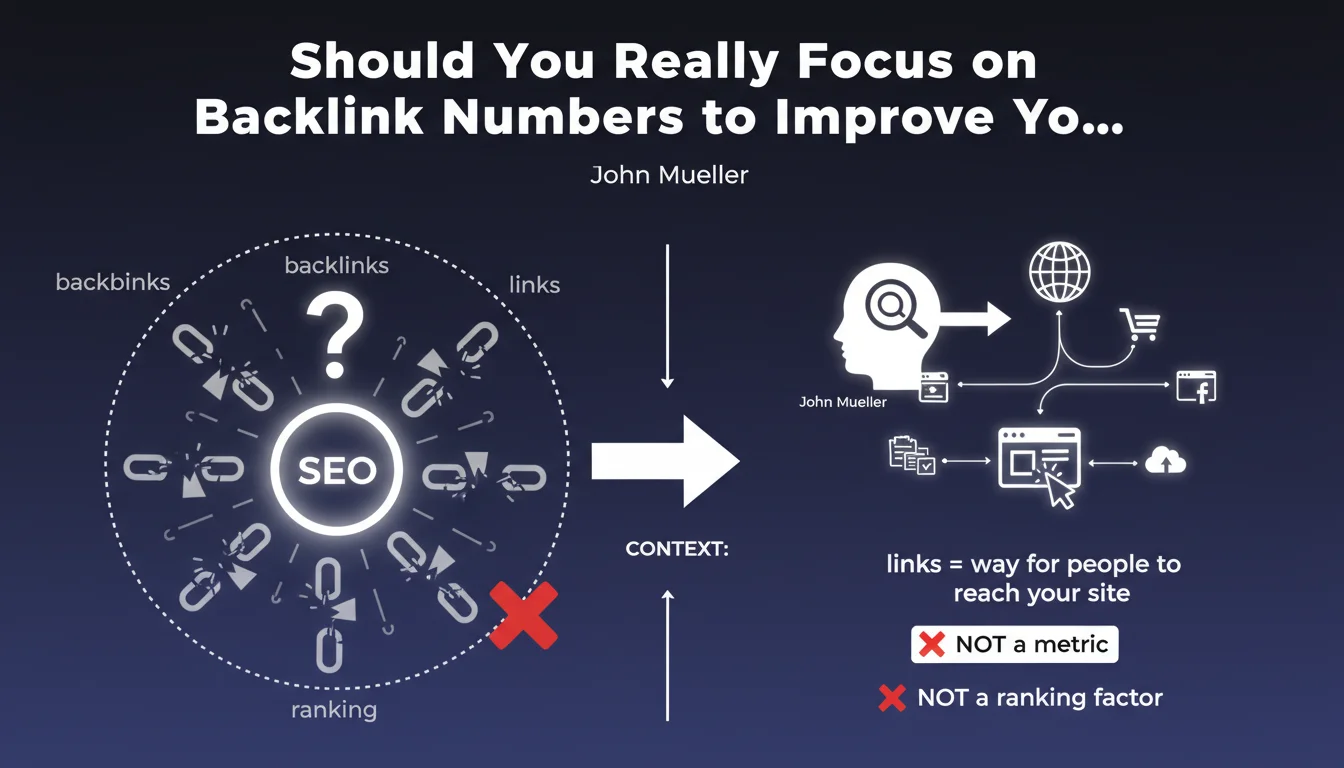
Official statement
What you need to understand
Why is it impossible to count backlinks precisely?
Google clearly indicates that there is no objective method for counting a website's backlinks. Each SEO tool (Ahrefs, SEMrush, Majestic) uses its own web crawl and its own interpretation algorithms.
This difference explains why tools display radically different numbers for the same site. No third-party tool can access Google's entire database, nor exactly replicate its way of analyzing links.
What does this mean for SEO professionals?
Google invites us to change our paradigm: backlinks should not be considered as an accounting metric, but as vectors of qualified traffic. The goal is to generate links that actually bring relevant visitors.
The raw number displayed in your SEO tools is therefore not a direct ranking factor. Google evaluates links according to much more complex criteria than the simple quantity measurable by third-party tools.
What are the real criteria that matter for backlinks?
- Thematic relevance between the source site and your content
- Real authority of the referring domain in its sector
- Semantic context around the link (surrounding text, anchor)
- Generated traffic: a link that brings engaged visitors
- Diversity of sources rather than concentration
- Naturalness of the link profile over time
SEO Expert opinion
Is this statement consistent with practices observed in the field?
Absolutely. For years, empirical tests have demonstrated that a single link from an authoritative media outlet can outperform hundreds of links from low-quality directories. The consistency is total with concrete observations.
This position from Google fits into a long-term trend: the progressive devaluation of easily manipulable quantitative metrics. Modern algorithms now evaluate contextual quality rather than raw volume.
What important nuances should be added to this statement?
Be careful not to fall into the opposite extreme. If Google minimizes counting, this doesn't mean that quantity is completely negligible. A robust link profile requires a certain critical mass of diversified backlinks.
The fundamental nuance: quality AND quantity are not opposed, they complement each other. The ideal remains to progressively accumulate quality links in significant numbers. A single good link is generally not enough against the competition.
In what cases might this logic be insufficient?
For ultra-competitive sectors (finance, insurance, real estate), competitors often have both quality AND massive quantity. In these niches, completely ignoring volume would be a strategic mistake.
Similarly, for a new site without history, reaching a critical mass of diversified links remains necessary to be considered a credible source by Google, even if these links are of average quality initially.
Practical impact and recommendations
How should backlink measurement tools be used?
Use tools to analyze trends rather than absolute numbers. Monitor the relative evolution of your profile, identify newly acquired links and detect potential losses.
Focus on qualitative analysis: examine the context of links, their thematic relevance and real traffic potential. Authority metrics (DR, DA) remain useful indicators but should not be objectives in themselves.
What link building strategy should be concretely adopted?
Favor a value-centered approach: create content that naturally deserves to be cited, establish relevant editorial partnerships, participate in your thematic ecosystem (interviews, expert contributions).
Diversify your link sources: specialized media, authority blogs, institutional sites, legitimate business partners. A natural profile mixes different types of links with varied anchors.
What priority actions should be implemented right now?
- Audit your current link profile to identify high-potential traffic sources
- Disavow toxic links from artificial networks or spam sites
- Create a calendar of linkable content (studies, infographics, comprehensive guides)
- Identify 10 relevant media outlets or blogs in your sector for editorial collaborations
- Set up a brand mention monitoring system to transform citations into links
- Analyze the link profile of your well-positioned competitors to detect opportunities
- Train your teams to think "linkability" from content creation
- Establish qualitative KPIs: referral traffic, engagement rate, conversions by source
In summary: Free yourself from the obsession with backlink numbers. Focus your efforts on acquiring links that generate qualified traffic and strengthen your thematic authority.
Measurement tools remain useful for monitoring and competitive analysis, but their numbers should never become objectives in themselves. Build a natural, progressive link building strategy centered on value.
These strategic optimizations require deep expertise and constant monitoring of algorithmic evolutions. Faced with the growing complexity of modern SEO, many companies choose to rely on a specialized SEO agency to structure a personalized approach, avoid costly mistakes and maximize the return on investment of their natural search engine optimization efforts.
💬 Comments (0)
Be the first to comment.