
Official statement
Other statements from this video 9 ▾
- 0:38 Comment Google Search Console peut-il réellement booster votre trafic organique ?
- 0:56 Search Console et Analytics : deux outils pour quelles données SEO distinctes ?
- 2:05 Combien de temps vos données Search Console restent-elles vraiment accessibles ?
- 2:05 Faut-il vraiment aligner les requêtes Search Console avec vos mots-clés cibles ?
- 2:05 Pourquoi Google recommande-t-il de séparer l'analyse de la recherche d'images et de la recherche web ?
- 6:18 Faut-il vraiment indexer toutes les pages de son site ?
- 8:54 Les rich results augmentent-ils vraiment la visibilité dans les résultats de recherche ?
- 8:54 L'expérience de page joue-t-elle vraiment un rôle déterminant dans le classement Google ?
- 9:20 Pourquoi Google recommande-t-il de vérifier le rapport de couverture d'index en priorité ?
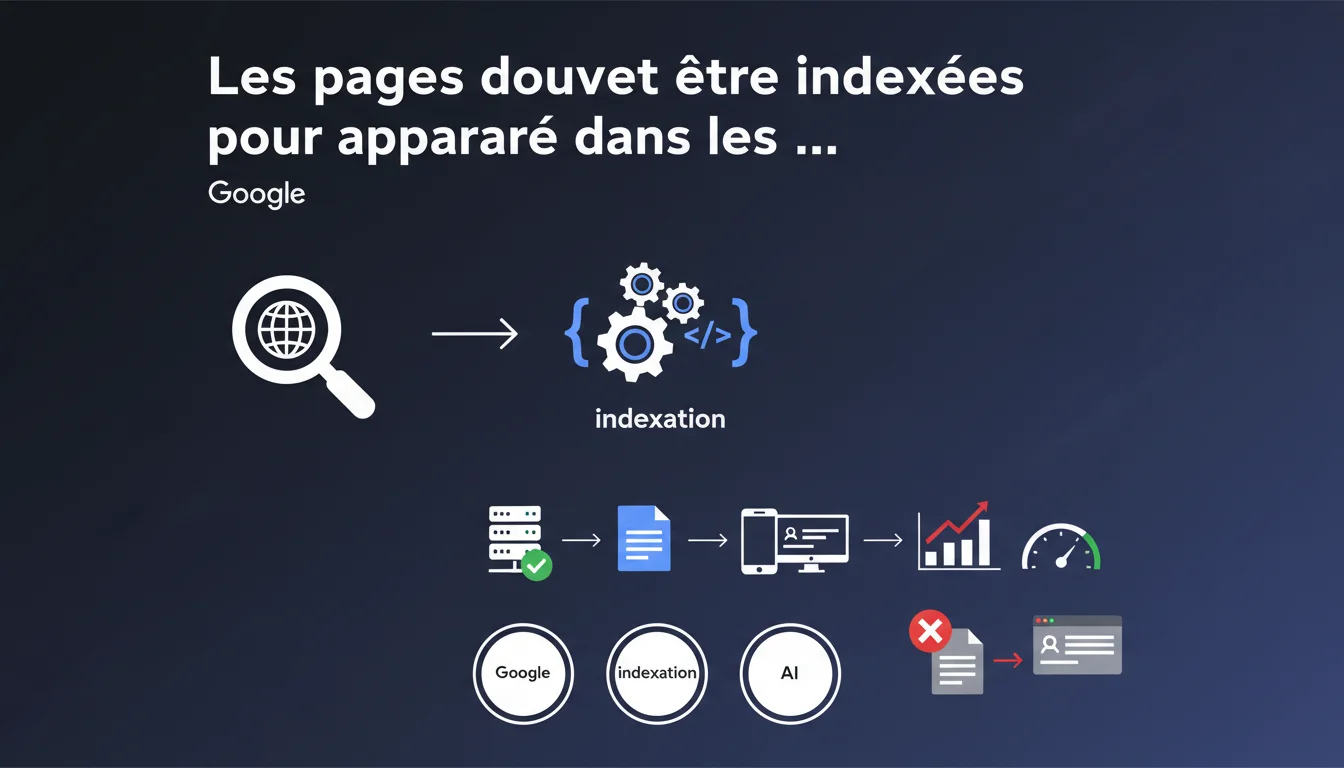
Google reminds us of an often-overlooked fact: a non-indexed page will never appear in search results. Before wondering why your pages aren't ranking, first check if they are indexed. The indexing status is the first diagnosis to make when facing any visibility issue.
What you need to understand
Why does Google bring up this obvious point? <\/h3>
This statement may seem basic, but it targets a field reflex that is observed too frequently: teams frantically optimizing content while the real issue lies upstream. Indexing <\/strong> is the absolute prerequisite — without it, any SEO strategy falls flat.<\/p> Google emphasizes methodology here. In the face of visibility issues, the first step is not to analyze backlinks <\/strong> or semantics, but to check if the page exists in the index. Yet, many practitioners skip this step and waste time on unnecessary optimizations.<\/p> The causes are multiple and not always obvious. A misconfigured robots.txt <\/strong>, a forgotten noindex <\/strong> tag, a canonical <\/strong> pointing elsewhere, content deemed too similar to other pages — all these are silent obstacles.<\/p> The crawl budget <\/strong> also comes into play on large sites. Google can crawl a page without indexing it if it does not seem relevant enough or if the site has too much duplication. And in some cases, a page can be indexed and then de-indexed <\/strong> after re-evaluation.<\/p> The Search Console <\/strong> remains the reference tool. The URL inspection tool provides a precise status: indexed, excluded, crawled but not indexed. Each status corresponds to a different diagnosis.<\/p> The test What prevents a page from being indexed? <\/h3>
How can you diagnose an indexing issue? <\/h3>
site:yoururl.com <\/code> in Google gives a quick indication, but it is not 100% reliable. Only the Search Console provides a real and detailed status. If a page does not appear in the inspection tool, it simply does not exist for Google.<\/p>
SEO Expert opinion
Is this statement a mere platitude or a necessary reminder? <\/h3>
One might think that reminding us that a page must be indexed to appear in results is obvious. Yet, field experience shows that a considerable number of sites encounter indexing issues without even realizing it.<\/p>
Many site owners focus on ranking <\/strong> while their pages are not even in the race. Google highlights a methodological flaw here: before trying to rank, check that you are in the index. This may seem like a trivial reminder, but it is fundamental in the diagnostic process.<\/p> Google remains deliberately vague about indexing criteria <\/strong>. A page may be frequently crawled without ever being indexed — and Google does not always provide a clear explanation in the Search Console. Statuses like "Crawled, currently not indexed" are frustrating as they offer no concrete clues. [To be verified]<\/strong><\/p> Another point not addressed: timing <\/strong>. How much time passes between crawling and indexing? Google never commits to timelines, making it difficult to know if a problem is structural or just a matter of patience. On some sites, pages can remain in limbo for weeks for no apparent reason.<\/p> Not all pages on a site are meant to be indexed. Filter pages, thank you pages, internal search results — all these contents clutter the index and dilute the crawl budget <\/strong>. Excluding these pages via noindex <\/strong> or robots.txt is a healthy practice.<\/p> Let’s be honest: the race for maximum indexing is a mistake. It is better to have a clean index with 500 relevant pages than a saturated index with 5000 mediocre pages. Google values quality <\/strong> and thematic coherence <\/strong>, not sheer volume.<\/p>What grey areas remain in this statement? <\/h3>
In what cases does a deliberately non-indexed page remain strategic? <\/h3>
Practical impact and recommendations
How can you concretely check the indexing status of your pages? <\/h3>
The first reflex: open the Search Console <\/strong> and use the URL inspection tool. Paste the concerned URL and check the status. If it is marked "URL not in Google", immediately investigate the reasons provided.<\/p> For a global diagnosis, check the index coverage report <\/strong>. It lists indexed pages, excluded pages, and those with errors. Filter by type of exclusion to identify recurring blocks: noindex, misconfigured canonicals, redirects, duplicated content.<\/p> If the page is blocked by robots.txt <\/strong>, correct it immediately. Next, check the meta robots <\/strong> tag: a forgotten noindex is a classic mistake, especially on staging sites transitioned to production without verification.<\/p> If Google indicates "Crawled, currently not indexed", the problem is more subtle. This often signals weak <\/strong> or redundant content. Enrich the page, differentiate it further, and increase its semantic depth. And — a frequently overlooked point — check its internal linking <\/strong>: an orphan page has little chance of being indexed.<\/p> For large sites with thousands of pages, a thorough technical audit is necessary. Identify patterns: are certain categories systematically excluded? Is the crawl budget <\/strong> saturated by unnecessary URLs? Automate monitoring via scripts that cross-check your sitemap with the actual index.<\/p>What actions to take if a page is not indexed? <\/h3>
❓ Frequently Asked Questions
Combien de temps faut-il pour qu'une page soit indexée après publication ?
Une page peut-elle être crawlée sans être indexée ?
Le test site:monurl.com est-il fiable pour vérifier l'indexation ?
Que signifie le statut "Crawlée, actuellement non indexée" ?
Faut-il indexer toutes les pages d'un site ?
🎥 From the same video 9
Other SEO insights extracted from this same Google Search Central video · published on 12/01/2022
🎥 Watch the full video on YouTube →Related statements
Get real-time analysis of the latest Google SEO declarations
Be the first to know every time a new official Google statement drops — with full expert analysis.
💬 Comments (0)
Be the first to comment.