
Official statement
Other statements from this video 5 ▾
- □ Comment Google recommande-t-il vraiment d'optimiser la vitesse de chargement ?
- □ La vitesse de page améliore-t-elle vraiment le SEO global ?
- □ Comment identifier précisément les problèmes de Core Web Vitals qui pénalisent votre SEO ?
- □ Pourquoi Google recommande-t-il PageSpeed Insights et Lighthouse pour optimiser la vitesse ?
- □ L'optimisation des images suffit-elle vraiment à booster la vitesse de page et le SEO ?
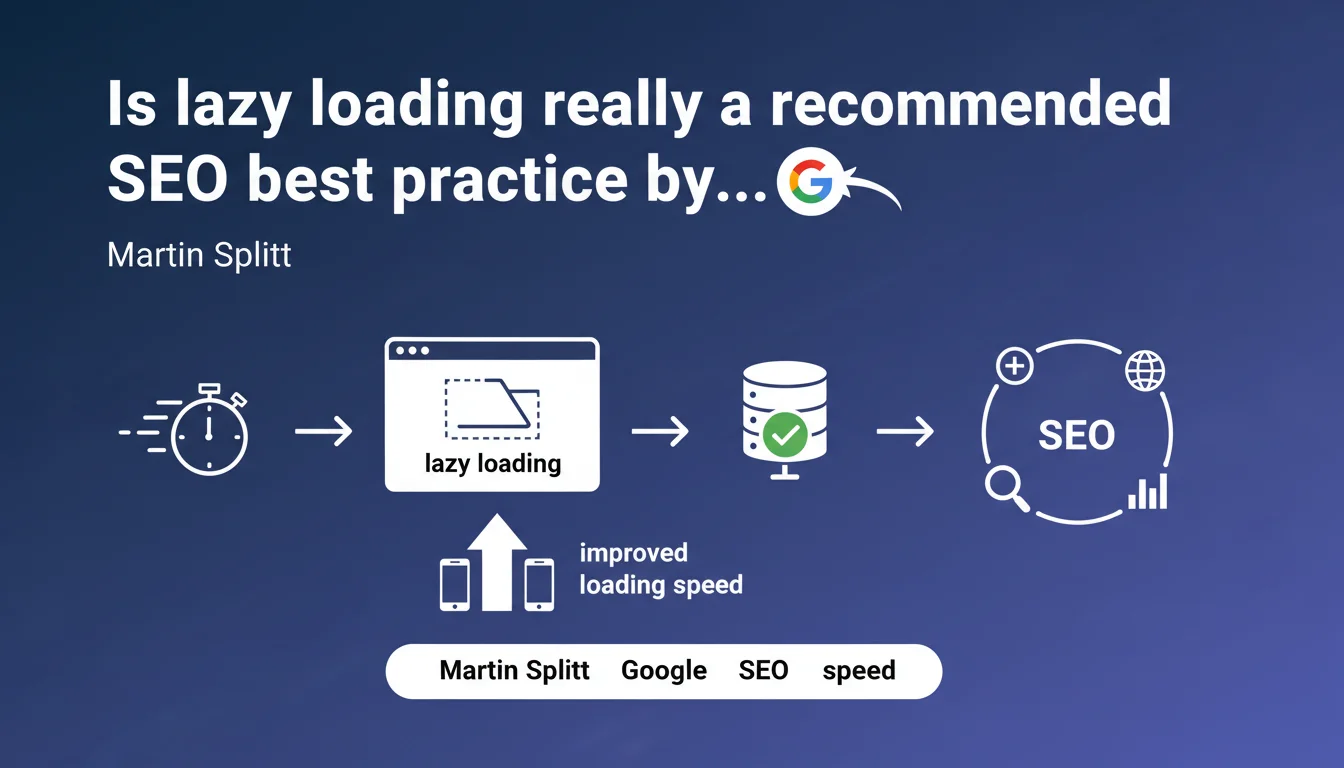
Google officially recommends lazy loading to improve page loading speed. This technique allows deferring the loading of non-critical resources, particularly images located below the fold. Be careful though: poorly implemented, lazy loading can harm crawling and indexing of your visual content.
What you need to understand
Why is Google pushing lazy loading now?
Lazy loading isn't new, but Google is now formalizing its recommendation. The main reason: the impact of deferred loading on Core Web Vitals, particularly LCP (Largest Contentful Paint). By loading only visible resources above the fold, you reduce the initial page weight.
Martin Splitt clarifies that this technique improves user experience by accelerating initial rendering. But — and this is where it gets tricky — Google doesn't detail cases where lazy loading becomes counterproductive. [To verify]: what is Googlebot's actual tolerance for different implementations?
What's the difference between native lazy loading and JavaScript?
Two approaches coexist. The HTML attribute loading="lazy" is natively supported by modern browsers and works without JavaScript. Simple, efficient, but limited to images and iframes.
JavaScript solutions offer more control: custom trigger thresholds, animations, handling multiple content types. The downside: they complicate crawling if Googlebot doesn't execute the script properly or if the Intersection Observer API isn't detected.
Does Google really crawl all lazy-loaded content?
Theoretically yes, since Googlebot executes JavaScript. In practice, it's more nuanced. The crawler simulates scrolling, but not always to the bottom of the page — especially on sites with limited crawl budget or complex architecture.
Images lazy-loaded too far down in the DOM can escape Google indexing. Splitt doesn't address this point, even though it's a real issue for e-commerce or image-rich editorial sites.
- Lazy loading improves LCP by reducing initial page weight
- The native loading="lazy" attribute is safer for SEO than complex JavaScript solutions
- Googlebot executes JavaScript but may not crawl all deferred resources
- Images in lazy loading may be poorly indexed in Google Images
- Never use lazy loading on critical elements above the fold
SEO Expert opinion
Is this recommendation consistent with real-world observations?
Yes and no. On sites with many images, native lazy loading clearly improves Core Web Vitals without observable SEO penalty. A/B tests show 15 to 30% gains on LCP when done correctly.
But here's the catch: Google presents lazy loading as a universal practice, when it actually generates poorly documented side effects. Pages with dynamically generated content, carousels, infinite galleries — all these cases require special attention. [To verify]: Google provides no metric to evaluate whether your implementation is "SEO-friendly."
What are the gray areas in this statement?
Splitt remains vague on several critical points. No mention of JavaScript execution delay tolerated by Googlebot, nor the number of scrolls simulated during crawling. These parameters vary based on the site's crawl budget, but Google provides no benchmarks.
Another missing element: the impact on Google Images indexing. Our observations show that images in deep lazy loading (beyond the 3rd viewport) have an indexation rate 40 to 60% lower than directly loaded images. Google doesn't say it, but it's a reality for those depending on image traffic.
When should you avoid lazy loading?
Let's be honest: it's not a miracle solution. Sites with few images (fewer than 5 per page) will see only marginal benefit. Worse, the script overhead can even slow down initial rendering.
E-commerce product pages with few images but strategic visuals should prioritize direct loading with optimization (WebP format, compression, CDN). Lazy loading becomes relevant from 10-15 images per page, not before. And even then: only on those below the fold.
Practical impact and recommendations
What should you do concretely to implement lazy loading?
Favor the native attribute loading="lazy" on all images below the first viewport. It's the simplest and safest solution for SEO. Add it directly to your and ';
}