
Official statement
Other statements from this video 7 ▾
- □ Do Core Web Vitals Really Impact Your Rankings in Google's Helpful Content System?
- □ Is Google really phasing out mobile-friendliness as a separate ranking signal?
- □ Should you worry about Google removing the mobile usability report from Search Console?
- □ Why is Google shutting down its mobile-friendly testing tool?
- □ Is Google Really Replacing FID with INP in Core Web Vitals—And What Does It Mean for Your Rankings?
- □ Can you finally edit code directly in Google's rich results test tool?
- □ Can you really get better content insights from Search Console without connecting Google Analytics?
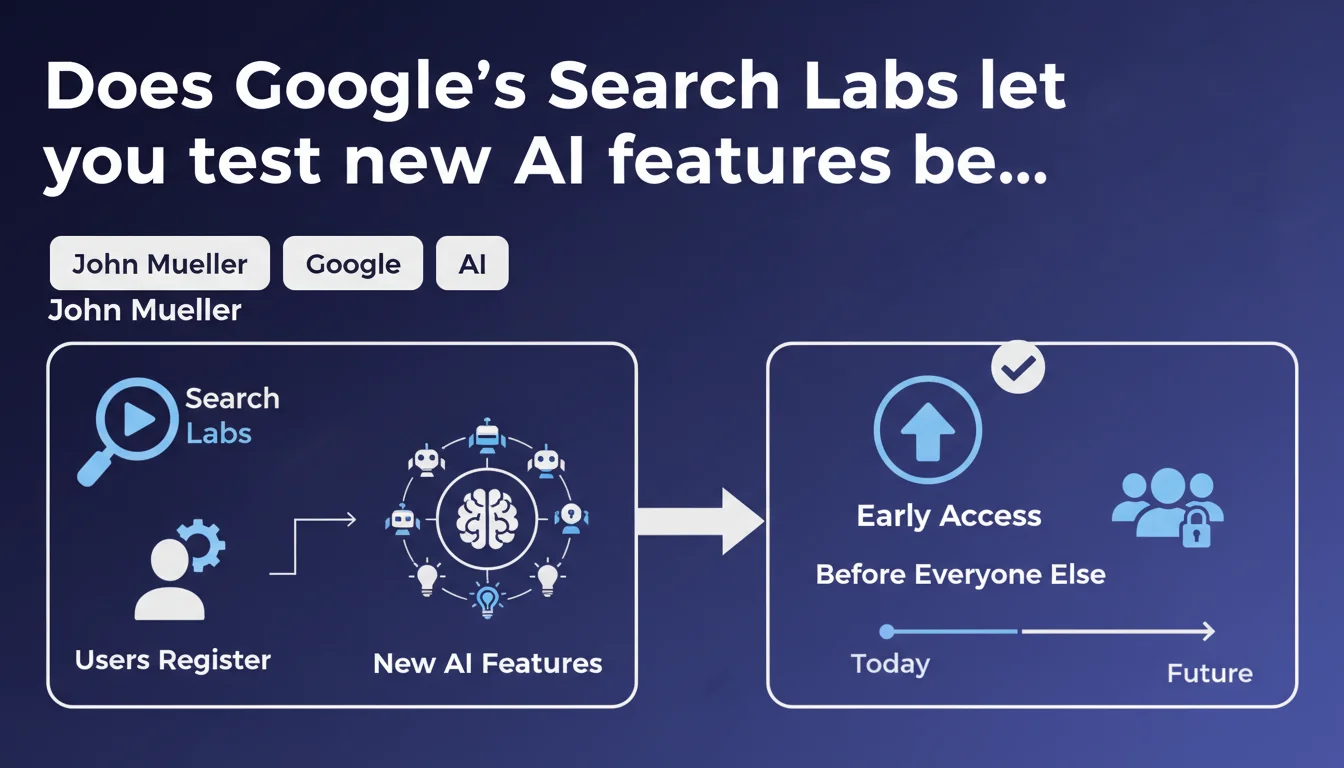
Google has launched Search Labs, an experimental platform where users can test new search engine features in advance, particularly generative AI tools. For SEO professionals, this is an opportunity to anticipate future SERP evolution and adapt strategies before these changes massively impact organic traffic.
What you need to understand
What exactly is Search Labs and why is Google opening this platform to the public?
Search Labs represents a shift in Google's approach, which for the first time is opening its experimentation labs to the general public. Unlike previous beta versions reserved for a select few, any user can register to test new features before their general rollout.
The stated objective? To gather real-world feedback on generative AI innovations — in other words, to validate that ChatGPT and Bing Chat won't bite off too much market share without a response. Google is testing the waters before diving massively into an AI-enriched SERP.
What types of features are being tested through these experiments?
The main focus is on search experiences enriched by generative AI. Concretely: synthesized answers displayed directly in the SERP, contextual suggestions, interactive formats that go beyond simple snippets.
For an SEO, this means Google is actively testing formats that could drastically reduce organic CTR if users get their answer without clicking. Informational niches are most exposed — FAQs, how-to guides, definitions.
How does this differ from Google's previous testing phases?
Historically, Google tested internally or with restricted samples. Search Labs democratizes access to experiments, which changes two fundamental things.
First point: volume of behavioral data. With thousands of users testing simultaneously, Google accelerates learning for its AI algorithms. Second point: partial transparency. SEOs can observe these evolutions in real time instead of being hit with them suddenly during a general rollout.
- Open access to experimental features (free registration)
- Focus on generative AI and synthesized answers in the SERP
- Ability for SEOs to anticipate future search result formats
- Increased risk of CTR decline on informational queries
- Shift in approach: Google communicates upstream rather than downstream
SEO Expert opinion
Does this transparency reveal accelerated competition or a deliberate strategy?
Let's be honest: if ChatGPT hadn't exploded in early 2023, would Google have opened Search Labs with this urgency? Probably not. The company is reacting to unprecedented competitive pressure — Microsoft has integrated conversational AI into Bing, and the narrative "Google is falling behind" is starting to circulate in the tech press.
Search Labs looks more like a defensive maneuver than a breakthrough innovation. Google is testing publicly to show it's not sitting idle, while simultaneously harvesting massive amounts of user data to refine its AI models. The timing is far from coincidental.
Can SEO professionals actually influence these developments?
The question deserves to be asked bluntly: does our feedback really matter, or are we just guinea pigs feeding the algorithms? [To be verified], but Google's history shows that user feedback influences mainly surface-level UX, rarely fundamental strategic decisions.
That said, participating in Search Labs allows you to detect trends before anyone else. If an AI feature starts massively cannibalizing organic clicks during the test phase, you have a few months to adapt your content strategy — create formats that AI can't summarize, focus on human expertise, optimize for transactional queries less vulnerable to disruption.
What risks face sites heavily reliant on informational traffic?
Publishers of purely informational content will suffer. If Google displays an AI-synthesized answer directly for "how to do X" or "what is Y", CTR collapses. Some preliminary studies on Bing Chat show 30 to 50% drops in organic clicks on queries covered by conversational AI.
The paradox: Google needs this content to train its models, but its organic visibility risks evaporating. In the medium term, only sites that provide value impossible to summarize will survive — original analysis, exclusive data, premium user experience.
Practical impact and recommendations
Should you sign up for Search Labs immediately?
Yes, without hesitation. Even if you don't actively use the features, observing how result formats evolve gives you 6 to 12 months ahead of the competition. Systematically note which queries trigger AI responses, what types of content get summarized, which sources are cited.
Create a tracking spreadsheet: query tested, AI response format, presence or absence of organic links, estimated CTR. This data will become strategic when these features are rolled out broadly.
How should you adapt your content strategy to these evolutions?
First rule: stop producing content that's easily summarized by AI. Articles like "Top 10 tips for X" or "Definition of Y" will lose massive visibility. Instead, focus on formats that AI can't reproduce alone.
Original case studies, proprietary data, conflicting analyses, interactive content, enriched videos, calculator tools — anything requiring human experience or exclusive resources. AI synthesizes general knowledge; you must produce specific, differentiated knowledge.
Which metrics should you track to anticipate impact on your traffic?
Closely monitor CTR by query type in Search Console. If you notice gradual erosion on your informational queries while positions stay stable, it's likely the effect of ongoing AI experiments.
Segment your analysis: transactional vs informational queries, head terms vs long-tail. Commercial queries perform better for now — users want to compare, see reviews, not just get one single answer.
- Sign up for Search Labs and systematically document new features observed
- Audit your content portfolio to identify vulnerable pages (simple FAQs, definitions, generic guides)
- Pivot toward high-value formats: case studies, exclusive data, in-depth analysis
- Monitor CTR evolution by query type in Search Console
- Diversify traffic sources (newsletters, communities, YouTube) to reduce dependency on informational SEO
- Test interactive formats (calculators, configurators) difficult for AI to replace
- Strengthen E-E-A-T signals to differentiate from generic AI-generated content
❓ Frequently Asked Questions
Search Labs est-il accessible uniquement aux États-Unis ?
Les fonctionnalités testées dans Search Labs seront-elles toutes déployées publiquement ?
Participer à Search Labs influence-t-il mon référencement naturel ?
L'IA générative de Google cite-t-elle ses sources comme Bing Chat ?
Faut-il optimiser spécifiquement ses contenus pour les réponses IA de Google ?
🎥 From the same video 7
Other SEO insights extracted from this same Google Search Central video · published on 18/07/2023
🎥 Watch the full video on YouTube →
💬 Comments (0)
Be the first to comment.