
Official statement
Other statements from this video 7 ▾
- □ Do Core Web Vitals Really Impact Your Rankings in Google's Helpful Content System?
- □ Is Google really phasing out mobile-friendliness as a separate ranking signal?
- □ Should you worry about Google removing the mobile usability report from Search Console?
- □ Is Google Really Replacing FID with INP in Core Web Vitals—And What Does It Mean for Your Rankings?
- □ Can you finally edit code directly in Google's rich results test tool?
- □ Can you really get better content insights from Search Console without connecting Google Analytics?
- □ Does Google's Search Labs let you test new AI features before everyone else gets them?
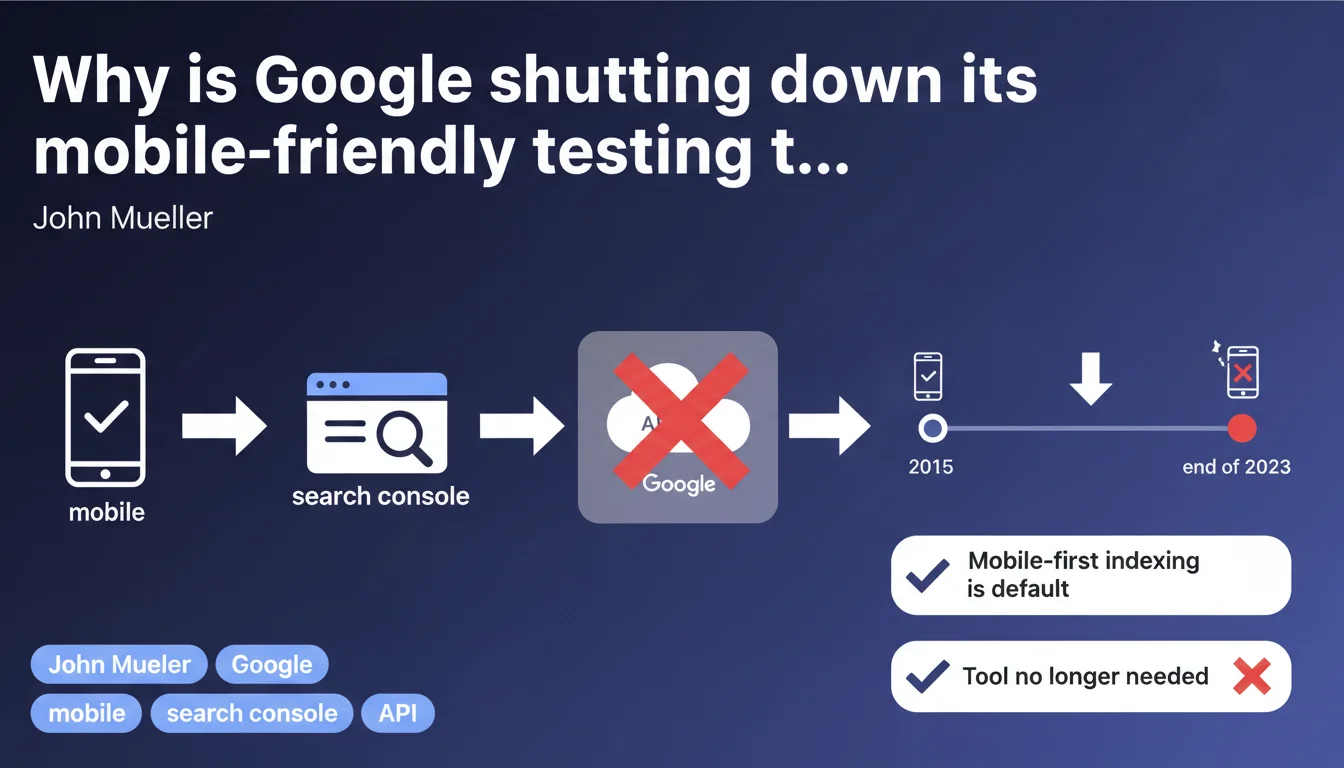
Google is removing the mobile-friendly testing tool and its API from Search Console. This decision marks the end of a historical tool, now replaced by other integrated solutions like Lighthouse and the 'Mobile Usability' report in Search Console. Mobile-friendliness is no longer a criterion to test in isolation — it has become a non-negotiable prerequisite.
What you need to understand
Which tool is Google actually removing?
The Mobile-Friendly Testing Tool was a standalone interface that allowed you to verify whether a page displayed correctly on mobile devices. It generated a visual report and flagged technical issues: text too small, clickable elements too close together, content wider than the screen.
Launched during the mobile transition period, this tool accompanied the rollout of mobile-first indexing. Its API also enabled automated large-scale testing. But Google is removing it from the game — for good.
Why this removal now?
Because mobile optimization is no longer a "nice to have". It's the standard. Google has been indexing the mobile version of sites first for several years now. Testing whether a site is mobile-friendly is now a given, not a one-off audit.
Google is betting on more comprehensive tools: Lighthouse for in-depth technical diagnostics, and the "Mobile Usability" report in Search Console to identify issues across your entire site. The dedicated tool is redundant — it's going away.
What alternatives are recommended?
- The "Mobile Usability" report in Search Console: detects display issues across your domain.
- Lighthouse (built into Chrome DevTools): comprehensive audit including performance, accessibility, SEO, and mobile-friendliness.
- Manual testing on real devices: nothing beats testing on an actual smartphone.
- Third-party specialized tools to simulate different devices and screen resolutions.
SEO Expert opinion
Does this decision truly reflect the state of the market?
Yes. Since Google switched to mobile-first indexing across the entire web, mobile optimization is no longer optional. Sites that don't clear this hurdle simply aren't visible anymore. The testing tool was useful during the transition phase — today, it's redundant.
However — and this is where it gets tricky — not all sites are up to the mark. Some sectors (legacy B2B, institutional sites, older platforms) still drag around non-responsive desktop versions. For them, losing a simple, visual tool means losing an internal persuasion argument.
Does Lighthouse really do the job of replacing the mobile-friendly tool?
Technically, yes. Lighthouse checks the viewport, font sizes, touch spacing — everything the old tool did. But its interface is more technical, less educational. [To verify]: for a non-tech project manager or a client who just wants to see "if it's working", Lighthouse can be intimidating.
The "Mobile Usability" report in Search Console is more accessible, but it doesn't provide a visual preview. We lose that ability to show a decision-maker concretely "here's how Google sees your page on mobile". It's a detail, but in consulting, these kinds of details matter.
Is there a hidden risk in this removal?
Just one: that some historical players rest on their laurels. "If Google no longer provides the tool, it must not be important anymore," they might think. Wrong. Mobile optimization remains a ranking criterion and a decisive user experience factor.
Practical impact and recommendations
What should you do if you were still using this tool?
Migrate immediately to the "Mobile Usability" report in Search Console. It automatically monitors your pages and flags display issues. Unlike the old tool, it works continuously — you're alerted the moment a problem appears.
Integrate Lighthouse into your audit workflows. If you're doing large-scale technical SEO, automate Lighthouse tests via the PageSpeed Insights API or CI/CD scripts. It's more powerful and more precise than the old tool.
How do you verify your site remains compliant after this removal?
- Set up Search Console and monitor the "Mobile Usability" report — zero errors tolerated.
- Test your pages regularly with Lighthouse (Chrome DevTools or PageSpeed Insights).
- Check the
<meta name="viewport">tag on all your pages — it remains essential. - Simulate display on real devices (Android/iOS) — not just responsive desktop mode.
- Audit pages template by template, not just the homepage.
What mistakes should you avoid at all costs?
Don't replace the removed tool with nothing. Some might think "we'll see if problems show up". Bad idea. Mobile display bugs directly impact your bounce rate and conversions — you can't afford to react after the fact.
Another pitfall: believing that "responsive = mobile-friendly". A site can be responsive and still be unusable on mobile if buttons are too small, forms aren't adapted, or content is poorly structured. Mobile-friendliness is also about mobile-first UX thinking.
The removal of the mobile testing tool marks a transition: Google treats mobile optimization as a given, not as a subject for one-off audits. Adapt your processes accordingly — monitor continuously, test with Lighthouse, and keep an eye on Search Console.
If managing the technical side of these optimizations feels complex or time-consuming, it may be wise to partner with a specialized SEO agency. Mobile-friendly auditing fits into a broader SEO approach — performance, crawl, indexation — that is often difficult to manage alone without on-the-ground expertise.
❓ Frequently Asked Questions
L'outil de test mobile va-t-il vraiment disparaître complètement ?
Le mobile-friendly reste-t-il un critère de classement après cette suppression ?
Peut-on encore utiliser Lighthouse pour tester le mobile-friendly ?
Le rapport « Ergonomie mobile » de Search Console suffit-il ?
Faut-il auditer à nouveau tous nos sites après cette suppression ?
🎥 From the same video 7
Other SEO insights extracted from this same Google Search Central video · published on 18/07/2023
🎥 Watch the full video on YouTube →
💬 Comments (0)
Be the first to comment.