
Official statement
Other statements from this video 10 ▾
- □ Should you still optimize meta descriptions if Google ignores them anyway?
- □ Should you still optimize meta descriptions for SEO in 2024?
- □ Is one backlink really all Google needs to discover and index your site?
- □ Do you still need rel=prev/next for pagination in 2024?
- □ Is boilerplate content really hurting your pages' search rankings?
- □ Is boilerplate really a threat to your search engine rankings?
- □ Are geolocation redirects killing your Google crawl?
- □ How does Google really determine user location for local SEO?
- □ Can Google really display rich results without schema markup?
- □ Should you configure the Content-Language header for PDFs and non-HTML files?
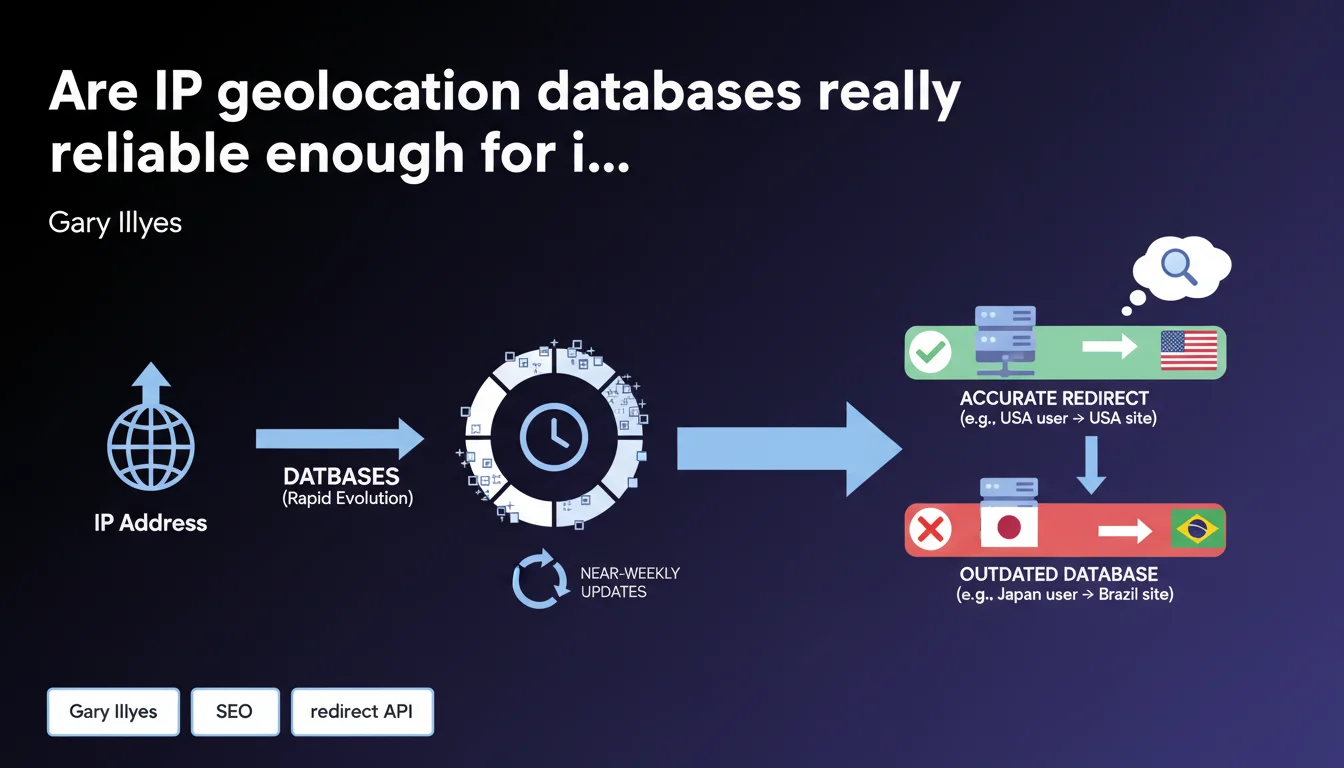
Databases that map IP addresses to countries evolve so quickly they require near-weekly updates. An outdated database can redirect your visitors to the wrong localized version of your site, sabotaging your international strategy. This isn't just a technical detail — it's a direct risk to user experience and conversions.
What you need to understand
Why do IP databases change so fast?
IP addresses aren't set in stone. Internet service providers constantly reassign their IP blocks, companies relocate their data centers, VPNs and proxies redistribute traffic. An IP that pointed to Paris last week could easily point to London today.
Google puts it bluntly: these databases evolve so quickly that a weekly update isn't even a luxury, it's the bare minimum. If you're routing users based on a database that's three months old, you're flying blind.
What's the real risk for a multilingual or multi-country site?
A French visitor lands on your site. Your system detects their IP using an outdated database, thinks they're from the UK, and redirects them to the .co.uk version. Result: wrong language, wrong currency, wrong commercial offer.
This doesn't just break user experience — it kills conversions. And if this visitor comes back multiple times and keeps getting bounced between versions, they'll eventually go to a competitor. Google doesn't say it explicitly, but that's exactly what happens in the real world.
What are the essential takeaways?
- IP-to-country databases become outdated in weeks, not months
- An outdated database sends users to the wrong localized versions of your site
- Google implicitly acknowledges that relying solely on IP geolocation is risky
- Weekly updates are presented as a necessity, not as a best practice
- This problem directly impacts user experience and, indirectly, the signals you send to Google
SEO Expert opinion
Does this statement really reflect what happens in the field?
Yes, and it's rare for Google to be this direct about a technical issue. IP geolocation is a constant mess for anyone managing an international site. Free databases like GeoLite2 get monthly updates, which Google says is already too slow.
Premium paid databases (MaxMind, IP2Location, etc.) push weekly, even daily updates for some. But how many sites actually integrate them with that frequency? Most run on databases that are three months behind, or worse.
What are the limitations of this IP geolocation approach?
Let's be honest: even with an up-to-date database, IP geolocation remains imprecise. VPN usage is exploding, companies access via international proxies, mobile users bounce between networks. Basing your entire redirect logic on IP is already taking a risk.
Google doesn't say it plainly here, but the direction they're heading is clear: they'd rather you let the user choose their version instead of forcing a redirect on them. Signals like browser language (Accept-Language) are more reliable — and less error-prone.
In what cases does this rule not really apply?
If you have a single-country site with one language version, you don't need to worry. The problem only affects sites with multiple regional versions: .fr, .de, .co.uk, or subdirectories like /fr/, /de/, etc.
And even then — if you don't use automatic IP-based redirects and let users choose via a language selector, this concern becomes minimal. The real risk is automatic 302/301 redirects with no way for users to override them.
Practical impact and recommendations
What should you actually do to secure geolocation?
First instinct: never redirect automatically without giving users a simple way to switch versions. A discreet banner at the top of the page ("You're on the French version. Would you prefer the UK version?") does the job without breaking the experience.
If you do use IP-based redirects, make sure your database is updated at minimum monthly, ideally weekly. MaxMind GeoIP2, IP2Location, or Digital Element offer automatic update feeds — configure them properly.
What mistakes must you avoid?
Don't rely solely on IP. Cross-reference with other signals: browser language (Accept-Language), user account currency if logged in, browsing history. A redirect based on a single signal is a fragile redirect.
Another classic pitfall: redirect loops. A French user who manually visits your .co.uk shouldn't be force-redirected to .fr if they've explicitly chosen the UK version. Store a cookie or session parameter to respect that choice.
How can you verify your site handles geolocation correctly?
- Test your site with a VPN from multiple countries and verify redirects work properly
- Check the freshness of your IP database: what's the last update date?
- Ensure a redirected user can easily switch versions (visible link, not buried)
- Use server logs to detect redirect loops or recurring routing errors
- Compare IP signals against
Accept-Languageto identify frequent inconsistencies - Monitor bounce rate and time on page for international landing pages — a spike could signal a routing problem
❓ Frequently Asked Questions
Quelle fréquence de mise à jour est recommandée pour une base de données IP-to-country ?
Dois-je absolument utiliser une base de données IP payante pour mon site multilingue ?
La géolocalisation IP affecte-t-elle directement le SEO ?
Faut-il rediriger automatiquement les utilisateurs ou les laisser choisir ?
Les VPN rendent-ils la géolocalisation IP inutile ?
🎥 From the same video 10
Other SEO insights extracted from this same Google Search Central video · published on 25/04/2024
🎥 Watch the full video on YouTube →
💬 Comments (0)
Be the first to comment.