
Official statement
What you need to understand
What's the fundamental difference between internal and external links according to Google?
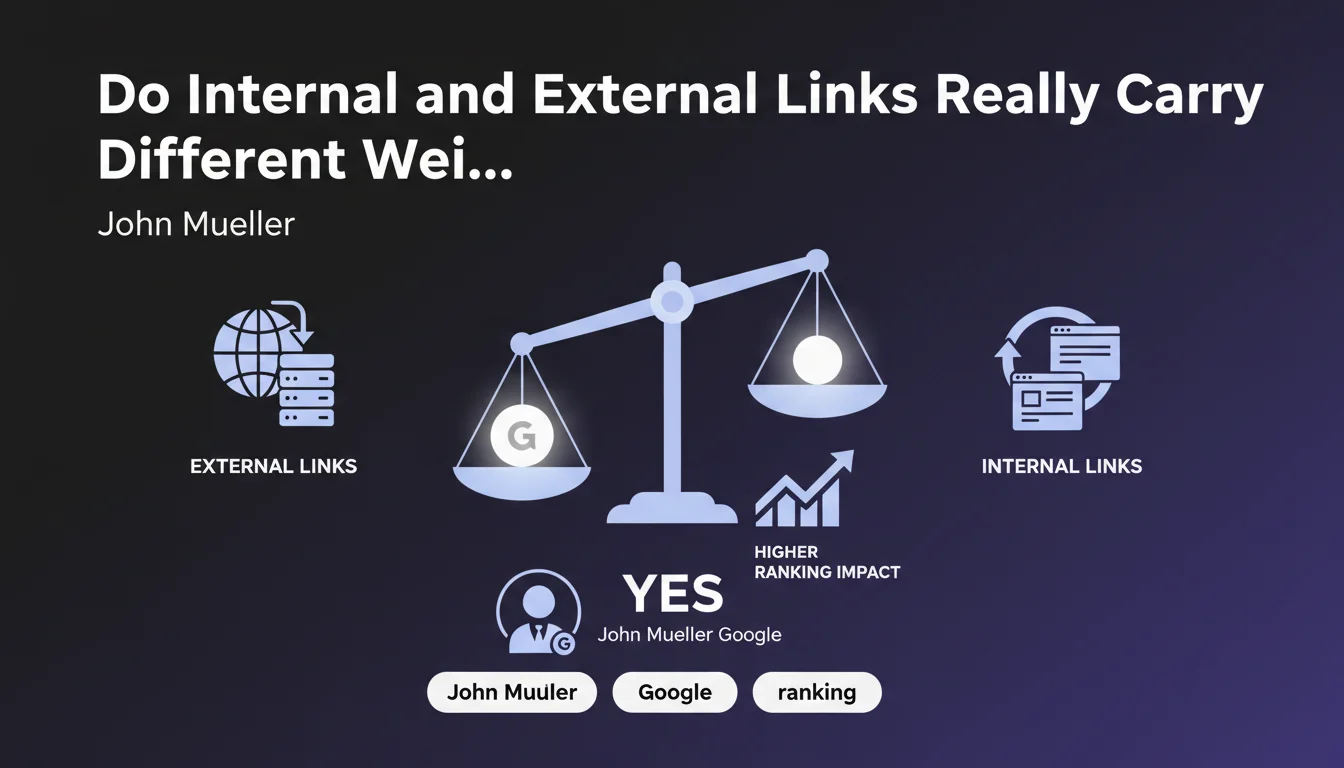
John Mueller officially confirmed that Google treats internal and external links differently in its ranking algorithm. This distinction is far from trivial as it directly impacts how PageRank flows throughout your site.
External links (backlinks from other sites) carry more weight in PageRank calculations than internal links. This is explained by the fact that an external link represents a vote of confidence from an independent third party, while an internal link is controlled by the site owner.
Why does this statement matter for SEO practitioners?
This official confirmation puts an end to certain speculations and validates field observations. It reinforces that acquiring quality backlinks remains an essential pillar of organic search optimization.
However, this doesn't mean internal links are negligible. They play a crucial role in distributing PageRank within your site and in Google's understanding of your architecture.
What are the key takeaways from this statement?
- Google applies differentiated treatment between internal and external links
- External backlinks carry more weight in PageRank calculations
- Internal links remain essential for architecture and PageRank distribution
- This distinction confirms the importance of a solid external link building strategy
- Balance between both link types is necessary for a complete SEO strategy
SEO Expert opinion
Does this statement align with what SEO experts have been observing?
Absolutely. John Mueller's confirmation perfectly matches the empirical observations we've been making for years. Sites that obtain quality backlinks generally progress faster than those only optimizing their internal linking.
However, the important nuance lies in the fact that quality trumps quantity. An external link from an authoritative and thematically relevant site will have infinitely more value than hundreds of internal links or dozens of low-quality backlinks.
What important nuances should be added to this statement?
Mueller's statement remains deliberately vague about exact ratios and weightings. In practice, a strategically placed internal link from your homepage to a key page can have a very significant impact.
Moreover, internal links have functions that external ones don't fulfill: user navigation, semantic contextualization, efficient crawling, and targeted SEO juice distribution. They're also entirely under your control.
In what cases can this general rule be nuanced?
For very large sites (e-commerce, media), optimized internal linking can generate spectacular gains, sometimes faster than acquiring new backlinks. The reason: these sites already have high domain authority to redistribute.
Similarly, in highly competitive niches where obtaining quality backlinks is extremely difficult, maximizing internal linking becomes a strategic necessity to exploit every ounce of available PageRank.
Practical impact and recommendations
What should you actually implement following this statement?
First, rebalance your efforts if you'd been neglecting one of the two dimensions. A complete SEO strategy requires both active external link building and optimized internal linking.
Second, focus your link building efforts on quality rather than quantity. A single backlink from an authoritative site in your niche is worth more than dozens of mediocre links.
Third, use your internal linking to maximize exploitation of the backlinks you obtain. Pages receiving backlinks should intelligently redistribute this PageRank to your strategic pages.
What common mistakes should you absolutely avoid?
Never abandon your internal linking strategy because backlinks are more powerful. It's like neglecting a house's foundations because the roof is important: both are necessary.
Also avoid overinvesting in aggressive or artificial link building techniques. Google is increasingly sophisticated at detecting unnatural link patterns, and penalties can be severe.
Finally, don't create watertight silos in your internal architecture. Good structure allows PageRank to flow naturally while maintaining strong thematic coherence.
How can you check and improve the balance between internal and external links?
- Audit your backlink profile with tools like Ahrefs, SEMrush, or Majestic to identify your external links
- Analyze your internal linking to spot orphan pages and contextual link opportunities
- Identify your pages receiving the most external PageRank and optimize their outgoing internal links
- Create a link building calendar to regularly acquire quality backlinks
- Establish a content strategy oriented toward linkbaiting to naturally attract external links
- Optimize internal link anchors to strengthen thematic relevance of your target pages
- Monitor PageRank distribution with internal linking visualization tools
- Develop lasting partnerships for qualitative and natural link exchanges
Google's confirmation that external and internal links are treated differently validates the importance of a balanced approach in SEO. While backlinks remain more powerful for overall authority, internal linking remains indispensable for effectively exploiting that authority.
The key lies in complementarity: build a solid internal architecture that maximizes the impact of each backlink obtained, while developing a qualitative and sustainable external link acquisition strategy.
These cross-optimizations require sharp technical expertise and constant monitoring of best practices. For companies wanting to maximize their organic visibility, support from an experienced SEO agency can prove decisive in developing and deploying a perfectly calibrated strategy, adapted to your sector and specific objectives.
💬 Comments (0)
Be the first to comment.