
Official statement
Other statements from this video 5 ▾
- □ Why do impressions always outpace clicks in your Search Console reports?
- □ Does Google really count impressions the way you think it does in Search Console?
- □ Is Google really blaming your content for low click-through rates, or is the SERP itself the real problem?
- □ Can losing impressions actually boost your SEO performance?
- □ Does your content really need a complete overhaul to boost your CTR?
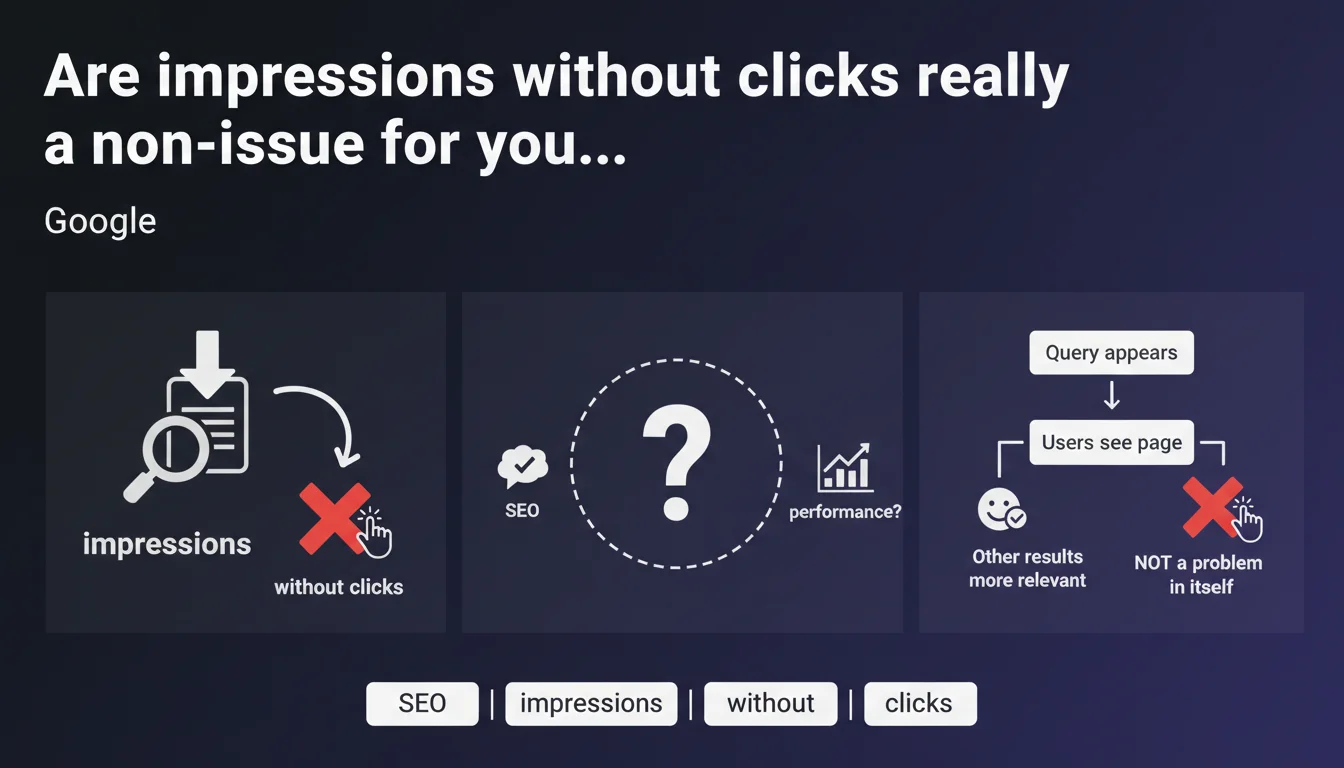
Google claims that receiving impressions without clicks is not problematic in itself. According to them, this simply indicates that other results seem more relevant to users for these specific queries. This position minimizes the impact of low CTR on search rankings.
What you need to understand
What does Google really mean by this statement?
Google is trying to reassure webmasters who are concerned about seeing their pages appear in the SERPs without generating clicks. The basic argument: an impression without a click is not a direct negative signal.
The nuance is important. Google isn't saying that CTR has no importance — it's saying that impressions without clicks are not a problem in themselves. In other words, it's not a penalty factor.
Why does this confusion exist among SEOs?
For years, the industry has speculated about the role of CTR as a ranking signal. Correlations have been observed between high CTR and improved positions, without establishing clear causality.
Google has always maintained a fuzzy position on this point. This statement is part of that trend: it neither confirms nor denies that CTR directly influences rankings.
How should you interpret impressions without clicks concretely?
An impression without a click means your page was visible but not attractive enough compared to other results. This can come from multiple factors: uninspiring title tag, dull meta description, too low a position, presence of featured snippets that directly answer the query.
Google is essentially saying: "You're in the race, but others seem to answer the search intent better." This is not a sanction, it's a diagnosis of relative relevance.
- Impressions without clicks don't trigger algorithmic penalties
- They indicate that other results seem more relevant to users
- CTR remains a performance indicator, not necessarily a direct ranking factor
- Position in the SERPs mechanically influences expected CTR
- Low CTR can signal a problem with intent/content alignment
SEO Expert opinion
Is Google's position consistent with what we observe in the field?
Yes and no. On one hand, it's true that we don't observe mechanical ranking drops simply because a page has low CTR. Pages can stagnate in positions 8-10 for months without dropping further.
On the other hand, field data suggests Google continuously tests user satisfaction. Pages with systematically low CTR on certain queries often end up losing ground to competitors who generate more engagement. [To verify] — impossible to prove direct causality, but the correlation is there.
What nuances does Google deliberately omit?
The statement is technically true but incomplete. Google doesn't mention that global behavioral signals — of which CTR is a part — likely feed its learning systems.
The real problem isn't the isolated impression without a click, it's the systematic pattern. If your page appears 10,000 times in position 5 with a 0.2% CTR, while the industry average is 3-4%, that sends a clear signal: your result isn't attractive.
And let's be honest — believing that Google completely ignores this behavioral data in aggregate would be naive. They don't say they use it directly as a ranking factor, but they also don't say they don't use it at all.
In what cases does this "non-problematic" status become problematic?
When your impressions without clicks translate into a fundamental misalignment between your content and search intent. If you rank on "best CRM" with an ultra-commercial product page while users are looking for a neutral comparison, your impressions without clicks are a symptom.
Another case: queries where Google displays SERP features that directly answer the question. You can have thousands of impressions in positions 2-3 with ridiculous CTR because the featured snippet above provides the answer. Google says this isn't a problem, but for you, it is — you're spending crawl budget with no return.
Practical impact and recommendations
What should you do concretely about impressions without clicks?
First, contextualize the data. Look at the average position of these impressions. A 1% CTR in position 15 is normal. The same CTR in position 3 is alarming.
Next, segment by query type. Impressions without clicks on broad informational queries where you rank at the bottom of the first page aren't critical. Those on your main commercial keywords in the top 5 are.
Concretely? Optimize your title tags and meta descriptions so they stand out. Analyze what top-ranking competitors do better. Test more engaging formulations, numbers, power words.
What mistakes should you avoid when interpreting this data?
Don't panic over every low-CTR query. Google has a point: it's not an immediate penalty signal. There's no need to rewrite all your snippets urgently.
Classic mistake: comparing your CTR to generic benchmarks without accounting for SERP nature. A position 1 page on a query with 3 Google Ads above it will mechanically have lower CTR than position 1 on a pure organic SERP.
Another trap: completely ignoring the problem under the pretext that "Google says it's not serious." Low CTR remains a symptom of perceived non-relevance. Even if it doesn't penalize you directly, it means you're leaving traffic on the table.
How should you monitor and effectively improve your CTR?
Set up regular tracking in Search Console. Filter queries with over 100 impressions and identify those where your CTR is significantly below the position average.
Test improvements progressively. Change a title, wait 2-3 weeks, measure impact. Structured rich snippets can also improve the attractiveness of your results — FAQ schema, review stars, breadcrumbs.
For queries where you face SERP features competition, consider targeting those positions (featured snippet, People Also Ask) rather than fighting for the classic blue link.
- Segment impressions without clicks by average position and query type
- Compare your CTR to real position averages, not generic benchmarks
- Optimize title tags and meta descriptions on strategic low-CTR queries
- Analyze SERP features that capture clicks before your organic results
- Test enriched snippet formats (schema markup) to improve visibility
- Monitor CTR evolution after each optimization in Search Console
- Don't panic over long-tail queries with low impression volume
❓ Frequently Asked Questions
Un faible CTR peut-il faire baisser mon classement dans Google ?
Quel CTR dois-je viser selon ma position dans les résultats ?
Comment améliorer mon CTR sans changer de position ?
Les featured snippets tuent-ils le CTR des résultats organiques classiques ?
Dois-je ignorer les impressions sans clics sur les requêtes longue traîne ?
🎥 From the same video 5
Other SEO insights extracted from this same Google Search Central video · published on 05/02/2025
🎥 Watch the full video on YouTube →
💬 Comments (0)
Be the first to comment.