
Official statement
Other statements from this video 5 ▾
- □ Pourquoi les impressions dépassent-elles toujours les clics dans vos rapports Search Console ?
- □ Comment Google comptabilise-t-il réellement une impression dans Search Console ?
- □ Les impressions sans clics sont-elles vraiment un non-problème pour votre SEO ?
- □ Pourquoi perdre des impressions peut-il améliorer vos performances SEO ?
- □ Faut-il vraiment retravailler son contenu pour augmenter le CTR ?
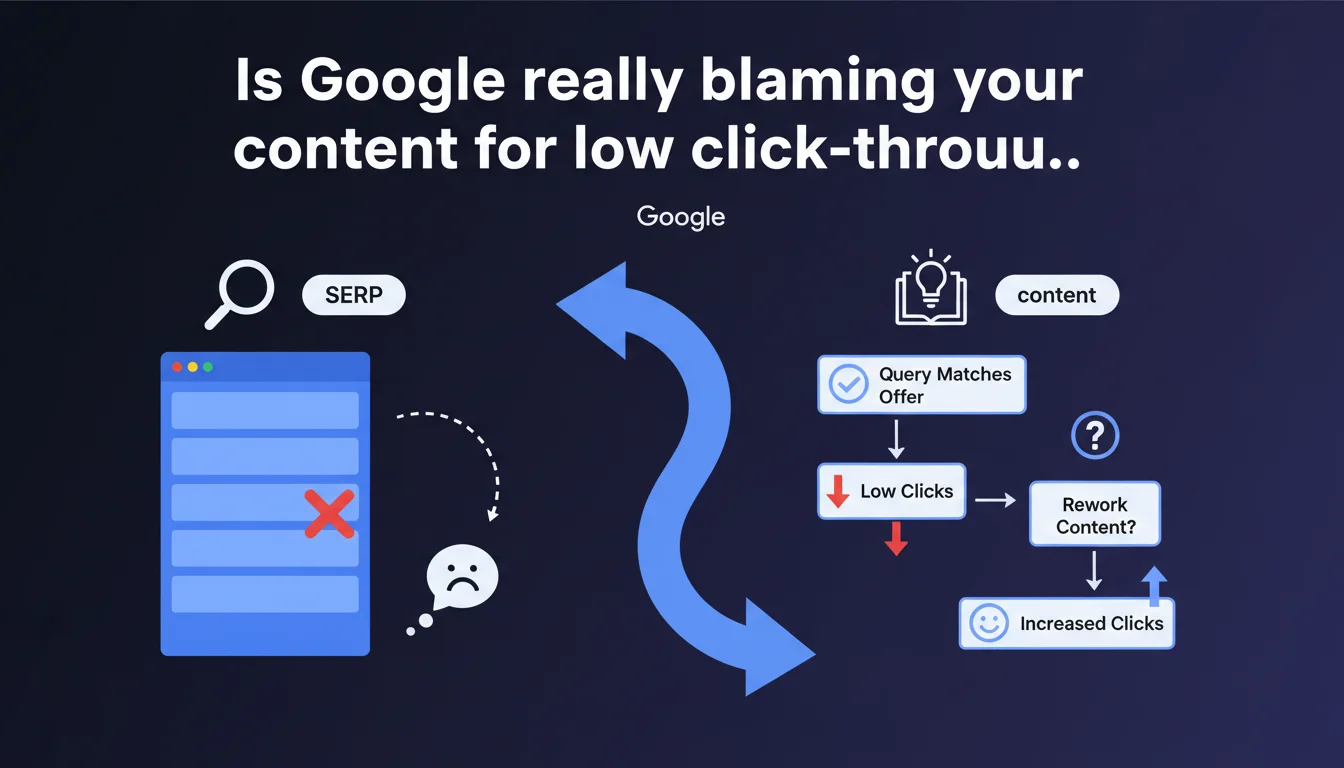
Google is shifting the responsibility for impressions without clicks onto your shoulders: if you rank for the right queries but nobody clicks, it's your content that's the issue, not their algorithm. The proposed solution? Rework your pages to better match user intent and improve your CTR. A perspective that oversimplifies a far more nuanced reality.
What you need to understand
What is Google really implying with this statement?
Google is establishing here a direct causality between impressions without clicks and content quality. If you appear for relevant queries but users ignore your result, it means your page isn't properly addressing their need.
This approach is based on the idea that the SERP functions like a transparent marketplace where the best content naturally emerges. CTR becomes a quality signal — a metric that reveals the actual relevance of your page in the eyes of searchers.
What exactly does Google expect when it says "rework your content"?
The phrasing remains deliberately vague. "Reworking" can mean adjusting your title and meta description to better reflect intent, or completely rethinking your page's editorial angle.
Google suggests two approaches: better matching the query (semantic and structural alignment) and convincing users to click (snippet optimization, adding dates, numbers, brackets). But there's no clarity on which lever takes priority.
What are the implicit assumptions behind this advice?
First assumption: your position in the SERP is sufficiently visible for CTR to be a reliable indicator. If you're in position 8-10, a low CTR reveals nothing about your content quality.
Second assumption: the SERP itself doesn't pose a structural problem. In other words, featured snippets, PAA, Knowledge Graph and other SERP elements have no impact on your CTR. A debatable perspective.
- CTR isn't just a content matter — your position, the presence of rich SERP elements, and advertising competition all play major roles
- Google doesn't clarify how to measure whether a query "exactly matches" what you offer — Search Console often gets this wrong
- Reworking content can mean adjusting HTML tags or completely rewriting your editorial angle — the boundary is blurry
- This statement ignores the impact of SERP features that cannibalize organic clicks
SEO Expert opinion
Is this statement consistent with real-world observations?
Partially. On straightforward transactional or informational queries, low CTR often reveals an angle or snippet problem. A/B tests on titles show that minor adjustments can double your CTR.
But on queries where Google displays PAA, a featured snippet, or a Knowledge Panel, CTR can collapse without your content being the culprit. [Needs verification]: Google provides no data on average organic CTR by position depending on SERP feature density.
What nuances should be added to this advice?
Google forgets to mention that CTR depends first on your average position. A 2% CTR in position 5 is normal; in position 1, it's catastrophic. Search Console displays aggregated impressions and clicks, but not always granular positional distribution.
Next, certain sectors suffer from ad saturation (insurance, finance, e-commerce) where the top 4 ads capture 60-70% of clicks. Reworking your content won't change that.
In what cases does this rule not apply?
If you rank in position 6-10, your CTR will be structurally low no matter what. Before optimizing content, you first need to climb to positions 1-3. This is an authority and backlinks problem, not a snippet problem.
On queries where Google displays a competing featured snippet, even a perfect title won't compensate for the loss of visibility. Same for queries where the Knowledge Graph directly answers the question — the user no longer needs to click.
Finally, some low CTRs are simply due to seasonality or timing misalignment. A page ranking for "best Christmas gifts" in July will naturally get zero clicks. That's not a quality signal.
Practical impact and recommendations
What should you concretely do to improve CTR?
Start by identifying pages that rank in positions 1-5 with CTR below the average for their position. Use Search Console to filter queries with more than 100 impressions and CTR < 5% in positions 1-3.
Next, analyze the SERP for each target query. Count the number of PAA, featured snippets, ads and other elements that precede your result. If the SERP is saturated, the problem isn't your content but your relative positioning.
Which title and meta description optimizations should you prioritize?
For titles, integrate the exact query at the beginning of the tag, add a number or date if relevant ("2025 Guide", "7 techniques"), and test power words ("complete", "free", "fast"). Keep it under 60 characters to avoid truncation.
For meta descriptions, rephrase the search intent as a question then answer it directly. Add a subtle call-to-action ("Discover how", "Download the guide"). Aim for 140-155 characters to maximize mobile display.
What mistakes should you avoid in this optimization approach?
Never modify multiple elements simultaneously — if you change title, meta description, and content all at once, you won't know what worked. Test one variable at a time and wait 2-3 weeks to measure impact.
Also avoid over-optimizing for clicks at the expense of relevance. A sensationalist title that promises the moon but doesn't match your content will degrade your bounce rate and send a negative signal to Google.
- Filter in Search Console for queries with >100 impressions, positions 1-5, CTR below position average
- Manually analyze the SERP to identify elements that cannibalize organic clicks
- Rework titles by integrating exact query, numbers, dates, and power words (max 60 characters)
- Optimize meta descriptions with intent reformulation + subtle CTA (140-155 characters)
- Test one modification at a time and measure impact over 2-3 weeks before iterating
- Monitor bounce rate and time on page — high CTR without engagement degrades ranking
- Prioritize pages with high impression volume to maximize optimization impact
❓ Frequently Asked Questions
Un CTR faible est-il toujours le signe d'un contenu de mauvaise qualité ?
Comment savoir si une requête "correspond exactement" à ce que j'offre ?
Faut-il privilégier l'optimisation du title ou de la meta description pour améliorer le CTR ?
Peut-on améliorer le CTR sans toucher au contenu de la page elle-même ?
Quel est le CTR moyen par position pour savoir si mon score est anormal ?
🎥 From the same video 5
Other SEO insights extracted from this same Google Search Central video · published on 05/02/2025
🎥 Watch the full video on YouTube →
💬 Comments (0)
Be the first to comment.