
Official statement
Other statements from this video 5 ▾
- □ Pourquoi les impressions dépassent-elles toujours les clics dans vos rapports Search Console ?
- □ Comment Google comptabilise-t-il réellement une impression dans Search Console ?
- □ Les impressions sans clics sont-elles vraiment un non-problème pour votre SEO ?
- □ Pourquoi Google affirme-t-il que les impressions sans clics révèlent un problème de contenu plutôt qu'un problème de SERP ?
- □ Faut-il vraiment retravailler son contenu pour augmenter le CTR ?
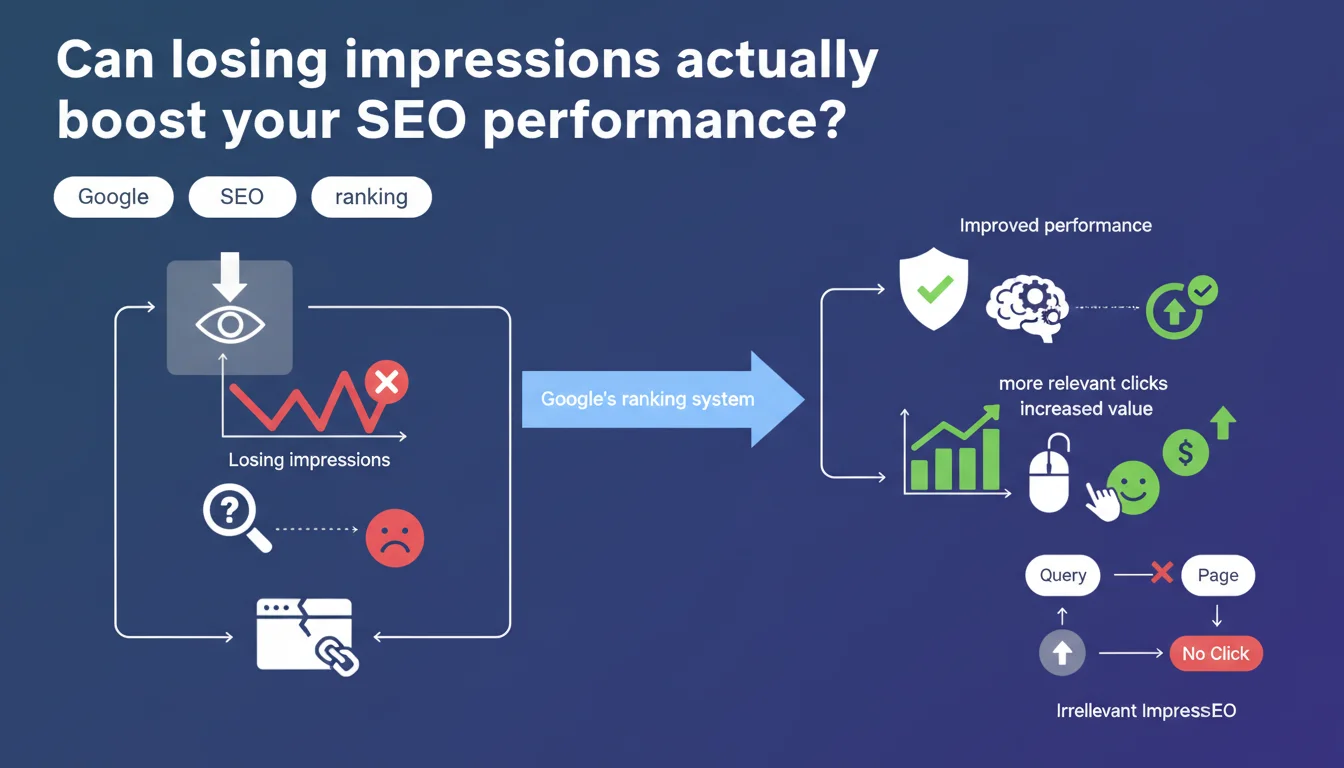
Google claims that a loss of impressions can be beneficial when its system detects that a page doesn't match a search query. These lost impressions would never have generated clicks anyway. This statement suggests that Google is optimizing for relevance over raw display volume.
What you need to understand
Does Google really adjust the display of irrelevant pages?
This statement reflects a logic of intelligent result filtering. Google claims that its algorithm continuously evaluates how relevant a page is for a given query. When this relevance is deemed insufficient, the page loses impressions — but these impressions would never have converted into clicks.
Concretely, this means that Google prefers to reduce a page's visibility rather than display it to a user who won't click. The stated objective: improve user experience by limiting irrelevant results. For an SEO practitioner, this implies that impression volume is no longer a reliable KPI on its own.
How should you interpret a drop in impressions in Search Console?
A fall in impressions can have two origins: either your content is losing thematic relevance for targeted queries, or Google is refining its understanding of search intent and concluding that your page no longer matches as well as before.
The pitfall: confusing a loss of impressions with a penalty. If your clicks remain stable or increase despite the drop in impressions, this confirms that Google has simply trimmed unqualified traffic. Conversely, if both clicks and impressions drop together, the problem lies elsewhere — loss of rankings, cannibalization, or actual demotion.
What signals does Google use to judge this relevance?
Google never details its criteria precisely, but we can isolate a few obvious levers: the click-through rate (CTR), post-click behavior (pogo-sticking, time on site), and semantic consistency between the query and page content.
If a page regularly appears for a query without ever getting clicks, Google draws a logical conclusion: this page doesn't answer the search intent. It then adjusts its impression distribution. This is a form of continuous algorithmic learning based on user feedback.
- A loss of impressions is not automatically negative — it can reflect a beneficial relevance adjustment.
- CTR and user behavior are key signals for evaluating consistency between query and content.
- Monitoring the impressions-to-clicks ratio helps detect a query-content misalignment before Google reduces visibility.
- A drop in impressions without a drop in clicks may indicate that Google is filtering unqualified queries.
SEO Expert opinion
Is this statement consistent with real-world observations?
Yes and no. We do observe cases where a page loses impressions on peripheral queries while maintaining, even increasing, its qualified traffic. Google does seem to refine impression distribution based on historical click-through rate.
But — and this is where it gets tricky — this logic assumes that CTR is a reliable signal of relevance. Yet, a low CTR can also result from poorly optimized title and meta description, an average position that's too low, or a SERP saturated with features (People Also Ask, featured snippets). In these cases, impression loss penalizes a page that could actually be relevant.
What nuances should be added to this claim?
Google presents this loss of impressions as a favor: "You lose traffic that would never have converted anyway." Let's be honest: this view is too binary. An impression without an immediate click can still contribute to brand awareness, brand recall, or deferred conversion.
Moreover, Google doesn't always distinguish clearly between informational and transactional queries. A product page may lose impressions on informational queries — which seems logical — but also on long-tail variations where purchase intent is genuinely present. [To verify]: Does Google really have enough data to judge relevance finely on low-volume queries?
In what cases does this rule not apply?
On very low-volume queries (a few dozen searches per month), Google lacks enough behavioral data to fine-tune impression distribution. A page may lose visibility without objective reason, simply because the algorithm lacks perspective.
Another problematic case: news or seasonal sites. A page can be highly relevant at one point in time, then lose relevance a few weeks later. If Google retains a history of poor CTR, it may under-display this page during the next period of relevance — even though it becomes legitimate again.
Practical impact and recommendations
What should you do concretely if impressions drop?
First step: segment queries in Search Console. Identify those where impressions are falling but CTR remains stable or increases. For these queries, the loss of impressions is probably beneficial — Google is filtering unqualified traffic.
On the other hand, if impressions drop AND CTR declines, that's a red flag. This means Google judges your page less relevant than before — or a competitor has gained relevance. Then you need to rework the content, intent, and on-page signals.
What mistakes should you avoid when analyzing impressions?
Don't focus on raw impression volume. This KPI, taken in isolation, means nothing. A page with 10,000 impressions and 50 clicks (CTR 0.5%) is less performant than a page with 1,000 impressions and 100 clicks (CTR 10%).
Another pitfall: trying to recover lost impressions at all costs. If Google has decided a page isn't relevant for certain queries, forcing it back (by over-optimizing content, manipulating anchor text) can generate traffic… that will never convert. You then waste time and crawl budget for nothing.
How do you optimize relevance to keep good impressions?
Work on semantic consistency between the target query and page content. Use Google's suggestions (People Also Ask, related searches) to refine intent. If a page loses impressions on queries where it should legitimately appear, strengthen relevance signals: title, H1, opening paragraphs.
Also optimize organic CTR: a compelling title and meta description can turn an impression into a click, signaling to Google that the page deserves its place. Test different formulations using SERP A/B testing tools (or manually by tracking CTR variations after each change).
- Segment queries in Search Console to isolate those where impression loss is beneficial.
- Don't try to recover impressions that never generate clicks — focus on qualified traffic.
- Strengthen semantic consistency between target query and content to limit legitimate impression losses.
- Optimize CTR via title and meta description to signal relevance to Google.
- Monitor the impressions-to-clicks ratio and average position to detect misalignments.
❓ Frequently Asked Questions
Une perte d'impressions signifie-t-elle toujours que ma page est moins bien classée ?
Dois-je tenter de récupérer toutes les impressions perdues ?
Comment savoir si la perte d'impressions est bénéfique ou problématique ?
Le taux de clics influence-t-il vraiment le classement dans Google ?
Peut-on forcer Google à réafficher une page sur des requêtes où elle a perdu des impressions ?
🎥 From the same video 5
Other SEO insights extracted from this same Google Search Central video · published on 05/02/2025
🎥 Watch the full video on YouTube →
💬 Comments (0)
Be the first to comment.