
Official statement
Other statements from this video 5 ▾
- □ Does Google really count impressions the way you think it does in Search Console?
- □ Are impressions without clicks really a non-issue for your SEO performance?
- □ Is Google really blaming your content for low click-through rates, or is the SERP itself the real problem?
- □ Can losing impressions actually boost your SEO performance?
- □ Does your content really need a complete overhaul to boost your CTR?
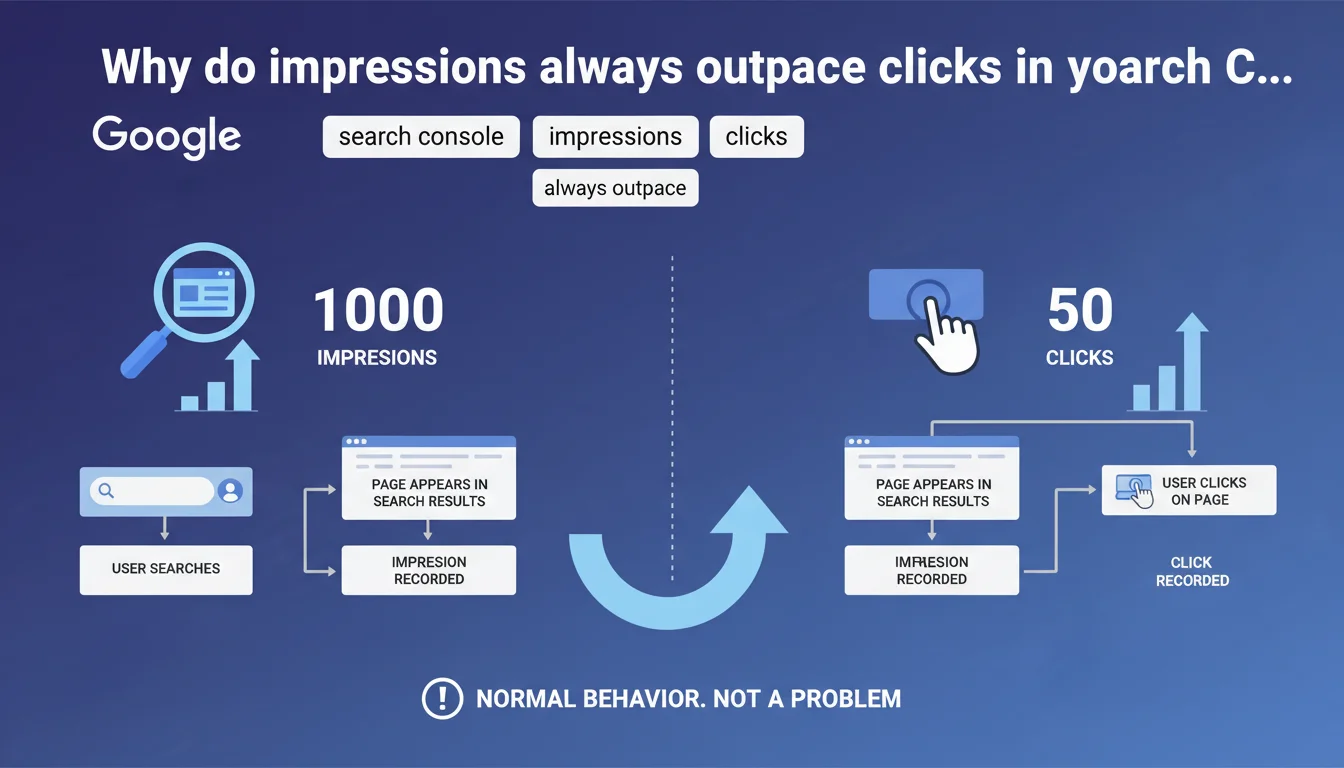
Google reminds us that impressions in Search Console are systematically higher than clicks — it's mechanical. An impression counts as soon as a page appears in search results, whether it's viewed or not. A click requires user action. Nothing abnormal then if your CTR stays below 100%.
What you need to understand
What is the concrete difference between an impression and a click?
An impression is counted as soon as a page from your site appears in search results, even if the user only scrolls through the first line. The link doesn't need to be visible on screen — Google considers that the page has been "served" in the SERP.
A click, on the other hand, requires action: the user must spot the link, judge the title and meta description attractive, and click. It's a basic conversion funnel: not all impressions turn into clicks.
Why is Google making this statement now?
Google regularly receives support tickets from webmasters concerned about a huge gap between impressions and clicks. Some think it's a tracking bug, others a invisible penalty.
The reality? It's normal operation. The engine reminds us that the gap is not abnormal — in fact, it's expected. A CTR of 3-5% on generic queries is quite standard.
What is the role of CTR in this equation?
The CTR (Click-Through Rate) measures exactly this ratio: clicks divided by impressions. The lower your CTR, the more visible the gap between the two metrics is in Search Console.
A CTR of 2% means that out of 1000 impressions, you get 20 clicks. 980 impressions "lost" — but that's normal, not concerning.
- An impression = your page appears in results, visible or not on screen
- A click = the user actively interacts with your link
- The CTR reflects the attractiveness of your snippet in the SERP
- A high impression/click gap does not indicate a technical problem, but rather a low conversion rate
SEO Expert opinion
Does this statement really bring anything new?
No. Google is stating the obvious for any SEO professional who works with Search Console daily. The impression/click gap is a mechanical inevitability.
What is interesting is that Google takes the trouble to state it publicly. It reveals a level of confusion among beginners or clients scrutinizing their dashboards without understanding the metrics. For an experienced practitioner, this statement changes absolutely nothing in strategy.
What nuances should be added to this claim?
Google's discourse is simplistic. It omits several edge cases where the impression/click gap can actually signal a real problem.
For example: abnormally low CTR on brand queries (your company name) can indicate a poorly optimized snippet, unfair competition on your branded terms, or worse — a competing rich snippet capturing attention at your expense.
Another case: massive impressions on positions 50-100 that generate zero clicks. Here, the problem isn't the gap itself, but the fact that you're ranking on irrelevant queries that tank your average visibility without adding value. [Check this regularly] in your query reports.
Is Google hiding critical information behind this obvious truth?
Let's be honest: Google has every reason to downplay CTR importance. Why? Because a collapsing CTR on certain queries can indicate that featured snippets, People Also Ask, or ads are cannibalizing organic clicks.
The engine will never talk about "click theft" by its own SERP features. This statement smooths the debate by reducing everything to "it's normal, move along". But an expert SEO knows that CTR evolution over time is a key indicator of your organic presence health against the rising tide of SERP elements.
Practical impact and recommendations
How to correctly interpret your Search Console data?
Never simply compare impressions and clicks in absolute values. It's a hollow metric. The CTR by query and CTR by page are far more revealing.
Segment your data: CTR on brand vs generic queries, CTR by average position, CTR by device. That's where you detect actionable anomalies.
What concrete actions can improve your CTR?
The main lever remains snippet optimization: title, meta description, URL. A title that doesn't match search intent kills your CTR, even at position 1.
Test rich snippets when relevant (FAQ schema, Review schema, Product schema). They increase visual surface area and mechanically boost CTR. Also monitor your competitors: if three sites above you display stars and you don't, you lose by default.
When should you worry about an abnormal impression/click gap?
A CTR that suddenly drops on historically performing queries deserves investigation. Possible causes: a competitor launching a more attractive snippet, Google testing a new SERP format on these queries, or a partial deindexation invisible in global reports.
Conversely, exploding impression volume without a matching click increase can reveal an internal cannibalization problem — multiple pages on your site competing for the same queries, diluting your CTR.
- Analyze CTR by position in Search Console — a 2% CTR at position 3 is catastrophic, at position 15 it's normal
- Segment by device (mobile vs desktop) — mobile CTR is structurally lower due to SERP clutter
- Identify pages with CTR below the average for their position — these are your priority optimization opportunities
- Test title and meta description variants on your strategic pages — simply adding a year or action verb can deliver +30% CTR
- Monitor trends over 3-6 months — gradual decline often signals progressive competitive degradation
- Don't neglect brand queries — a CTR under 50% on your brand name should trigger an alert
❓ Frequently Asked Questions
Un CTR de 5% est-il considéré comme bon ou mauvais ?
Pourquoi mes impressions augmentent mais mes clics stagnent ?
Les impressions comptent-elles même si ma page est en bas de la première SERP ?
Dois-je optimiser les pages avec beaucoup d'impressions mais peu de clics ?
Le CTR influence-t-il directement le classement Google ?
🎥 From the same video 5
Other SEO insights extracted from this same Google Search Central video · published on 05/02/2025
🎥 Watch the full video on YouTube →
💬 Comments (0)
Be the first to comment.