
Official statement
Other statements from this video 9 ▾
- □ Should a technical SEO audit really go beyond crawlability and indexation?
- □ Is your technical SEO audit actually missing what really matters?
- □ Is your SEO audit doomed to fail before you even start?
- □ What are the technical priorities Google really wants you to audit first?
- □ Are you really leveraging Google Search Console's crawl data to boost your indexation strategy?
- □ Should you really worry about a spike in 404 errors in Google Search Console?
- □ Is your SEO audit actually helping you—or wasting resources on irrelevant checks?
- □ Should you really implement every recommendation your SEO audit tools suggest?
- □ How can you prioritize your SEO fixes without wasting endless time and resources?
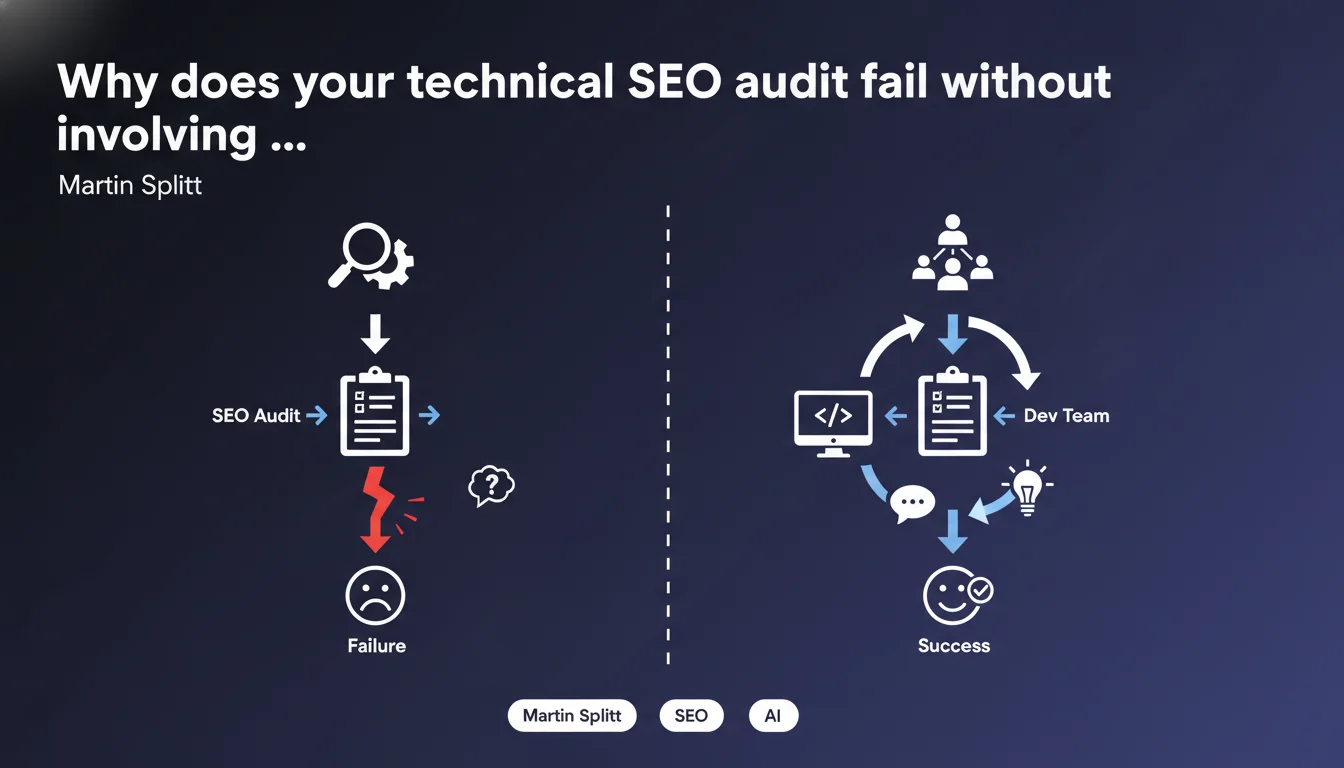
Martin Splitt reminds us of an obvious truth too often overlooked: your technical SEO recommendations must be validated with the people who actually understand your site's infrastructure. Without this dialogue, you risk proposing unimplementable optimizations or missing the technical context that explains certain choices. SEO doesn't happen in a silo.
What you need to understand
Why does Google insist on technical collaboration?
Splitt's statement aims to correct a frequent drift: technical SEO audits conducted in a vacuum, with zero interaction with the teams maintaining the site. A consultant can identify 50 problems in Screaming Frog, but if half are false positives linked to deliberate architectural choices, the audit loses all credibility.
Google knows that SEO recommendations disconnected from technical reality end up in a drawer. By pushing for this collaboration, they're seeking to improve the quality of implementations — not just the quality of PowerPoint slides.
What does "verifying that your assessment makes sense" mean in concrete terms?
It means challenging your assumptions. You think load time is catastrophic? The technical team might explain that the CDN has specific caching rules for certain geographies, or that the origin server is never solicited directly.
You recommend server-side rendering for a React site? The devs will tell you if their current stack supports it, or if it requires a complete infrastructure overhaul. Sometimes, the best SEO recommendation isn't the one that's technically ideal, but the one that can actually be implemented in the next 3 months.
What are the risks of an SEO audit without technical dialogue?
- Inapplicable recommendations: suggesting prerendering on architecture that doesn't support it without massive investment
- Undetected false positives: identifying "errors" that are actually intentional behaviors (geo-redirects, conditional content)
- Loss of credibility: the technical team rejects the entire audit if the first 10 recommendations show a misunderstanding of context
- Absurd prioritization: focusing on minor details while major blockers go unnoticed due to lack of context
- Exploding timelines: underestimating implementation complexity by not understanding the technical stack
SEO Expert opinion
Is this recommendation actually followed in the field?
Let's be honest — not nearly enough. I've seen dozens of "complete" SEO audits where the consultant never exchanged a single email with a developer. The report comes out, lists 200 problems, and six months later nothing has moved because nobody on the technical side believes in it.
The structural problem? Many marketing teams outsource SEO to agencies with no direct access to tech teams. A game of telephone begins: the SEO agency talks to the marketing project manager, who talks to the product owner, who talks to the lead dev. At each step, the nuance is lost.
When does this collaboration become counterproductive?
Be careful not to swing to the opposite extreme: the technical committee syndrome. If every SEO recommendation must pass through 4 technical validations and 3 arbitration meetings, you'll never move forward.
I've seen projects where the technical team used "complexity" as a blanket argument to systematically block any optimization. "We can't touch the routing, it's too risky." "Lazy loading images would break our entire caching system." At some point, you have to make a call — and that's where things get stuck.
What's the right balance between SEO demands and technical feasibility?
The real skill of a senior SEO is proposing three levels of solutions for each identified problem. The ideal solution (often heavy), the realistic solution (implementable in 2 months), and the quick win (deployable next week).
This approach lets you dialogue intelligently with devs. You're not showing up with a non-negotiable list of demands — you're opening a discussion about trade-offs. And that's where the magic happens: the technical team starts proposing alternative solutions themselves that you wouldn't have thought of.
Practical impact and recommendations
How do you structure dialogue with the technical team from the start?
Involve the devs before you even start the audit. Ask for 30 minutes to understand the architecture: technical stack, infrastructure constraints, ongoing projects. This half hour will save you 10 hours of false leads.
During the audit, maintain direct communication — Slack, email, whatever works. The moment something seems odd, ask immediately rather than making assumptions. "I see that all product URLs have a ?ref= parameter, is that normal or a tracking bug?"
What mistakes should you avoid in this collaboration?
Don't speak technically if you don't master it. Using terms like "the server" or "the cache" vaguely will destroy all your credibility. If you can't tell the difference between browser cache and CDN cache, train yourself before making recommendations on the subject.
Another classic pitfall: a professorial tone. You're not there to "educate" the technical team about SEO. You're there to co-build solutions. The difference is fundamental.
What needs to be implemented concretely after this exchange?
- Organize a technical kick-off before any major SEO audit (30-60 min with lead dev and/or architect)
- Document the architecture in your audit: stack, CMS, CDN, hosting — this contextualizes your recommendations
- Create a direct communication channel with at least one technical contact during the audit
- Present your final recommendations in the presence of the technical team, not just marketing
- Classify your recommendations by technical complexity level (quick wins / medium term / overhaul)
- Define together an implementation roadmap with realistic milestones — not a wish list
- Schedule regular follow-up meetings to adjust priorities as new constraints emerge
🎥 From the same video 9
Other SEO insights extracted from this same Google Search Central video · published on 06/11/2025
🎥 Watch the full video on YouTube →
💬 Comments (0)
Be the first to comment.