
Official statement
Other statements from this video 9 ▾
- □ Un audit SEO technique doit-il vraiment se limiter au crawl et à l'indexation ?
- □ Pourquoi votre audit technique SEO passe probablement à côté de l'essentiel ?
- □ Pourquoi votre audit SEO échoue-t-il avant même d'avoir commencé ?
- □ Comment exploiter vraiment les données de crawl de Google Search Console ?
- □ Faut-il vraiment s'inquiéter d'un pic d'erreurs 404 dans la Search Console ?
- □ Pourquoi un audit SEO standardisé peut-il nuire à votre stratégie ?
- □ Faut-il vraiment suivre tous les conseils de vos outils d'audit SEO ?
- □ Comment prioriser vos corrections SEO sans perdre un temps fou ?
- □ Pourquoi votre audit SEO technique échoue-t-il sans l'équipe de dev ?
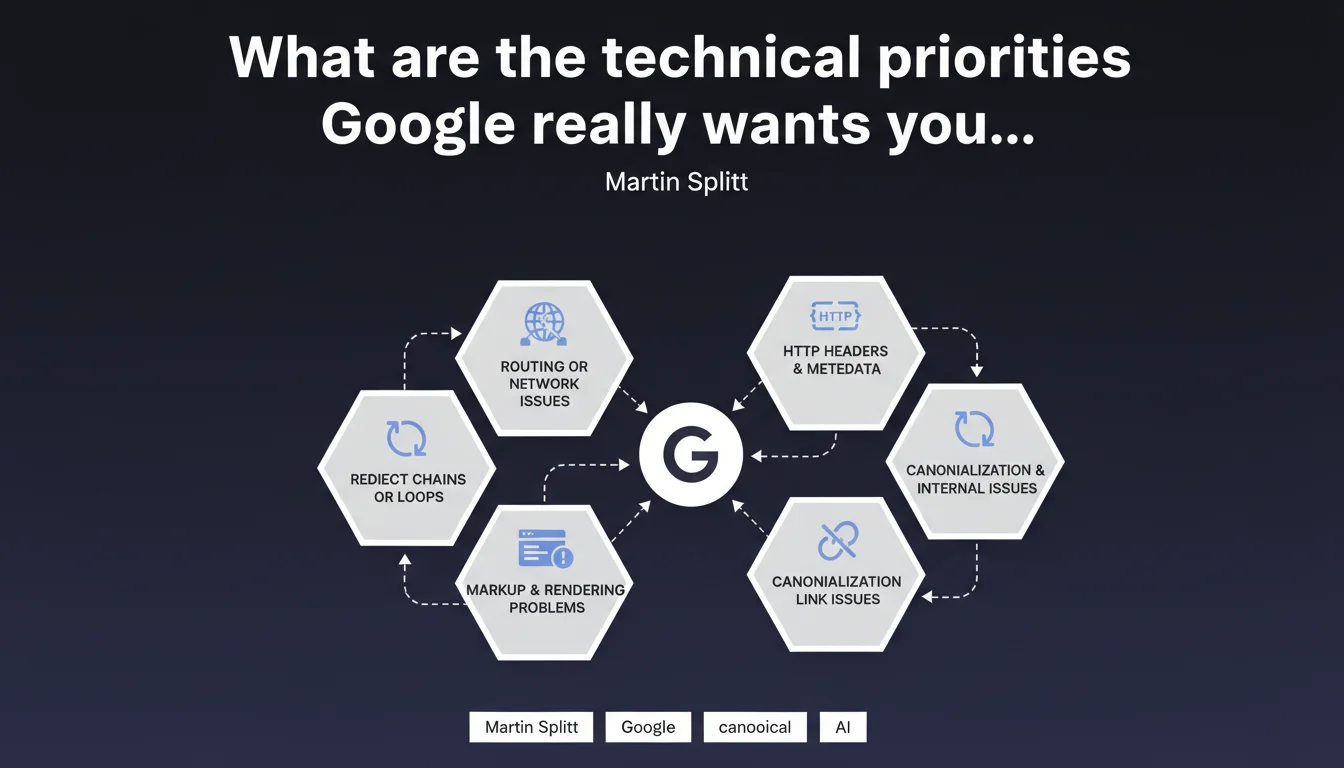
Martin Splitt outlines the priority technical checks during an audit: routing/network, HTTP headers, redirects, canonicalization, internal links, markup and rendering. This official checklist allows you to structure your audits around the elements Google considers critical for crawling and indexation.
What you need to understand
Why does Google list these specific points in a technical audit?
This statement is far from trivial. Martin Splitt defines here the minimum scope of a technical audit credible in Google's eyes.
Each element mentioned corresponds to a potential friction point in the crawling and indexation process. If any of these aspects malfunctions, Googlebot may miss content, misinterpret your signals, or waste its crawl budget.
What sets this list apart from a standard SEO audit?
The nuance is subtle but important: Splitt doesn't talk here about pure performance (Core Web Vitals, load times) or editorial content.
He focuses exclusively on the mechanisms of discovery and technical interpretation of your site. This is the infrastructure layer that conditions everything else.
What are the concrete elements to verify according to this statement?
- Routing and network: server accessibility, latency, timeouts, DNS
- HTTP headers and metadata: status codes, cache headers, robots directives
- Redirect chains and loops: number of hops, circular redirects
- Canonicalization and internal links: consistency of canonical signals, functional linking structure
- Markup and rendering: structured data, critical JavaScript, client-side vs server-side rendering
SEO Expert opinion
Does this list truly cover all technical fundamentals?
Let's be honest: yes, but it's intentionally minimalist. Splitt defines the foundation, not exhaustiveness.
A complete SEO audit must also integrate crawl budget management, information architecture, navigation facets, internationalization issues (hreflang), and 404 and soft 404 error handling. This list doesn't replace an in-depth diagnosis — it outlines its mandatory contours.
Why does Google insist on rendering in this list?
Rendering appears at the end of the list, but it's probably the trickiest point in 2025. Many modern sites rely on client-side JavaScript, and Googlebot must execute this code to access content.
If your client-side rendering generates critical content after several seconds, or if resources block execution, Google may index an incomplete version of your pages. The devil is in the details: a simple misconfigured lazy-loading can sabotage indexation.
Do redirects really deserve this much attention?
Absolutely. Redirect chains are a notorious crawl budget killer, and loops block indexation outright.
Concretely? A URL that goes through 3 redirects before reaching the final version consumes 4 requests instead of 1. Multiply that by a few thousand pages and you understand why Google mentions it explicitly.
Practical impact and recommendations
How to structure a technical audit based on this statement?
Start by crawling your site with a tool that detects these issues: Screaming Frog, OnCrawl, Botify or similar. But be careful: not all handle JavaScript rendering reliably.
Then, cross-reference this data with Search Console to identify pages crawled but not indexed, server errors, and canonicalization issues reported by Google itself.
What errors should you avoid when fixing these issues?
Never fix in bulk without prioritizing. A redirect chain on 10 orphaned pages has less impact than a canonical problem on your product template affecting 50,000 URLs.
Another classic pitfall: fixing symptoms without understanding the cause. If you have redirect loops, it's often a server configuration or conflicting .htaccess rules issue — not just a few URLs to manually fix.
What should you concretely do to align your site with these recommendations?
- Audit network routing: test server latency, DNS, timeouts (tools: GTmetrix, WebPageTest, Uptrends)
- Verify critical HTTP headers: 200/301/404 status codes, X-Robots-Tag, cache directives
- Map all redirects: detect chains and loops (Screaming Frog, redirect checker)
- Control canonical consistency: canonical tags, sitemap, internal links point to same version
- Test JavaScript rendering: compare source HTML vs rendered DOM, identify blocking resources
- Validate structured markup: Schema.org, Open Graph, Twitter Cards via Rich Results Test
- Segment internal links: avoid linking to canonicalized or redirected URLs
🎥 From the same video 9
Other SEO insights extracted from this same Google Search Central video · published on 06/11/2025
🎥 Watch the full video on YouTube →
💬 Comments (0)
Be the first to comment.