
Official statement
Other statements from this video 9 ▾
- □ Un audit SEO technique doit-il vraiment se limiter au crawl et à l'indexation ?
- □ Pourquoi votre audit technique SEO passe probablement à côté de l'essentiel ?
- □ Pourquoi votre audit SEO échoue-t-il avant même d'avoir commencé ?
- □ Quels sont vraiment les points techniques à auditer en priorité selon Google ?
- □ Comment exploiter vraiment les données de crawl de Google Search Console ?
- □ Faut-il vraiment s'inquiéter d'un pic d'erreurs 404 dans la Search Console ?
- □ Faut-il vraiment suivre tous les conseils de vos outils d'audit SEO ?
- □ Comment prioriser vos corrections SEO sans perdre un temps fou ?
- □ Pourquoi votre audit SEO technique échoue-t-il sans l'équipe de dev ?
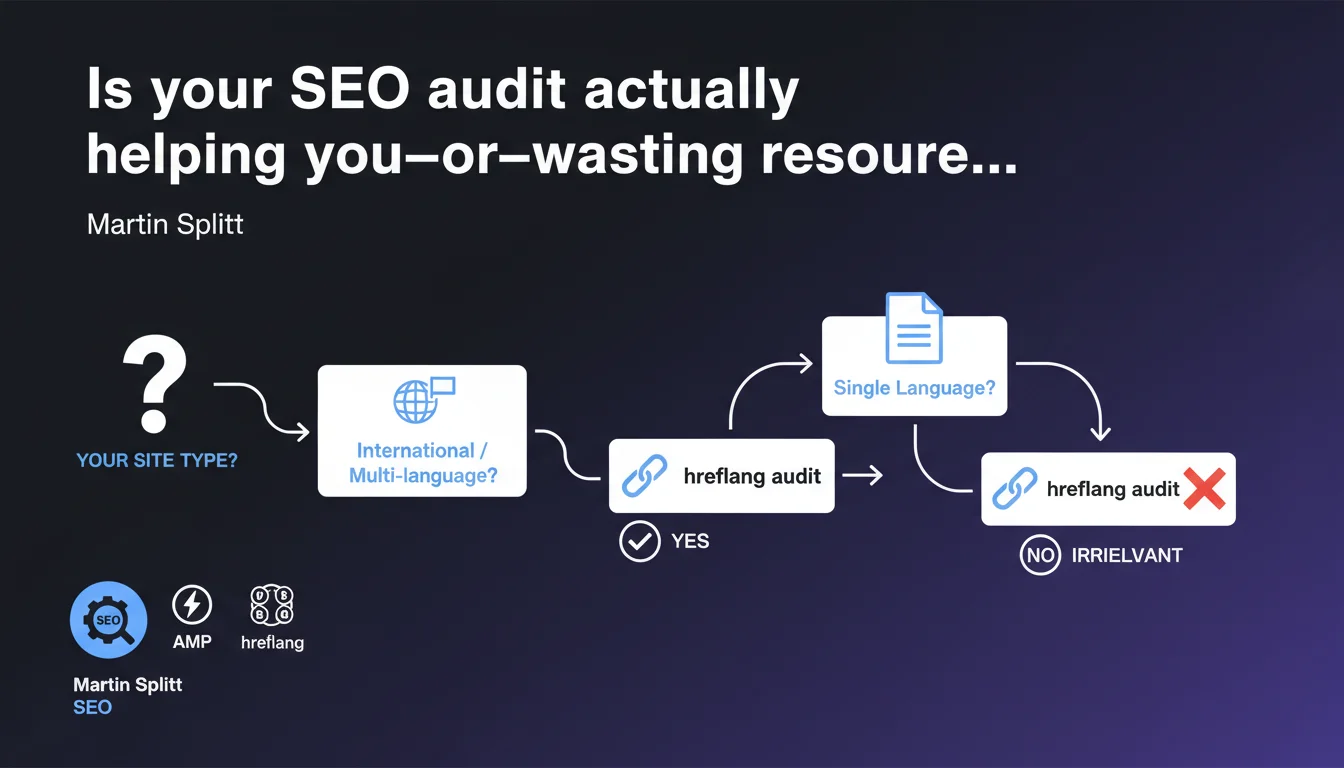
An effective SEO audit is never one-size-fits-all. According to Martin Splitt, the aspects you need to verify must match your site's technical specifics — for example, auditing hreflang on a single-language site is a waste of time. The real challenge: focus your effort where it actually matters.
What you need to understand
Has SEO auditing become a mindless checklist?
Too many audits look like generic templates applied without any real thinking. Martin Splitt reminds us of something obvious that many forget: not every site faces the same technical challenges.
A multilingual e-commerce site with 15 country versions has nothing in common with a French-language WordPress blog. Yet how many audits include hreflang checks on sites that don't need them at all? That's noise, not signal.
What does this actually change in your audit approach?
Splitt's statement confirms that Google expects contextual audits. An international site requires thorough verification of hreflang tags, geo-targeted redirects, and linguistic consistency in crawling.
A single-language local site? None of that applies. Instead, you might need to dig deeper into internal linking structure, Core Web Vitals performance, or semantic content relevance.
Why does this approach become mission-critical in 2025?
Because your resources — time, budget, and crawl allocation — are finite. Search engines themselves prioritize their crawling efforts based on detected site structure.
If your audit focuses on off-topic issues, you'll miss the real optimization levers. And you risk recommending unnecessary fixes that clutter development roadmaps.
- An effective audit rests on upfront context analysis: architecture, geographic targets, languages, and business model
- Automated audit tools often generate diagnostic noise that requires manual filtering
- Certain technical aspects (hreflang, pagination, schema markup) only matter for specific configurations
- A skilled SEO auditor knows what not to audit — that's equally important as what they verify
SEO Expert opinion
Does this statement challenge standardized audits?
Yes and no. Audit frameworks remain useful as a starting point — they ensure nothing gets overlooked. The problem comes when they become the destination rather than the roadmap.
I've seen 150-page audits that devoted 12 pages to hreflang for a 100% French site. The result: real problems (duplicate content, keyword cannibalization, broken internal links) were buried under useless detail.
What are the risks of a poorly calibrated audit?
First risk: attention dilution. If you surface 200 items to fix with 120 being irrelevant, your technical team will treat everything as equally urgent — which means actually urgent items get deprioritized.
Second risk: lost credibility. Recommending hreflang fixes to a site with no language versions shows you didn't understand the context. Savvy clients catch this immediately.
Should you build completely custom audits from scratch?
Not necessarily. The most effective approach combines a shared foundation (indexability, crawlability, performance, content) with context-specific adjustments.
But those adjustments must be deliberate and documented. If you drop a section from your standard template, explain why in the audit. If you add one, justify it. This is what separates industrial auditing from expert diagnostics.
Practical impact and recommendations
How do you identify relevant aspects before starting your audit?
Begin with a discovery phase. Ask straightforward questions: how many languages? how many countries? what's the tech stack? what's the business model?
These answers immediately orient your audit. A Shopify site won't share the same challenges as a custom WordPress installation or a Next.js SSR application.
Which audit sections should you adjust based on context?
For an international site, strengthen: hreflang implementation, geo-redirect consistency, cross-language duplication, crawl budget per language version.
For a single-language local site, focus on: internal linking structure, semantic content optimization, technical performance, local schema markup (LocalBusiness).
For an e-commerce site, emphasize: facets and pagination, out-of-stock product handling, category architecture, product page richness.
What concrete steps should you take right now?
- Audit your current audit template: which sections run on autopilot when they shouldn't?
- Build a decision matrix: for each site type (e-commerce, editorial, SaaS, local), list priority areas and what to skip
- Train your teams to assess context before running automated analysis tools
- Document the methodology choices explicitly in each audit: explain why sections are included or excluded
- Review past audits to pinpoint off-target recommendations that cluttered development roadmaps
🎥 From the same video 9
Other SEO insights extracted from this same Google Search Central video · published on 06/11/2025
🎥 Watch the full video on YouTube →
💬 Comments (0)
Be the first to comment.