
Official statement
Other statements from this video 5 ▾
- □ Does Google really slow down crawling when you change hosting providers?
- □ Does hosting migration always slow down Google's crawl?
- □ Can server geographic distance really hurt your Page Experience ranking?
- □ Are Multi-Server CDNs Really Risk-Free for SEO?
- □ Does your server location really impact local search rankings?
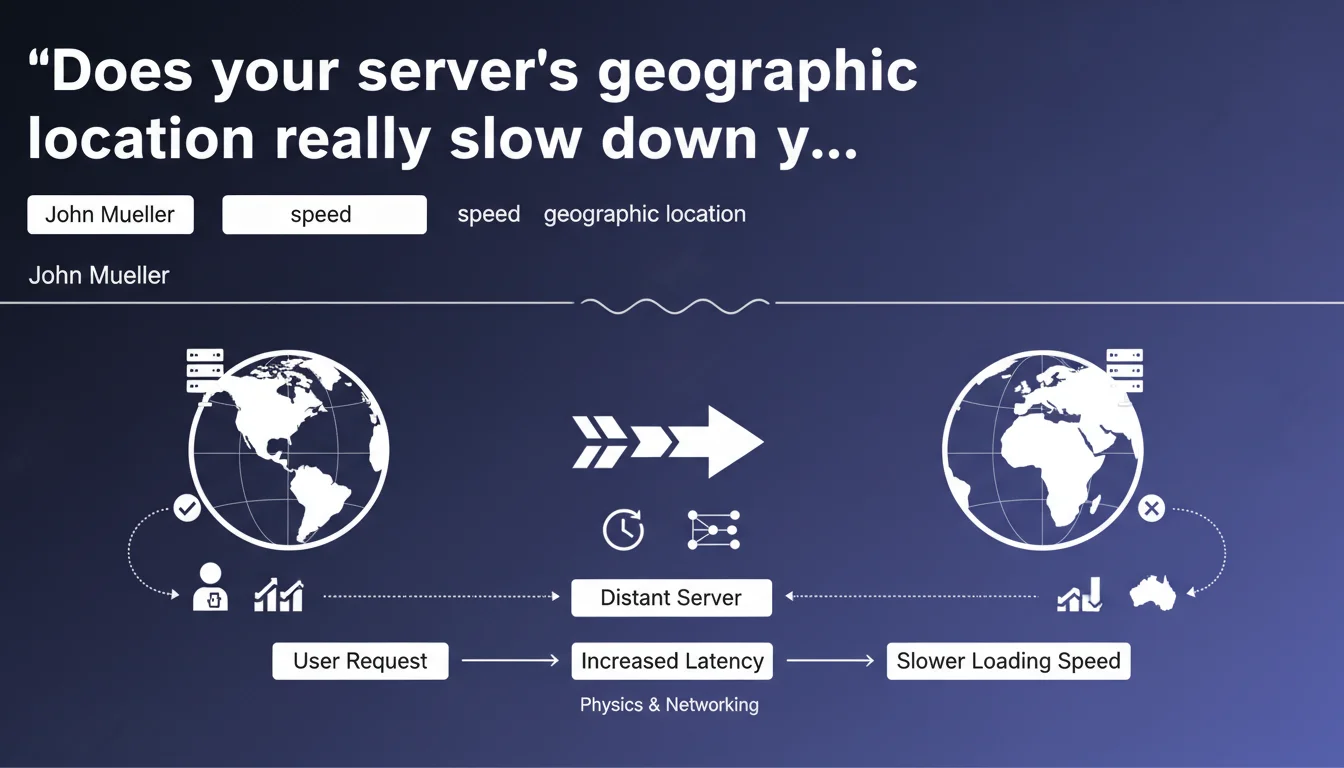
A server located geographically far from your users mechanically increases load time due to physical laws and network infrastructure. This latency can impact user experience and, indirectly, your SEO performance. The physical distance between server and visitor is far from negligible.
What you need to understand
Why does physical distance impact speed?
Data travels through physical cables — fiber optics, copper, submarine links. Even at the speed of light, each kilometer traveled adds latency. A user in Paris accessing a server in Sydney experiences an incompressible delay of several hundred milliseconds, just for the initial round trip.
This principle is nothing theoretical. It's pure physics: the propagation speed of a signal in fiber optic cable is approximately 200,000 km/s, or two-thirds the speed of light. A round trip from Paris to New York alone represents about 80 ms of unavoidable latency, not counting intermediate network equipment.
How does this latency translate concretely?
Every HTTP request — HTML, CSS, JS, images — experiences this delay. On a modern site that loads dozens of resources, network latency accumulates. HTTP/2 and HTTP/3 mitigate the problem with multiplexing, but don't eliminate the initial physical transit time.
The first TCP connection and TLS negotiation are particularly sensitive to latency. A high RTT (Round-Trip Time) slows down the SSL handshake, delays the first byte received, and degrades the Time to First Byte (TTFB), a metric Google scrutinizes closely.
Does Google really measure this difference?
Yes. The Core Web Vitals include LCP (Largest Contentful Paint), directly impacted by how quickly critical resources load. A high TTFB delays the entire rendering process. Google collects this data through the Chrome User Experience Report, based on real-world navigations.
The ranking algorithm incorporates user experience. A slow site for most users risks a penalty, even a minor one. It's not a major ranking factor, but in competitive verticals, every millisecond can tip the scales.
- Physical distance creates unavoidable latency between server and user
- This latency impacts TTFB and Core Web Vitals (particularly LCP)
- Google measures real-world speed via field data (CrUX)
- HTTP/2 and HTTP/3 mitigate but don't eliminate the problem
- Hosting far from your primary audience degrades user experience
SEO Expert opinion
Is this statement consistent with field observations?
Absolutely. We consistently observe a correlation between server-user distance and TTFB. A French website hosted in the United States regularly shows 150-300 ms of additional latency for European visitors. This is measurable via GTmetrix, WebPageTest, or directly in Google Search Console.
A/B tests during server migrations confirm the impact. Moving a site from a US datacenter to Europe for a European audience reduces TTFB by 30 to 50% on average. LCP improvement follows mechanically, sometimes by several hundred milliseconds.
What nuances should be applied to this rule?
First point: a CDN (Content Delivery Network) largely neutralizes this problem. By caching your static resources on nodes geographically close to your users, you bypass the distance of the origin server for 80-90% of content. Cloudflare, Fastly, AWS CloudFront — they all operate on this principle.
Second nuance: infrastructure quality matters as much as distance. A premium datacenter 5,000 km away with optimized networking can outperform a mediocre host 500 km away. Network latency is not purely a matter of kilometers, but also of peering, bandwidth, and routing.
Third point — and Google remains [To verify] unclear on this — the direct SEO impact of server geolocation is marginal. What matters is the effective measured speed. A slow site loses rankings, regardless of why. Google doesn't penalize distance itself, but its measurable consequences.
In what cases does this rule not apply?
If you use a performant CDN, the origin server location becomes almost irrelevant for static content. Only dynamic requests (APIs, non-cached pages) suffer the full latency. For a largely static or well-cached site, the real impact is minimal.
For truly global audiences, there is no "ideal" server. A worldwide site will always struggle with high latency for some users — unless deploying a multi-region infrastructure, which involves different technical complexity.
Practical impact and recommendations
What should you do concretely to optimize server location?
First identify your primary geographic audience via Google Analytics or Search Console. If 80% of your visitors are in Europe, a European server is essential. This is the foundation. A host like OVH, Scaleway, or AWS eu-west region guarantees low latency for this audience.
Next, deploy a CDN — even a basic one. Cloudflare offers a free tier that covers 90% of needs. The CDN caches images, CSS, JS and delivers these resources from the node closest to the user. The effect on LCP is immediate and measurable.
Enable HTTP/3 if your infrastructure allows. This protocol reduces initial latency and improves network performance, especially on mobile. Most modern CDNs support it natively.
What mistakes should you avoid when changing servers?
Never brutally move a site to production without testing. A poorly prepared datacenter change can introduce DNS issues, invalid SSL certificates, or server incompatibilities. Test first on a subdomain or staging environment.
Don't choose a host based on price alone. A $3/month server in an oversaturated datacenter on the other side of the world will ruin your SEO efforts. Location and infrastructure quality justify reasonable investment.
Don't neglect DNS configuration. An overly long Time to Live (TTL) delays propagation during migration. Reduce TTL to 300 seconds a few days before a server change, then restore a normal value after stabilization.
How can you verify your infrastructure is properly configured?
Use WebPageTest with multiple test locations. Compare TTFB from Paris, New York, Tokyo. The gap reveals how well your CDN works and how relevant your server location is. A gap < 100 ms between regions indicates good configuration.
Check the Core Web Vitals report in Google Search Console. Monitor LCP by device and URL group. Progressive LCP degradation after a server migration is a red flag.
Test DNS latency with tools like DNSPerf. Slow DNS adds 50-200 ms before even connecting to the server. Cloudflare DNS (1.1.1.1) or Google Public DNS reduce this delay.
- Identify your audience's primary geographic location via Analytics
- Choose a datacenter in the same geographic zone
- Deploy a performant CDN for static resources
- Enable HTTP/3 to reduce initial latency
- Reduce DNS TTL before any server migration
- Test speed from multiple geographic locations
- Monitor TTFB and LCP in Search Console after any changes
- Avoid low-cost hosts with poor infrastructure
❓ Frequently Asked Questions
Un CDN annule-t-il complètement l'impact de la distance du serveur d'origine ?
Dois-je changer d'hébergeur si mon serveur est loin de mon audience principale ?
Google pénalise-t-il directement un site hébergé loin de son audience ?
Quelle différence de latence est acceptable entre mon serveur et mes utilisateurs ?
Un hébergement mutualisé peut-il compenser la distance par de meilleures performances serveur ?
🎥 From the same video 5
Other SEO insights extracted from this same Google Search Central video · published on 23/02/2022
🎥 Watch the full video on YouTube →
💬 Comments (0)
Be the first to comment.