
Official statement
Other statements from this video 12 ▾
- □ Why is Google now rejecting certain directives in your robots.txt file?
- □ Can Google really index your URLs blocked by robots.txt without you being able to do anything about it?
- □ Does Google really process HTTP status codes during the crawl phase, not after?
- □ Does Google extract meta robots and canonical tags during indexing rather than at crawl time—and why does this distinction matter for your site?
- □ Should you really rely on JavaScript to handle noindex directives?
- □ Should you use X-Robots-Tag to keep PDFs and binary files out of Google's index?
- □ Does the unavailable_after directive really slow down Google's crawling?
- □ Should you disable Google cache to take control of how your snippets appear in search results?
- □ Can you really force Google to refresh a snippet without owning the website?
- □ Does Google's removal tool actually delete your URLs from the index?
- □ Why does it really take Google months to permanently remove a page from its index?
- □ Does Google's URL removal tool actually stop crawling your pages?
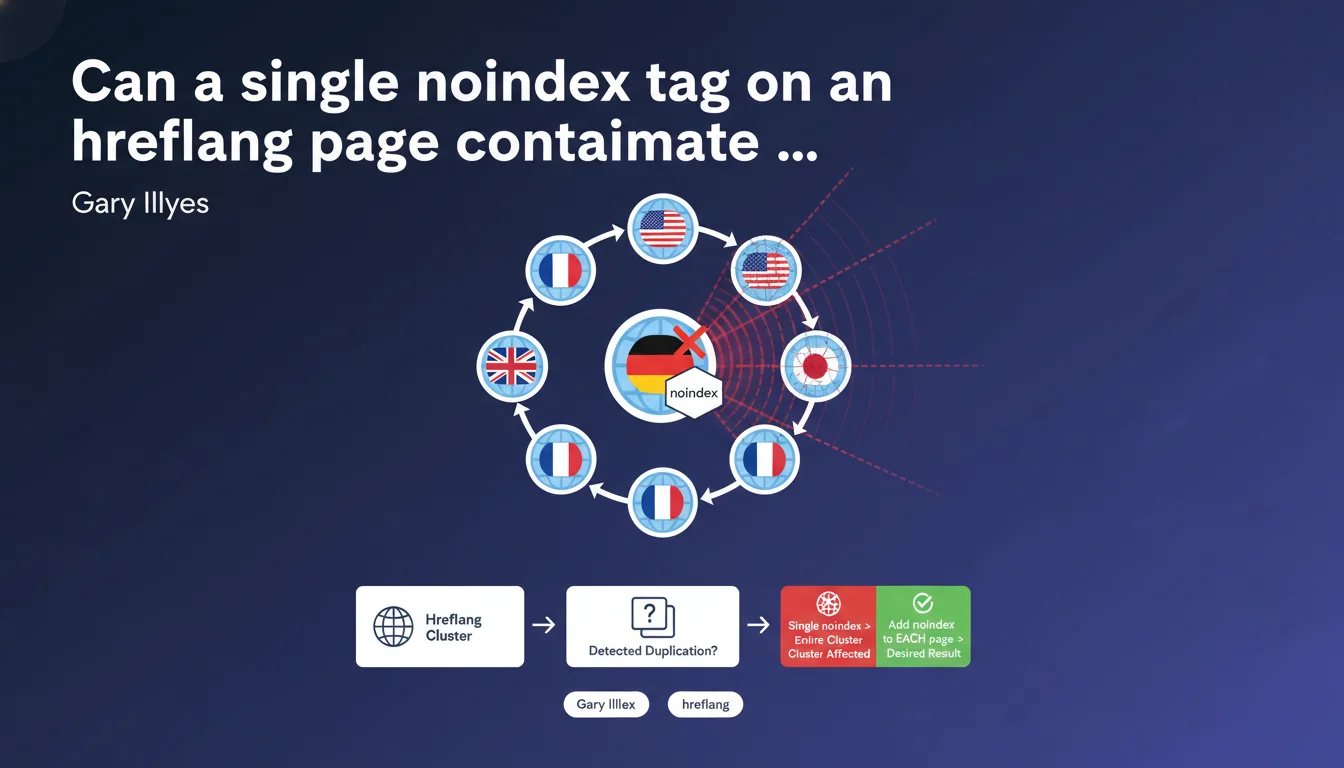
Gary Illyes confirms that pages within an hreflang cluster influence each other mutually. A misplaced noindex on just one variant can trigger a domino effect across your entire cluster if Google detects duplication. To properly deindex, you must apply noindex to each affected URL individually.
What you need to understand
What is an hreflang cluster and why do pages influence each other within it?
An hreflang cluster groups together all language or geographic versions of the same page. Google treats them as a cohesive set, not as isolated entities. Concretely: if you have a page /fr/, /en/, /de/, they form a cluster linked by hreflang annotations.
This interconnection means that the behavior of one page can contaminate the others. Google analyzes the cluster as a whole to detect inconsistencies, duplication, or contradictory signals. It is precisely this mechanism that causes problems with noindex.
How can a noindex affect your entire cluster?
If you place a noindex on just one variant — say the German version — and Google detects duplication between pages in the cluster, it may interpret this signal as a global instruction. The risk? That all pages in the cluster are progressively deindexed, even those you wanted to preserve.
The effect is not systematic or immediate, but depends on the quality of your hreflang signals and the level of similarity detected between pages. The more your content resembles each other, the greater the risk.
What does Google recommend to avoid this contamination?
The official position is clear: apply noindex to each page you actually want to remove. Do not rely on an isolated noindex to affect only a single variant. This is a cautious approach that implicitly acknowledges the limitations of algorithmic cluster processing.
- Pages in an hreflang cluster are not treated as completely independent by Google
- A noindex on one variant can trigger cascading deindexation if duplication is detected
- The official recommendation: explicitly apply noindex to each URL you want to remove
- Risk increases with the degree of similarity between cluster contents
SEO Expert opinion
Is this statement consistent with real-world observations?
Yes — and it's actually a topic that comes up regularly in international SEO audits. I've observed several cases where a noindex placed on a secondary variant (often a less strategic language) gradually led to the deindexation of other cluster variants. The delay can range from a few weeks to several months, which complicates diagnosis.
What strikes me is the use of the word "potentially" in the statement. Google does not guarantee that the effect will occur systematically, but admits that the risk exists if duplication is detected. It's an implicit acknowledgment that their hreflang cluster processing is not as granular as one might hope.
What nuances should be applied to this rule?
First nuance: this contamination seems more frequent when content is machine-translated or very similar structurally. If your variants are truly localized with unique content per market, the risk decreases — but doesn't disappear entirely. [To verify] to what extent differentiation actually protects the cluster.
Second point: the statement does not specify whether the effect applies equally depending on the position of the page in the cluster. Does a noindex on the en-US version (often dominant) have the same impact as a noindex on the pt-BR version? Observations suggest yes, but Google remains unclear.
In which cases does this logic not apply?
If you use separate subdomains or domains for your international variants (instead of subdirectories), the effect can be mitigated. Google sometimes treats these configurations as more separate entities, even in the presence of hreflang. But this is not absolute protection.
Another exception: clusters with radically different content per market, where only the navigation structure remains common. In this case, Google detects less duplication and contamination risk drops. But again, no official guarantees.
Practical impact and recommendations
What should you concretely do to manage noindex in an hreflang context?
First rule: if you need to remove one or more variants from an hreflang cluster, explicitly apply noindex to each affected URL. Never assume that an isolated noindex will remain confined to a single page. This is the official recommendation, and it's justified by observed risks.
Next, remove hreflang annotations pointing to noindexed pages. If a page is no longer meant to be indexed, it should no longer appear in your hreflang network. Leaving hreflang links pointing to noindex pages creates an inconsistency that Google may interpret unpredictably.
Third action: monitor the indexation of your entire cluster after applying a noindex, even if you thought you were targeting just one variant. Use Search Console for each language property and verify that the pages you wanted to preserve remain properly indexed.
What errors must you absolutely avoid?
Classic mistake: placing a noindex on one variant while maintaining bidirectional hreflang links. This is contradictory. Either the page is part of the cluster and should be indexed, or it is being removed and should no longer appear in annotations.
Another pitfall: combining noindex and canonical to another cluster variant. These two signals are incompatible and create confusion. If you want to consolidate multiple variants, use canonical. If you want to remove a page, use noindex. Never use both simultaneously.
How can you verify that your hreflang configuration is healthy?
Regularly audit your hreflang annotations to detect pointers to noindex pages, 404s, or canonicalized content. These inconsistencies are frequent and often invisible without dedicated tools. A crawler configured to follow hreflang allows you to map all clusters and identify anomalies.
Also verify that your content is sufficiently differentiated between variants. If Google detects massive duplication, even without noindex, it can arbitrarily choose which version to index and ignore others. Real localization remains your best protection.
- Apply noindex to each page you wish to remove, never to just one isolated variant
- Remove hreflang annotations pointing to noindexed pages
- Never combine noindex and canonical in an hreflang context
- Monitor indexation of your entire cluster after changes, not just the modified page
- Regularly audit hreflang pointers to non-indexable pages (404s, noindex, canonical)
- Truly differentiate content between language variants to limit contamination risks
❓ Frequently Asked Questions
Faut-il retirer les annotations hreflang vers une page noindexée ?
Le risque de contamination existe-t-il uniquement si les contenus sont dupliqués ?
Peut-on combiner noindex et canonical dans un cluster hreflang ?
L'effet de contamination est-il immédiat ?
Les sous-domaines protègent-ils mieux contre cet effet que les sous-répertoires ?
🎥 From the same video 12
Other SEO insights extracted from this same Google Search Central video · published on 04/08/2022
🎥 Watch the full video on YouTube →
💬 Comments (0)
Be the first to comment.